



“Ask any multi-location operator how many new members they signed last month and you’ll get a number instantly. Ask how many members haven’t checked in for three weeks, and the answer is usually a shrug. That gap is where most of the revenue opportunity is hiding,” Daniel Wischer, SVP Global Enterprise Solutions at PerfectGym.
The fitness industry is bringing in more members than ever.
Participation continues to grow, awareness of health and wellness remains strong, and club operators are seeing steady acquisition across markets. On the surface, the numbers suggest momentum.
And yet, many multi-location fitness businesses are finding that growth feels harder than it should.
The challenge doesn’t end at the front door. It begins once a member joins, where engagement becomes more difficult to track, understand and sustain over time. Retention has always been a challenge in fitness, but for enterprise operators, it has become the defining constraint on long-term growth.
This is something PerfectGym sees play out every day – an emphasis on marketing and acquisition, with ground lost once the journey begins.
Where Retention Gets Lost
Most large fitness chains operate in environments that generate significant amounts of data. Membership activity, class participation, payments, access control and ancillary services all produce valuable information about how members engage.
The problem is the systems supporting many large fitness businesses were simply not built for the level of complexity operators manage today.
Over time, organizations have added tools to support different functions — booking, billing, access, programming — each solving a specific need. While these systems perform well individually, they create fragmentation when viewed as part of a larger operational picture.
Further, this fragmentation does not present as a single point of failure. Instead, it introduces small inefficiencies that are absorbed into daily workflows. Reports take longer than expected, insights require manual reconciliation and decision-making relies on partial information. Because the business continues to run, these limitations are often accepted rather than addressed.
At scale, this becomes an operational blind spot. What might be visible through intuition in a small network becomes much harder to identify across dozens or hundreds of locations.
“Most operators don’t realize their systems are holding them back because everything still works just well enough,” says Erwin Korst, SVP Global Enterprise Sales at PerfectGym. “But as expectations rise, especially around AI and personalization, those limitations become much harder to ignore.”
The result is a business that is performing but not optimizing.
Visibility alone doesn’t solve the problem. A second challenge lies in how usable the data actually is.
“Most operators are ‘data aware’ -they know they have numbers,” Wischer explains. “But very few are ‘data ready,’ meaning they have those numbers structured in a way that can actually be used to predict churn or drive additional revenue.”
In an industry increasingly shaped by AI, that distinction is becoming critical.
“The industry is moving toward more personalization, more automation, more intelligence,” Korst says. “But none of that works without a strong data foundation. If the data isn’t connected, the value just doesn’t materialize.”
What Changes When Data Is Connected
As operators move toward more integrated systems, the way they understand and manage retention begins to shift.
A connected data environment allows for a more complete view of the member journey, making it possible to identify patterns of engagement and disengagement in real time. Instead of reacting to cancellations after they occur, teams can recognize early indicators and respond with more timely, targeted actions.
The best operators are already turning retention from a cost center into a revenue engine — identifying which members are candidates for upsell, which are at risk of churn before they even know it themselves, and which locations are underperforming on secondary revenue.
Services such as personal training, small group offerings and additional amenities can be introduced in ways that reflect how members are actually engaging, turning data from a reporting function into a growth driver.
The shift is not about adding more tools, but about creating an environment where the data already being generated can be used more effectively.
That shift is what PerfectGym is building toward with enterprise operators. While much of the market has built technology around boutique studios and single-location businesses, PerfectGym takes a broader approach. The platform is built to handle the complexity of large, multi-location enterprise chains — but its flexibility also serves boutique operators looking for a scalable foundation they won’t outgrow.
Whether it’s navigating different tax structures across states, integrating localized payment systems or consolidating multiple data streams into a single environment, the focus is on handling the heavy lifting that comes with scale.
At the core of that approach is a simple but critical objective: creating a true “single source of truth.”
Today, most enterprise operators are running four or five disconnected systems — booking in one tool, billing in another, access control in a third, with data trapped behind proprietary walls. Pulling a unified member view often means manual reconciliation across platforms.
Most legacy systems were never designed to break down those silos; PerfectGym’s open platform and connected data architecture are built specifically to solve that problem.
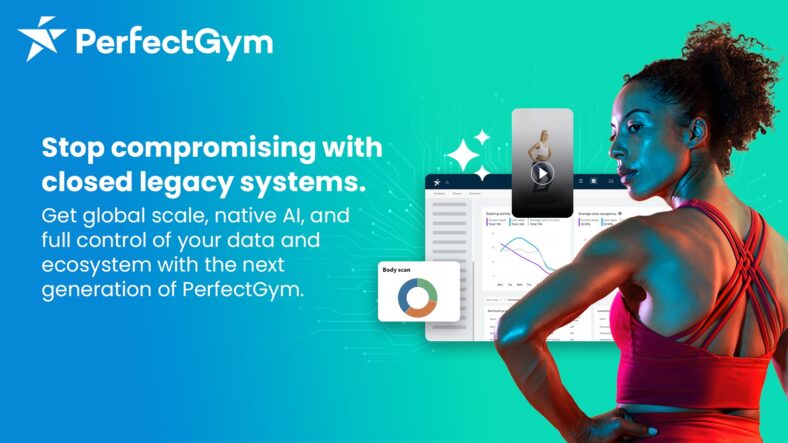
For enterprise operators, that means bringing membership, engagement and revenue data into a single environment that can actually be used to drive decisions. By connecting systems through an open API and a wide ecosystem of integrations, the goal is to move operators from being aware of their data to being powered by it.
That commitment to working closely with enterprise operators is reflected in PerfectGym’s investment in local U.S. leadership and operations, bringing hands-on support closer to one of the most complex and competitive fitness markets in the world.
Looking ahead, growth will increasingly be shaped across the full member lifecycle, not just at the point of acquisition. As AI, personalization and automation continue to advance, operators will need systems capable of supporting that complexity.
“It’s about giving the power back to the operators,” says Korst. “Let us power your business with a robust, enterprise-grade backend you can rely on.”
Operators evaluating their own data readiness can start by asking three questions:
Can you identify which members haven’t visited in three weeks?
Can you see which locations are underperforming on secondary revenue?
Can you pull a unified member view without logging into multiple systems?
If the answer to any of these is no, the gap between where you are and where the industry is heading may be wider than you think.
