


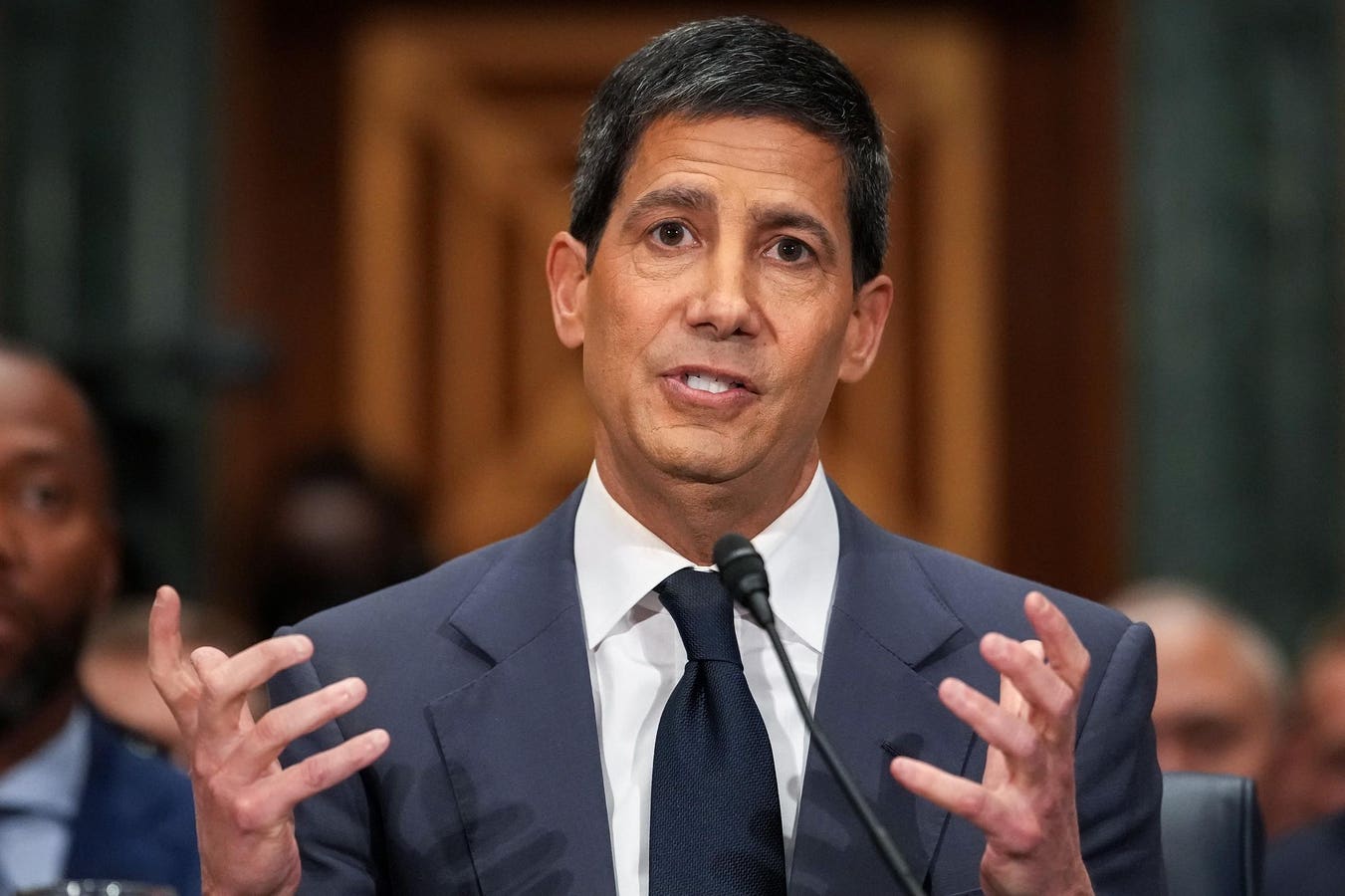

WASHINGTON, DC – APRIL 21: Kevin Warsh, U.S. President Donald Trump’s nominee for Chair of the Federal Reserve, testifies during his Senate Committee on Banking, Housing, and Urban Affairs confirmation hearing in the Dirksen Senate Office Building on April 21, 2026 in Washington, DC. President Trump nominated Warsh, a former member of the Federal Reserve Board of Governors, to replace Jerome Powell amid bipartisan concerns over the Justice Department’s criminal investigation into the central bank’s current leader. (Photo by Andrew Harnik/Getty Images)
Getty Images
Kevin Warsh appears on track for confirmation as the next Federal Reserve chair. Sen. Thom Tillis, a previous holdout, wrote on X on Sunday, April 26, that, “I look forward to supporting Kevin Warsh’s confirmation.” That’s because the Department of Justice appears to have dropped its criminal investigation into Jerome Powell, which Tillis strongly opposed as a challenge to the Fed’s independence.
If confirmed, Warsh could become Fed chair in May and preside over his first meeting of the Federal Open Market Committee on June 16-17. Warsh outlined during his April 21 confirmation hearing that he plans “regime change” at the Fed, with reduced emphasis on forward guidance, a smaller balance sheet and a more focused role for the central bank on a narrow definition of monetary policy. These initiatives align with Warsh’s previous statements. However, the overall path for monetary policy may remain similar to Powell’s, based on market expectations.
Why Warsh Wants To Dial Back Forward Guidance
Warsh may seek to scale back the Fed’s use of forward guidance — when policymakers signal how monetary policy may trend over the coming months. The Fed used this tool during the financial crisis to signal that rates would remain low for a sustained period, helping manage market expectations. However, Warsh sees forward guidance as less useful in normal economic environments and believes it can hamper effective policymaking if the Fed becomes pre-committed to a particular course of action.
What A Smaller Fed Balance Sheet Would Mean
The Fed’s balance sheet has grown dramatically since the 2008 financial crisis and again during the pandemic. Before the financial crisis, the Fed’s balance sheet was roughly $800 billion. It expanded sharply through several rounds of quantitative easing and ultimately peaked at just over $8 trillion in 2022. These increases came from large‑scale purchases of Treasury and agency mortgage‑backed securities, which injected liquidity into the financial system and helped push long‑term interest rates lower.
Since that peak, the Fed has reduced its holdings through quantitative tightening. The balance sheet now stands at a little under $7 trillion, still far above pre‑2008 levels and representing a significant share of outstanding U.S. government debt.
A Narrower Focus On Monetary Policy
Warsh plans to focus the Fed more narrowly on monetary policy. That means the central bank may have less to say about topics such as the environment or diversity. Warsh has signaled that he intends to keep the focus on the Fed’s statutory mandates: controlling inflation and maintaining full employment. He also believes that performing well against these goals will help preserve the Fed’s independence.
How Markets Are Pricing A Warsh Fed
Despite these details from Warsh, monetary policy expectations remain broadly similar to those under Powell, according to fixed-income markets. That means interest rates could move lower in 2026, but for now, the most likely outcome is that rates hold steady for the remainder of the year.
A fundamental trade-off remains. Tariffs and the Iran conflict have pushed inflation a little higher, implying incrementally higher interest rates even though inflation has eased from previously high levels. Set against that, the labor market is being closely watched. Signs of labor market weakness might encourage the Fed to cut interest rates, but so far the labor market has held up better than many expected, even if the pace of hiring has slowed.
Beyond Warsh’s appointment, it remains to be seen whether Powell will stay on the FOMC after his term as chair ends and how the Supreme Court will rule on Gov. Lisa Cook’s potential firing. Both issues could influence near-term monetary policy.
