


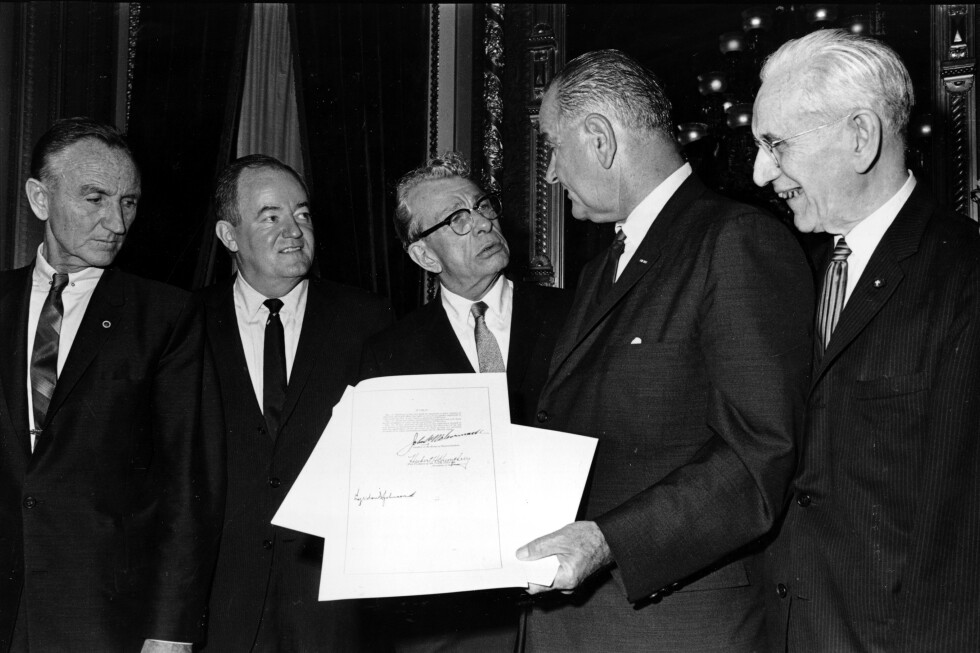
WASHINGTON (AP) — President Lyndon B. Johnson knew the legislation he was about to sign was momentous, one that took courage for certain members of Congress to pass since the vote could cost them their seats.
To honor that, he took the unusual step of leaving the Oval Office and going to Capitol Hill for the signing ceremony. It was Aug. 6, 1965, five months after the “Bloody Sunday” attack on civil rights marchers in Selma, Alabama, gave momentum to the bill that became known as the Voting Rights Act.
In the six decades since, it became one of the most consequential laws in the nation’s history, preventing discrimination against minorities at the ballot box and helping to elect thousands of Black and Hispanic representatives at all levels of government.
On Wednesday, the U.S. Supreme Court knocked out a major pillar of the law that had protected against racial discrimination in voting and representation. It was a decision that came more than a decade after the court undermined another key tenet of the law and led to restrictive voting laws in a number of states. Voting and civil rights advocates were left fearful of what lies ahead for minority communities.
“It means that you have entire communities that can go without having representation,” said Cliff Albright, a co-founder of the group Black Voters Matter. “It is literally throwing us back to the Jim Crow era unapologetically, and that’s not exaggeration.”
Kareem Crayton, vice president of the Brennan Center for Justice’s Washington office, said the court’s steady work to erode the Voting Rights Act, culminating in Wednesday’s decision, amounted to “burying it without the funeral.”
Hollowing out America’s ‘greatest legislative landmark’
The Supreme Court’s ruling came in a congressional redistricting case out of Louisiana after the state created a district that gave the state its second Black representative to Congress.
It found that map to be an unconstitutional gerrymander because it took race into account to draw the lines. In an opinion written by Justice Samuel Alito, the court’s conservative majority said the provision of the Voting Rights Act in question, called Section 2, was designed to protect voters from intentional discrimination.
Justice Elena Kagan in her dissent said the bar to show intentional discrimination is “an almost insurmountable barrier for challenges to any voting rights issues to prove discrimination.”
Voting rights experts said the ruling leaves the Voting Rights Act only a shell of what it had been and will provide an open door for political mapmakers at every level — from local school districts to state legislatures to Congress — to undermine minority representation.
“We’re witnessing the evisceration of America’s greatest legislative landmark at the hands of a far right Supreme Court,” Democratic U.S. Rep. Ritchie Torres of New York said.
Maria Teresa Kumar, president of Voto Latino, said the decision will allow more aggressive “cracking and packing” of populations to dilute their votes, “not just in congressional districts but also in state legislatures, county commissions, school boards and city councils.”
VRA was the key tool to fight dilution of voting strength
Voting rights experts said there is no doubting the law’s impact over the decades.
Sherrilyn Ifill, a law professor at Howard University and the former president of the NAACP Legal Defense Fund, said there were about 1,500 Black elected officials throughout the country in 1970. Today, that stands at more than 10,000.
“And it isn’t because of the goodness of people’s hearts,” she said.
She said that success was a direct result of Black communities, civil rights activists and lawyers having the tools, through the Voting Rights Act, to file challenges to efforts to diminish the voting strength of Black and Hispanic voters. Most of the Section 2 cases have been over representation in local governments.
It’s not just the numbers.
A loss of representation, especially in state legislatures and Congress, will translate into minority communities losing a voice on issues that matter to them, such as healthcare, education and needed public works upgrades, said Sophia Lin Lakin, deputy director of the American Civil Liberties Union’s Voting Rights Project.
“States can now point to partisan objectives to justify maps that strip voters of color of representation, and federal courts will have little basis to intervene,” she said.
A steady erosion by the court, a future in doubt
The landmark law signed by Johnson 61 years ago had been amended over the years, but the biggest change was in 2013, when the Supreme Court released its ruling in Shelby County v. Holder. That decision essentially ended a provision of the Voting Rights Act mandating the way states and local jurisdictions were included on a list of those needing to get advance approval, or preclearance, for voting-related changes.
That decision paved the way for mostly Republican states to pass a wave of restrictive election legislation, especially after President Donald Trump, a Republican, falsely claimed widespread fraud cost him reelection in 2020 against Democrat Joe Biden.
In a surprise ruling in 2023, the Supreme Court upheld Section 2 in a redistricting case out of Alabama, a ruling that it essentially reversed on Wednesday.
The question now is what comes next, for minority representatives and the communities they represent.
In Louisiana, the decision puts Democratic Rep. Cleo Fields on the endangered list. This isn’t the first time redistricting has complicated Fields’ political plans. He served for two terms in the 1990s before the state redrew his congressional district.
“I’ve been down this road before, you know, 33 years ago,” he said.
Shomari Figures, who won the seat created in Alabama after the court’s 2023 decision, said the decision doesn’t make changes to that state’s current congressional districts, but it has made proving future racial discrimination in redistricting cases significantly tougher.
“It will lead to states, primarily in the South, launching immediate efforts to redraw districts in ways that will dilute the impact of Black voters and drastically reduce the number of realistic opportunities to elect Black members to Congress,” he said.
Shalela Dowdy, an Alabama resident who was a plaintiff in the lawsuit that resulted in the creation of a new district now represented by Figures, said she is worried the decision will lead to the rollback of the district created in 2023, which she said gave Black voters a greater voice.
“Putting it in the hands of the states on this level is dangerous,” Dowdy said. “There’s just been a history of the states not doing the right thing based off their state population.”
___
Chandler reported from Montgomery, Ala. Associated Press writers Jeff Amy in Atlanta; Joey Cappelletti, Matt Brown and Haya Panjwani in Washington; and Graham Lee Brewer in Oklahoma City contributed to this report.
