


Google Quantum AI released a paper that sent ripples through the blockchain world. The research confirms something notable: Algorand is among the most advanced chains when it comes to post-quantum security.
According to the findings, Algorand has had PQ‑secure state proofs since 2022. The first live post‑quantum transaction on Algorand took place in 2025. To date, the network has processed over 140,000 quantum‑resistant transactions on mainnet. All of this is built directly into the protocol (no roadmap promises, no future opt‑in). It’s been running for 3.5 years.
That’s a big achievement. Algorand deserves credit for being ahead of the curve.
But while institutions and researchers take note of Algorand’s lead, a different project is getting solid attention from retail investors. BMIC ($BMIC), a quantum‑safe wallet platform, has raised nearly $500,000 in its presale. And for those searching for the best quantum-resistant crypto to buy, BMIC offers a focused, wallet‑first approach that complements (and in some ways surpasses) what Algorand has built.
What Google Confirmed About Algorand
The Google Quantum AI paper didn’t just praise Algorand for vague reasons. It highlighted concrete technical milestones.
Algorand integrated post‑quantum security into its core protocol years before most chains even started talking about the threat. State proofs (a mechanism for verifying blockchain state without trusting a central party) have been PQ‑secure since 2022. The first live PQ transaction occurred in 2025, and now the network has processed more than 140,000 such transactions.
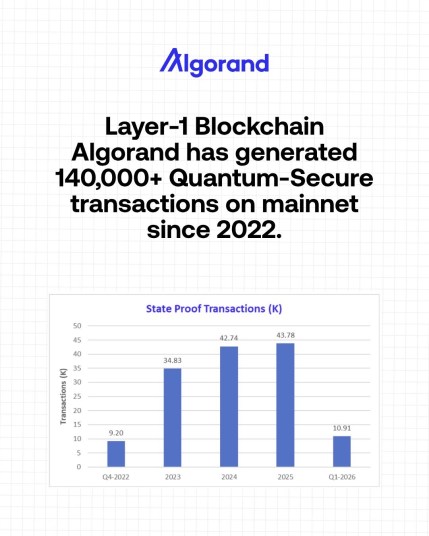
Source: X/@Algorand
This is not a testnet experiment. It’s live, it’s working, and it’s been battle‑tested.
For anyone worried about quantum computers breaking blockchain cryptography, Algorand provides a level of reassurance that few other layer‑1s can match. The network doesn’t need to rush a migration because it never left the starting gate late.
BMIC vs. Algorand: Different Focus, Same Goal
Algorand’s post‑quantum security is built at the chain level. It protects the network’s consensus, validators, and state proofs. That’s critical for the blockchain itself.
But Algorand does not, by default, protect individual user wallets from the “harvest now, decrypt later” threat. If you hold ALGO or use Algorand’s standard wallet, your public key can still be exposed during transactions, just like on Ethereum or Bitcoin. The chain’s quantum resistance does not automatically extend to every wallet interacting with it.
This is where BMIC takes a different, and in some ways more direct, approach.
BMIC is not a layer‑1 blockchain. It’s a quantum‑safe finance stack built on top of existing networks like Ethereum. The core product is a wallet that never exposes your public key on‑chain. Using signature‑hiding architecture (ERC‑4337 smart accounts and private L2 routing), BMIC ensures there is no public key for a future quantum computer to harvest.
That means every transaction, every staking position, every payment made through BMIC is shielded from “harvest now, decrypt later” attacks. The protection is at the user level, not just the chain level.
Algorand secures its network. BMIC secures your keys. Both are valuable, but for an individual investor looking for the best crypto to buy for personal asset protection, BMIC’s wallet‑first model may be more directly relevant.
Why BMIC Could Be the Best Quantum-Resistant Crypto to Buy Right Now
Algorand is not far behind. In fact, in terms of chain‑level quantum resistance, it’s arguably ahead of almost everyone. But BMIC offers something Algorand does not: a complete, user‑facing quantum‑safe financial stack available today in presale.
The BMIC presale has raised nearly $500,000, with a fixed supply of 1.5 billion tokens. Half of that supply (750 million) is allocated to the presale, and the team holds just 3% – well below industry average. The current token price is $0.051009, with tiered increases leading to a higher public launch price.
Beyond the wallet, BMIC includes quantum‑secure staking (no exposed keys), a PQC‑protected payment card system, and AI‑driven threat detection that automatically upgrades cryptography as NIST standards evolve. For institutions, BMIC offers Quantum Security‑as‑a‑Service.
Algorand proved that post‑quantum security can be built into a layer‑1 blockchain. BMIC is proving that the same level of protection can be delivered directly to end users, without waiting for chain‑level upgrades.
For anyone searching for the best quantum-resistant crypto to buy in 2026, BMIC represents a pure play on the quantum‑security narrative. It’s not competing with Algorand—it’s solving a different piece of the puzzle. But for individual investors who want to protect their own assets, BMIC’s wallet may be the more immediate answer.
Two Paths to a Quantum‑Safe Future
Algorand’s validation by Google Quantum AI is a milestone for the entire crypto industry. It proves that post‑quantum security is not science fiction—it’s already running on mainnet.
BMIC takes that same principle and applies it to the wallet layer. No exposed public keys. No harvest‑now, decrypt‑later risk. Just a clean, quantum‑native design from day one.
The presale is still open, and the next price increase approaches with each new buyer. Algorand may have the head start in chain‑level security, but BMIC offers something just as valuable: a chance to get in early on the best quantum-resistant crypto to buy for the coming decade.
Meet the future of quantum-secure Web3 with BMIC:
Presale: https://bmic.ai/
Social: https://x.com/BMIC_ai
Telegram: https://t.me/+6d1dX_uwKKdhZDFk
