Close Menu
  • Home
  • AI & Technology
  • Politics
  • Business
  • Cryptocurrency
  • Sports
  • Finance
  • Fitness
  • Gadgets
  • World
  • Marketing

Subscribe to Updates

Subscribe to our newsletter and never miss our latest news

Subscribe my Newsletter for New Posts & tips Let's stay updated!

What's Hot

Republicans amp up their push for White House ballroom

April 28, 2026

SEQUEL Brands Rolls Out Portfolio-Wide Loyalty and Referral Infrastructure Powered by Solution One & Perkville

April 28, 2026

Monero To $1,160? Analyst Sees Major XMR Rally Ahead

April 28, 2026
Facebook X (Twitter) Instagram
  • Home
  • About US
  • Advertise
  • Contact US
  • DMCA
  • Privacy Policy
  • Terms & Conditions
Facebook X (Twitter) Instagram
MNK NewsMNK News
  • Home
  • AI & Technology
  • Politics
  • Business
  • Cryptocurrency
  • Sports
  • Finance
  • Fitness
  • Gadgets
  • World
  • Marketing
MNK NewsMNK News
Home » Crypto is booming again. Trump’s return explains both the rise and the risk
Cryptocurrency

Crypto is booming again. Trump’s return explains both the rise and the risk

MNK NewsBy MNK NewsJuly 13, 2025No Comments4 Mins Read
Facebook Twitter Pinterest LinkedIn Tumblr Email
Share
Facebook Twitter LinkedIn Pinterest Email


The jump in Bitcoin prices is part of a broader upward trend. Since Trump’s re-election in November, Bitcoin has continued to climb steadily, its market capitalisation now surpassing even that of Google. It is not just Bitcoin. Total crypto market capitalisation has grown from under $2.5 trillion in June 2024 to $3.7 trillion now.

These developments follow a significant shift in US crypto policy. Trump reversed his earlier anti-crypto stance and appointed several pro-crypto figures in key regulatory roles: David Sacks as the White House crypto czar, Paul Atkins to the Securities and Exchange Commission (SEC), and Brian Quintenz to the Commodity Futures Trading Commission (CFTC). 

The SEC has dropped multiple enforcement actions and narrowed its interpretation of securities laws. The Justice Department shut its crypto enforcement unit on 4 April.

There were other policy signals, including an executive order prohibiting any US central bank digital currency and the creation of a Strategic Bitcoin Reserve using government-seized assets. Trump has also announced plans for a broader “Crypto Strategic Reserve” to include assets like Ethereum, Solana, and XRP.

Together, these actions signalled regulatory clarity and long-term policy alignment with the crypto sector, leading to higher investor confidence.
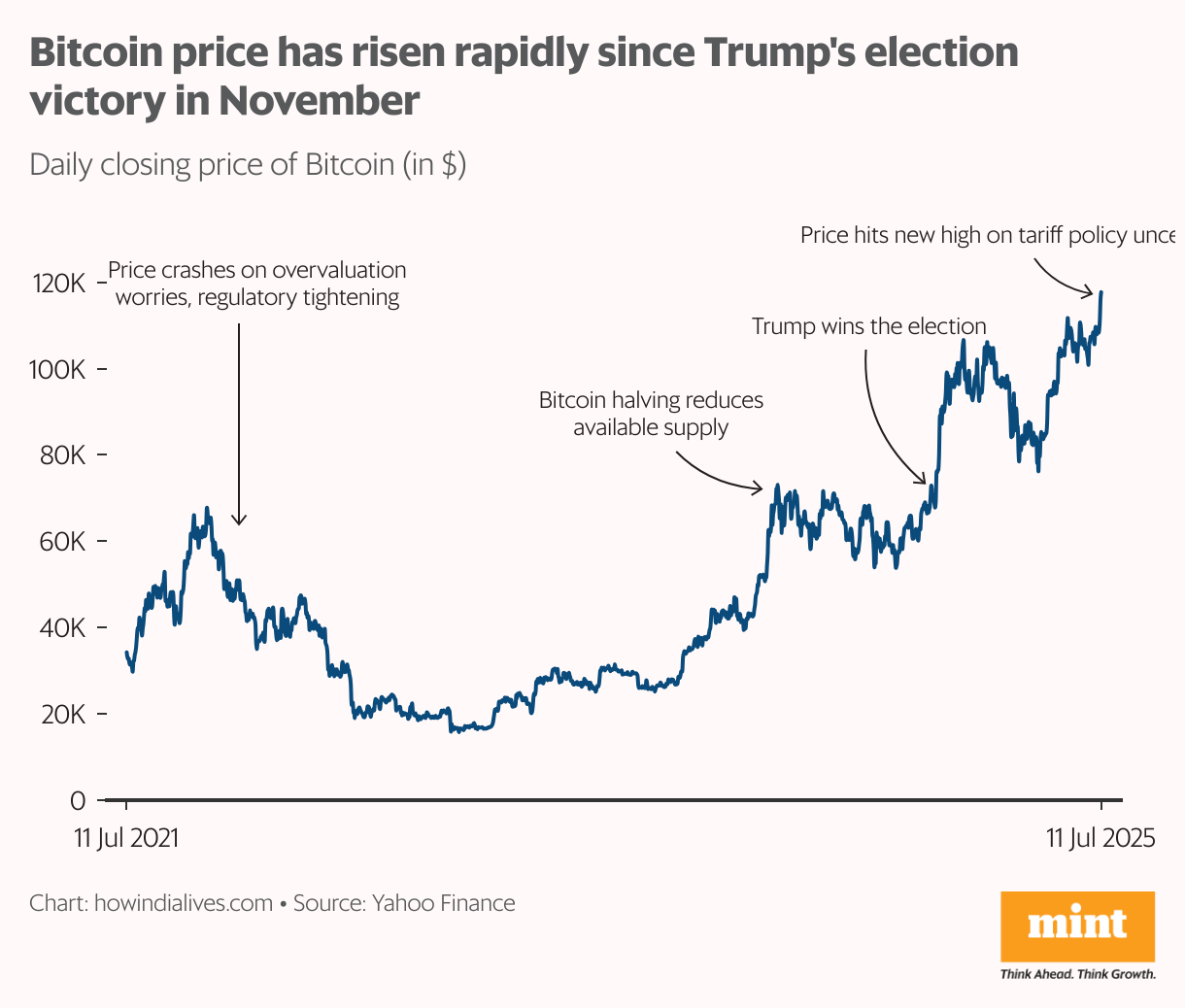
 The chart shows Bitcoin's price has experienced significant growth, with some volatility, and is currently near its highest level in the displayed period, supporting the claim of a 22% jump this year.

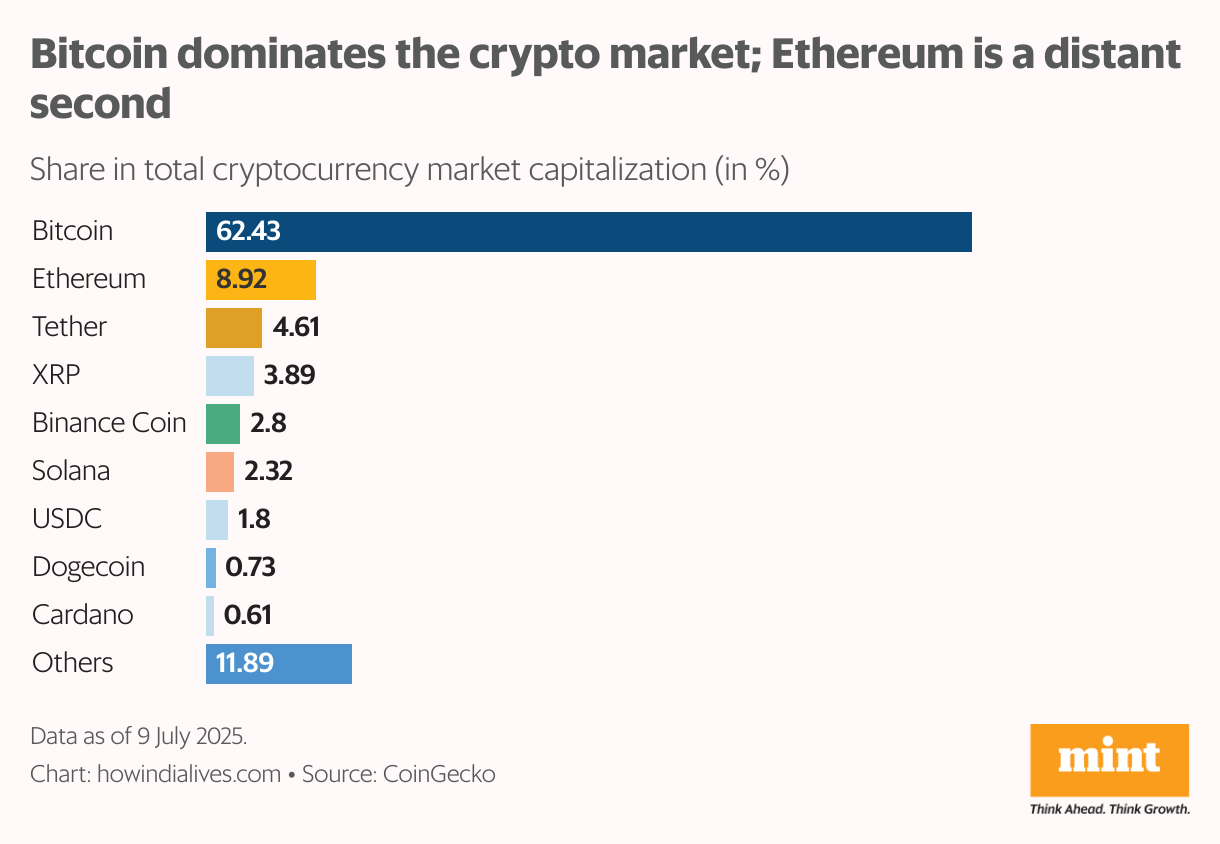
The chart shows that, as of July 9, 2025, Bitcoin dominates the cryptocurrency market with a 62.43% share of total market capitalization. Ethereum is next at 8.92%, while other major cryptocurrencies like Tether, XRP, and Binance Coin each hold much smaller shares. All other cryptocurrencies combined make up 11.89% of the market. The chart uses horizontal bars to visually compare each share.

Capital moves

The regulatory clarity has boosted institutional interest in crypto. In the first quarter of 2025, venture capital investment in crypto startups reached $6 billion, according to PitchBook, compared with about $10 billion each in 2024 and 2023, when regulatory uncertainty and enforcement actions deterred large investors.

Asset managers have upped their exposure. Spot Bitcoin and Ethereum exchange-traded funds (ETFs) have seen strong adoption, with cumulative net inflows surpassing $50 billion by mid-2025. Total ETF assets stood near $140 billion, making them among the fastest-growing financial products this year.

The SEC’s rollback of SAB 121, an accounting rule, has removed key custodial barriers for banks. The US Department of Labor has also eased restrictions on crypto allocations in retirement accounts. These moves have helped integrate crypto into mainstream financial products, bringing back banks, pension funds, and institutional allocators.
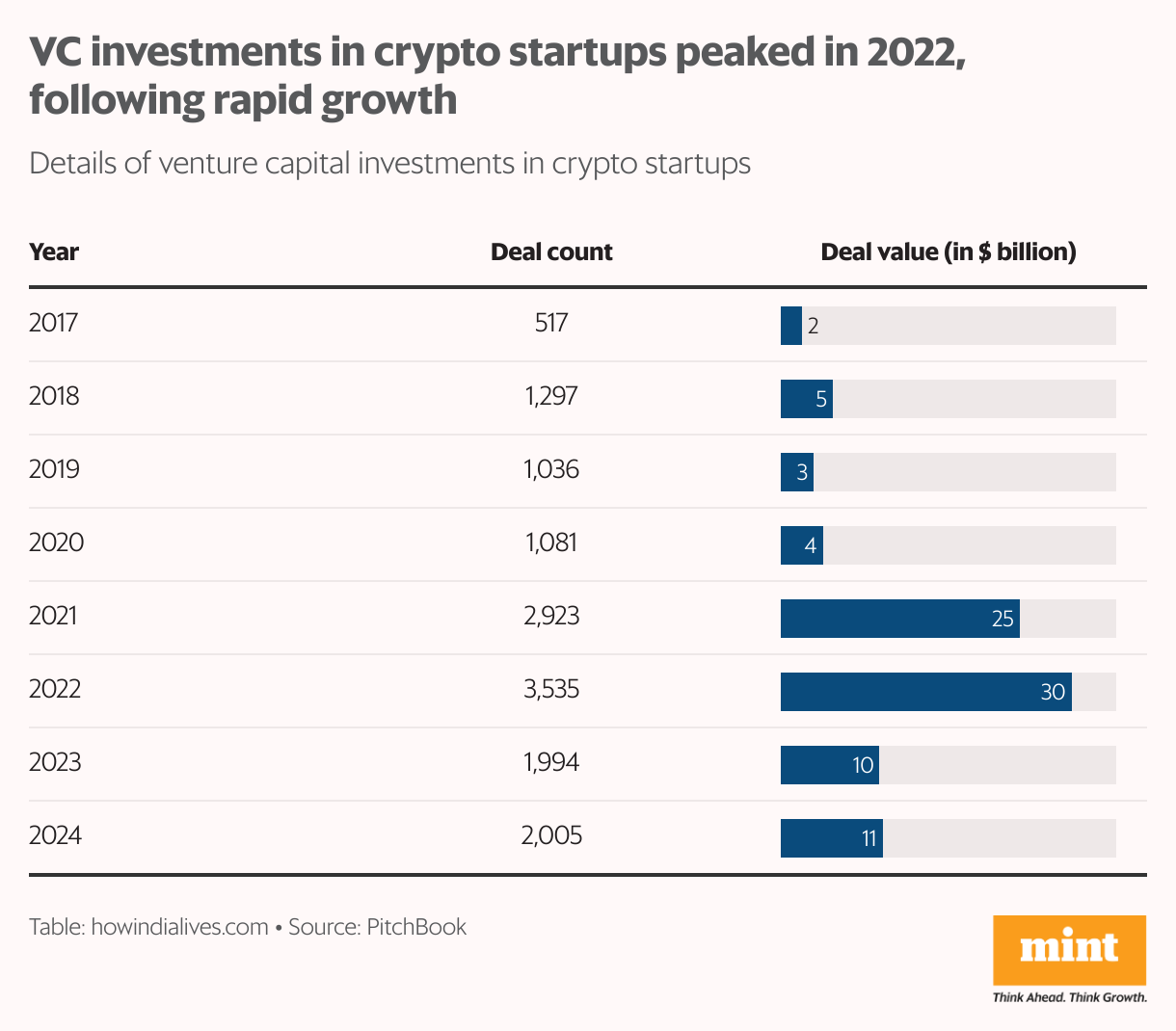
The chart shows venture capital investments in crypto startups grew rapidly from 2015 to 2022, with deal counts peaking at 3,535 and deal values reaching $30.3 billion in 2022. After this high, both the number of deals and total investment amounts declined, dropping to around 2,000 deals and just over $10 billion in 2023 and 2024. In the first quarter of 2025, there were 405 deals totaling $6 billion, indicating a continued slowdown from the earlier boom. The chart highlights the explosive growth during 2021-2022 and the subsequent cooling in the crypto startup investment landscape.

Token stability

Another area that has seen action under Trump is stablecoins—digital tokens pegged to fiat currencies like the US dollar. According to Forbes, the total market capitalisation of the world’s top five stablecoins is $230 billion. Business-to-business stablecoin payments increased from under $100 million to over $3 billion per month over the past year.

This expansion, again, was driven by regulatory action. In June, the US Senate passed the Guiding and Establishing National Innovation for US Stablecoins (GENIUS) Act. It provided a clear legal framework, mandated strict customer protection standards, and imposed know-your-customer and anti-money laundering compliance.

Adoption has grown across financial services, as companies use stablecoins for payroll, treasury management, and cross-border payments. PayPal and Visa are integrating stablecoins for payments. Stripe launched stablecoin financial accounts in 101 countries. BNY Mellon, a major custody bank, has moved to hold reserves for Ripple’s stablecoin, a sign of stablecoins’ integration into mainstream financial infrastructure. Ripple, which issues the XRP cryptocurrency, launched the RLUSD stablecoin in July.
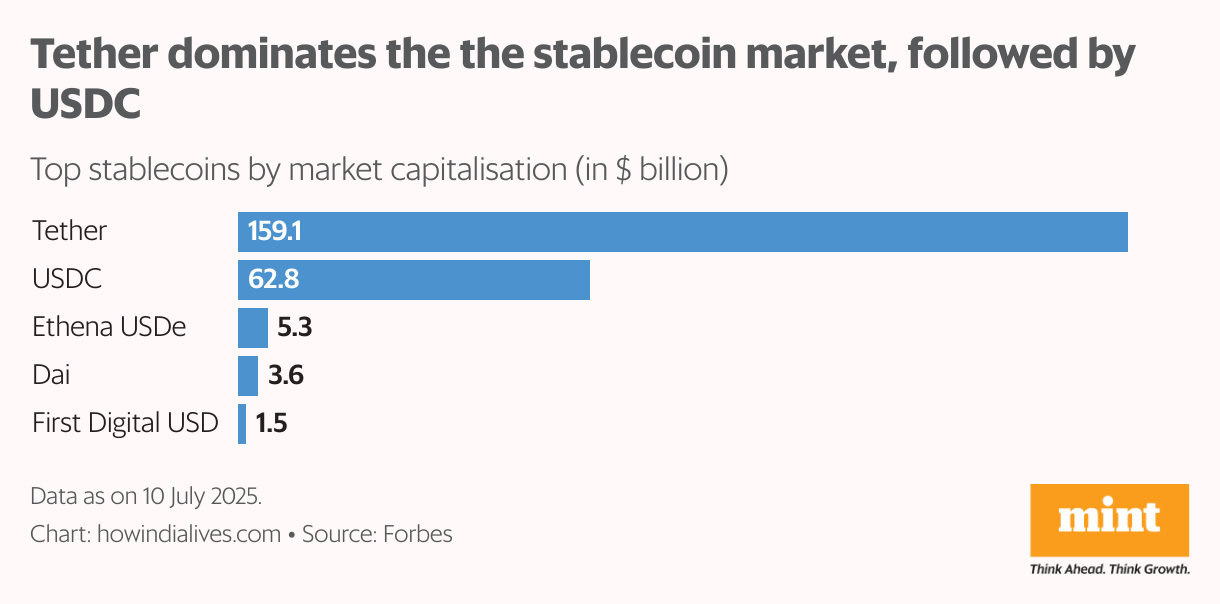
The chart presents the market capitalization of the top five stablecoins as of July 10, 2025, totaling $232 billion. Tether (USDT) is the clear leader with a market cap of $159.09 billion, followed by USDC at $62.84 billion. The remaining stablecoins—Ethena USDe, Dai, and First Digital USD—have significantly smaller market caps at $5.33 billion, $3.64 billion, and $1.45 billion, respectively. The chart uses horizontal bars to visually highlight the dominance of Tether and USDC compared to the much smaller market shares of the other stablecoins

Risk layer

Recent developments related to cryptocurrencies, however, have renewed concerns over volatility, regulatory gaps, and illicit activity. Bitcoin and other cryptocurrencies remain sensitive to political signals. The GENIUS Act has raised questions about unintended consequences, including financial instability and consumer harm. Market participants cite “random policy shocks” and “instant dumps” linked to presidential remarks.

Illicit use remains significant. In 2024, hacks caused $2.2 billion in losses, with stablecoins accounting for 63% of illicit crypto transaction volume. Ransomware payments reached $75 million. In the first half of 2025, crypto phishing attacks in the Web3 ecosystem led to $39.7 million in losses across 43,000 addresses, using tactics such as wallet-level bulk approvals, impersonation via social media, deepfake-led social engineering, and malicious browser tools.
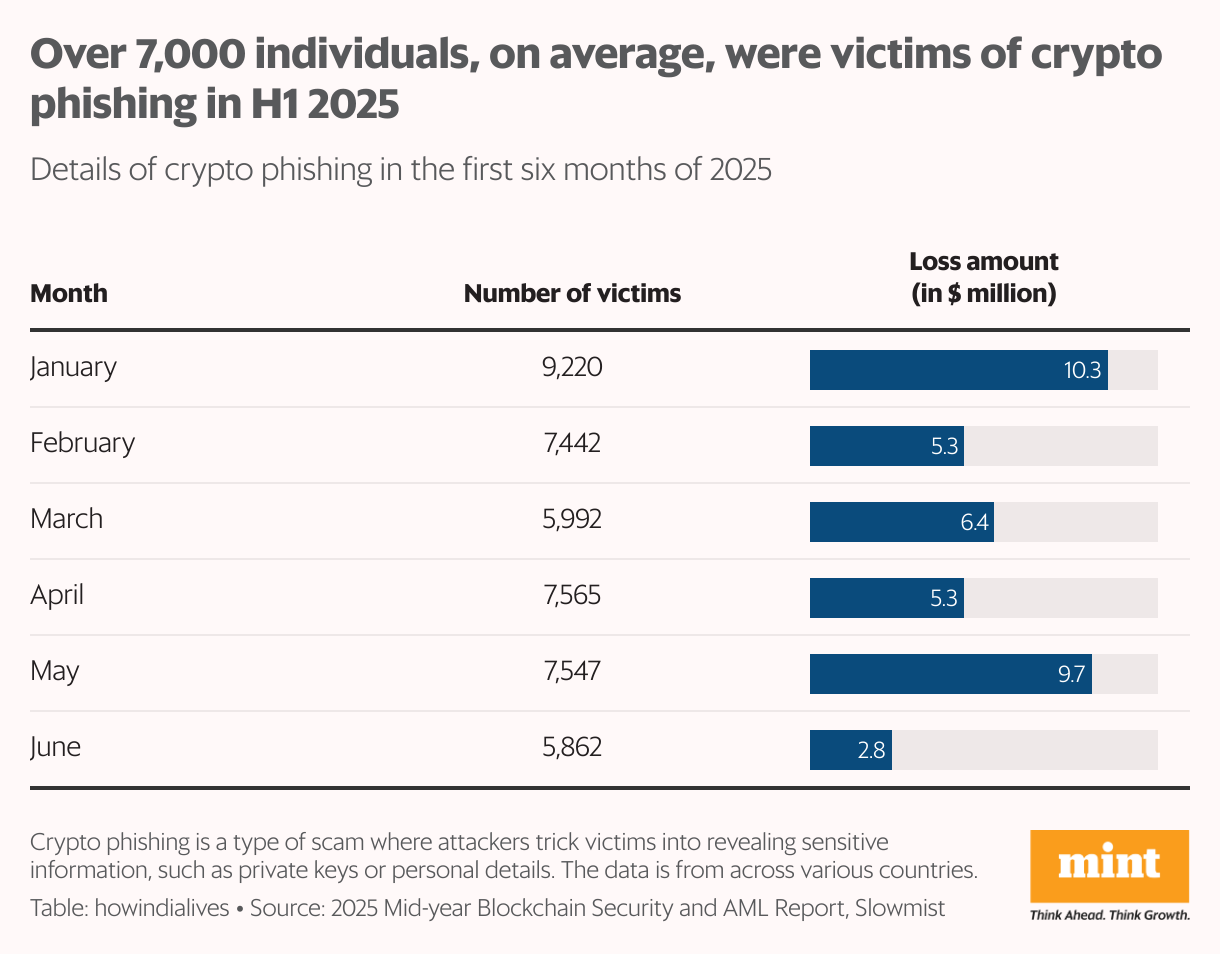
This chart shows over 43,000 people have fallen victim to crypto phishing scams in the first half of 2025, with total losses exceeding $40 million. The chart highlights that the number of victims ranged from about 5,800 to over 9,200 in different incidents, with individual loss amounts between $2.8 million and $10.25 million. Crypto phishing involves attackers tricking users into revealing sensitive information like private keys or personal details. The data reflects cases from multiple countries and underscores the ongoing risks associated with crypto-related scams.

Additional concerns relate to conflicts of interest. Trump has launched the $TRUMP meme coin, followed by a separate digital token from US First Lady Melania Trump. The family also holds stakes in World Liberty Financial, issuer of the USD1 stablecoin and WLFI token. While regulatory clarity has boosted adoption, the close alignment between policy and personal financial interest has raised questions about transparency and governance.


www.howindialives.com is a database and search engine for public data.


Source link

Share. Facebook Twitter Pinterest LinkedIn Tumblr Email
MNK News
  • Website

Related Posts

Monero To $1,160? Analyst Sees Major XMR Rally Ahead

April 28, 2026

Bitcoin To $88,000? Analysts Eye May Breakout After Key Close

April 28, 2026

Bitmine’s Ethereum Holdings Reach Record 5 Million Tokens–CEO’s Bullish Outlook

April 28, 2026
Add A Comment
Leave A Reply Cancel Reply

Editors Picks

Inter’s title charge hits bump in road, Milan-Juve clash ends in stalemate

April 27, 2026

PM Shehbaz signs off on letting fans attend PSL playoffs

April 27, 2026

Blistering Chapman steers United to Qualifier as sloppy Sultans falter

April 26, 2026

Tickets for HBL PSL 11 final to go on sale from April 27

April 26, 2026
Our Picks

Monero To $1,160? Analyst Sees Major XMR Rally Ahead

April 28, 2026

Bitcoin To $88,000? Analysts Eye May Breakout After Key Close

April 28, 2026

Bitmine’s Ethereum Holdings Reach Record 5 Million Tokens–CEO’s Bullish Outlook

April 28, 2026

Recent Posts

  • Republicans amp up their push for White House ballroom
  • SEQUEL Brands Rolls Out Portfolio-Wide Loyalty and Referral Infrastructure Powered by Solution One & Perkville
  • Monero To $1,160? Analyst Sees Major XMR Rally Ahead
  • Bitcoin To $88,000? Analysts Eye May Breakout After Key Close
  • YouTube is testing an AI search mode that ‘feels more like a conversation’

Recent Comments

No comments to show.
MNK News
Facebook X (Twitter) Instagram Pinterest Vimeo YouTube
  • Home
  • About US
  • Advertise
  • Contact US
  • DMCA
  • Privacy Policy
  • Terms & Conditions
© 2026 mnknews. Designed by mnknews.

Type above and press Enter to search. Press Esc to cancel.