Close Menu
  • Home
  • AI & Technology
  • Politics
  • Business
  • Cryptocurrency
  • Sports
  • Finance
  • Fitness
  • Gadgets
  • World
  • Marketing

Subscribe to Updates

Subscribe to our newsletter and never miss our latest news

Subscribe my Newsletter for New Posts & tips Let's stay updated!

What's Hot

Gladiators keep Kingsmen winless to record first victory

March 29, 2026

TAO Price Could Hit $3,000 in 18 Months, but This $0.049999 Crypto Presale Solves a Billion‑Dollar Problem AI Can’t

March 29, 2026

Bitcoin Price Stalls Under $68,800, Resistance Caps Upside Again

March 29, 2026
Facebook X (Twitter) Instagram
  • Home
  • About US
  • Advertise
  • Contact US
  • DMCA
  • Privacy Policy
  • Terms & Conditions
Facebook X (Twitter) Instagram
MNK NewsMNK News
  • Home
  • AI & Technology
  • Politics
  • Business
  • Cryptocurrency
  • Sports
  • Finance
  • Fitness
  • Gadgets
  • World
  • Marketing
MNK NewsMNK News
Home » With song and seed, Brazil’s Indigenous Maxakali confront climate change | Climate Crisis News
World

With song and seed, Brazil’s Indigenous Maxakali confront climate change | Climate Crisis News

MNK NewsBy MNK NewsApril 30, 2025No Comments4 Mins Read
Facebook Twitter Pinterest LinkedIn Tumblr Email
Share
Facebook Twitter LinkedIn Pinterest Email


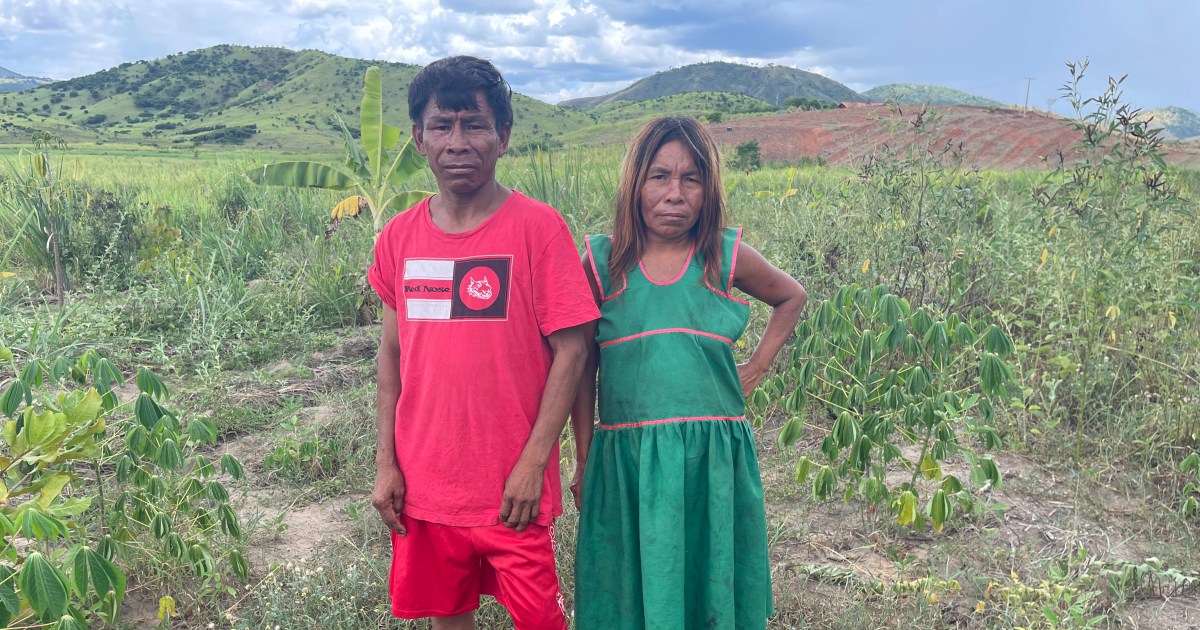
Maxakali territory once spanned at least three large valleys in the Atlantic Forest. Elders in the village remember how the forest supplied food, medicine and construction materials — in addition to serving as habitat for the yãmĩyxop, spiritual beings central to Maxakali beliefs.

“There were medicines in the forest for us,” explained Damásio. “When we had stomachaches, we would use the bark from the trees to feel better. But now, it’s just grass. The farmers burned everything.”

But the four remaining Maxakali reservations — reduced to 6,434 hectares (15,900 acres) of pasture — contain less than 17 percent of their original vegetation. Some experts consider the Atlantic Forest to be regionally extinct.

That absence has many Maxakali leaders turning to reforestation — and finding in their musical traditions an ecological blueprint of the past.

Damasio Maxakali holds up a stalk from a banana tree in the lush vegetiation of the Hamhi project.
Manuel Damásio Maxakali tends to banana trees in Minas Gerais, Brazil [Sara Van Horn/Al Jazeera]

Singing organises life in Maxakali villages: Music, for instance, is used to cure illness, teach history or transmit practical instructions, like how to make bags or weave fishing nets.

“Songs tie together the whole Tikmũ’ũn social structure,” said de Tugny, the Hāmhi project coordinator, who is also a musicologist at the Federal University of Minas Gerais. “People don’t compose songs. They have songs.”

To have a song, she added, means being capable of taking care of the spirit considered to be the song’s creator.

Ancestral songs also provide an extremely detailed register of local ecology. Twelve musical canons, distinct in grammar and lexicon, total about 360 hours of song. Contained in the lyrics are hundreds of species of flora and fauna now extinct in the territory.

“We sing about everything: the saplings, the bananas, ourselves,” explained Manuel Kelé, leader of the village of Água Boa. “Even dogs have a song within our religion.”

A Maxakali woman uses a hoe to tend to crops
Caretakers at the Hāmhi nursery tend to the growing trees and plants [Sara Van Horn/Al Jazeera]

One song, for example, lists 33 species of bees, some of which don’t have names in Brazil’s national language, Portuguese, and only two of which are currently present in the territory. The lyrics supply information about bee behaviour that many Maxakali have never witnessed first-hand.

“The songs are snapshots,” said de Tugny. “They are like photographs of every detail that exists in the Atlantic Forest: the names of insects, birds, plants, moments of relationship between an animal and a leaf. All these are registered.”

For the Maxakali, ritual songs also play a crucial role in helping the forest regenerate. Singing is a daily part of their work in Hāmhi’s tree nurseries.

Nursery caretakers not only sing to seeds as they are buried, but they also make music as part of the regular rhythms of harvesting and cultivation. Caretakers divide into groups, position themselves around the nursery, and sing in concert with each other. The song lyrics help participants remember the ecological knowledge of their ancestors.

And while some of the work at Hāmhi is dedicated to planting fruit trees and other crops, the project’s leaders see reforestation as key to reducing the region’s fire risks.

A woman leans on a wooden gardening implement outdoors in Minas Gerais
Song is an important part of the growing cycle in Maxakali culture [Sara Van Horn/Al Jazeera]

Since its inception in 2023, the Hāmhi project has planted over 60 hectares (148 acres) of fruit trees and 155 hectares (383 acres) of Atlantic Forest vegetation. The goal is a reforested area nearly twice that size.

Programme participants have also organised themselves into a provisional fire brigade and even created natural fire barriers, using traditional methods like planting species of fire-resistant vegetation.

“Songs help the forest grow,” said Damásio, the village leader. “We ask those who have died to help us. They walk here and assist us. We are calling on the forest to grow back.”


Source link

Share. Facebook Twitter Pinterest LinkedIn Tumblr Email
MNK News
  • Website

Related Posts

Trump says China’s Xi ‘hard to make a deal with’ amid trade dispute | Donald Trump News

June 4, 2025

Who was Sana Yousaf, Pakistani TikTok star shot dead by a gunman? | Crime News

June 4, 2025

El Salvador convicts army officers for 1982 killing of 4 Dutch journalists | Crime News

June 4, 2025
Add A Comment
Leave A Reply Cancel Reply

Editors Picks

Gladiators keep Kingsmen winless to record first victory

March 29, 2026

In letter to PSL CEO, police detail alleged security protocol breach by Lahore Qalandar’s Shaheen Afridi, Sikandar Raza

March 29, 2026

England Test captain Stokes sidelined as he recovers from injury

March 29, 2026

Tiger Woods arrested, charged with DUI after Florida crash

March 28, 2026
Our Picks

TAO Price Could Hit $3,000 in 18 Months, but This $0.049999 Crypto Presale Solves a Billion‑Dollar Problem AI Can’t

March 29, 2026

Bitcoin Price Stalls Under $68,800, Resistance Caps Upside Again

March 29, 2026

Nonprofit European Crypto Initiative gets Ethereum-focused rebrand

March 29, 2026

Recent Posts

  • Gladiators keep Kingsmen winless to record first victory
  • TAO Price Could Hit $3,000 in 18 Months, but This $0.049999 Crypto Presale Solves a Billion‑Dollar Problem AI Can’t
  • Bitcoin Price Stalls Under $68,800, Resistance Caps Upside Again
  • Nonprofit European Crypto Initiative gets Ethereum-focused rebrand
  • Crypto News: Pepeto Announces Stage Sold Out While BNB Price Prediction Targets $3,000 but Smart Money Is Already Moving Somewhere Else

Recent Comments

No comments to show.
MNK News
Facebook X (Twitter) Instagram Pinterest Vimeo YouTube
  • Home
  • About US
  • Advertise
  • Contact US
  • DMCA
  • Privacy Policy
  • Terms & Conditions
© 2026 mnknews. Designed by mnknews.

Type above and press Enter to search. Press Esc to cancel.