


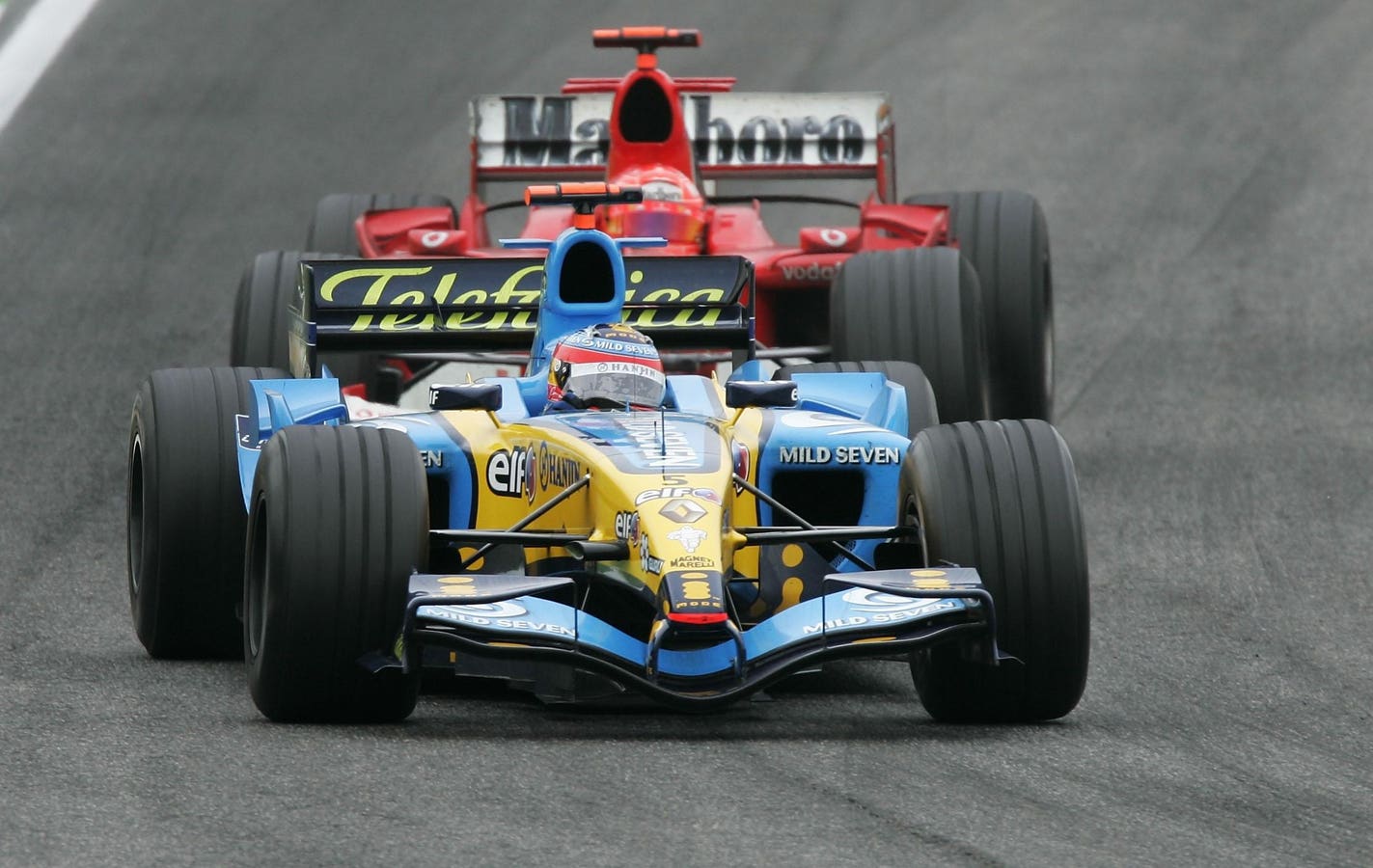
IMOLA, ITALY – APRIL 24: Fernando Alonso of Spain and Renault leads second placed Michael … More
The Formula 1 season may be just two races old, but 2026 is already dominating the conversation amid speculations the sport may welcome back the V10 engines.
The dramatic, roaring sound of V10s was the soundtrack to Formula 1 for two decades, before the engines were eventually banned in 2006 in favour of V8s.
Eight years later, the sport moved to a new 1.6-litre turbocharged units with hybrid assistance that has largely been in use ever since.
But the longing for a return to V10 never fully dissipated in some quarters and was brought back on the agenda but FIA president Mohammed Ben Sulayem last month.
“FIA must also lead the way on future technological motorsport trends,” he said in a post on Instagram.
“We should consider a range of directions, including the roaring sound of the V10 running on sustainable fuel.”
Ben Sulayem has since instructed Nikolas Tombazis, the FIA’s single-seater director, to look into the feasibility of returning to V10 engines, the clearest indication yet that Formula 1 was considering the future of its current power units.
Why do Formula 1 fans and drivers want V10 engines back?
The remarks came just two days a report on BBC Sport revealed former Formula 1 supremo Bernie Ecclestone had urged the sport’s commission to bring back the V10s.
The 94-year-old has long been a vocal opponent of the hybrid engines, which have never quite won some fans over.
Formula 1’s fan base is a broad church and among them are plenty of traditionalists, who maintain the cars should sound much louder.
Williams-Renault FW14B, Grand Prix of Canada, Circuit Gilles Villeneuve, 14 June 1992. Renault RS4 … More
Some of the drivers are in agreement too.
“It is no secret that the V6 has never sounded great,” Lewis Hamilton said last week ahead of the Chinese Grand Prix.
“I remember the first time I came to an Formula 1 race in 1996 in Spa and arriving and Michael [Schumacher] coming through Turn One and my rib cage just vibrated. I was so hooked. It was the most amazing thing I felt and heard.
“Over the years we’ve lost that. If we are able to move back to those amazing sounding engines and still able to see the sustainable goals, why not?”
Max Verstappen, who has only ever raced in the hybrid engine era, sang from the same hymn sheet.
“For pure emotion of the sport, V10 is definitely much better than what we have now,” the Dutchman said.
“It just brings so much more, even if the speed of the car was maybe slower. The feeling you got from an engine like that is something that you can’t describe compared to what we have now.”
McLaren and Williams introduced V10s in Formula 1 in 1989 in response to the ban on turbocharged engines and the power units went on to dominate the sport until they were outlawed in favor of 2.4-litre V8 in 2005.
What are the Formula 1 rules for 2026?
But with major rule changes coming into effect next season, there are several logistical challenges standing in the way of a return to V10 engines.
First and foremost, the fact Formula 1 has committed to keep using hybrid engines for another five-year period beginning in 2026 until the end of the 2030 season.
From next year, the engines will use fully sustainable fuels as part of the sport’s move to net-zero carbon emission by 2030.
The new power units will triple the amount of electrical power used and the engines will have a near 50-50 split between electric and internal combustion power.
The changes have convinced Honda to reverse its decision to quit Formula 1, while Audi, General Motors and Ford will join the sport, bringing the number of engine manufacturers up to six in 2026.
Against that backdrop, a return to naturally aspirated engines would not appeal to manufacturers, who have already spent hundreds of millions of dollars in development.
TOPSHOT – Ferrari’s British driver Lewis Hamilton (front L) leads the pack at the start of the … More
In a statement released this week, Audi said the rule changes “were a key factor in Audi’s decision to enter Formula 1”, while Mercedes has already indicated a hybrid element is paramount to it continuing in the sport.
The German giant will be providing engines to Alpine from next year after Renault, the French team’s parent company, announced it would exit the sport at the end of the season.
McLaren also has a Mercedes customer engine agreement in place until the end of the 2030 season.
But as Tombazis alluded to, V10 engines running sustainable fuels could be cheaper to manufacture and easier to design than the current hybrids.
“I think the right way to go about it is: do we want three or four years later to go to a different type of power unit?,” he said in Shanghai last week.
“If the answer to that is yes, then there’s question number two – what we do in the intervening period.
“The progress with sustainable fuels has led to views that maybe the engines could be simpler. […] The current power units are way too expensive. That’s why the president [Sulayem] made the comments about a V10 engine in 2028 and so on.”
Can Formula 1 return to V10 engines?
SHANGHAI, CHINA – MARCH 23: Toto Wolff, Executive Director of Mercedes AMG Petronas F1 Team and Zak … More
But not everyone is so enthusiastic.
In an exclusive interview with Autosport, Mercedes team principal Toto Wolff suggested Formula 1 would “be silly” to discuss engine changes before the new set of regulations has even been implemented.
He also noted the current hybrid engines were crucial in convincing the likes of Audi and Ford to join the sport.
“Before regulations have even started – to say let’s look at the next engine and power unit, I just think it makes Formula 1 look a little bit erratic.
“There needs to be a long-term plan and everybody is pulling on the same side.”
Over the weekend, McLaren team principal Zak Brown indicated Formula 1 was too far down the track in terms of future planning to consider a return to V10 engines.
“I don’t see how you can unwind what’s in place because of all the different power unit changes happening,” he said.
His Red Bull counterpart, however, left the door open to change.
“The romantic in you, a screaming V10, so long as it’s done responsibly with fully sustainable fuels, is hugely attractive,” Christian Horner said.
“The big question is when would that be for and what would be the game plan between where we sit today and then.”
