


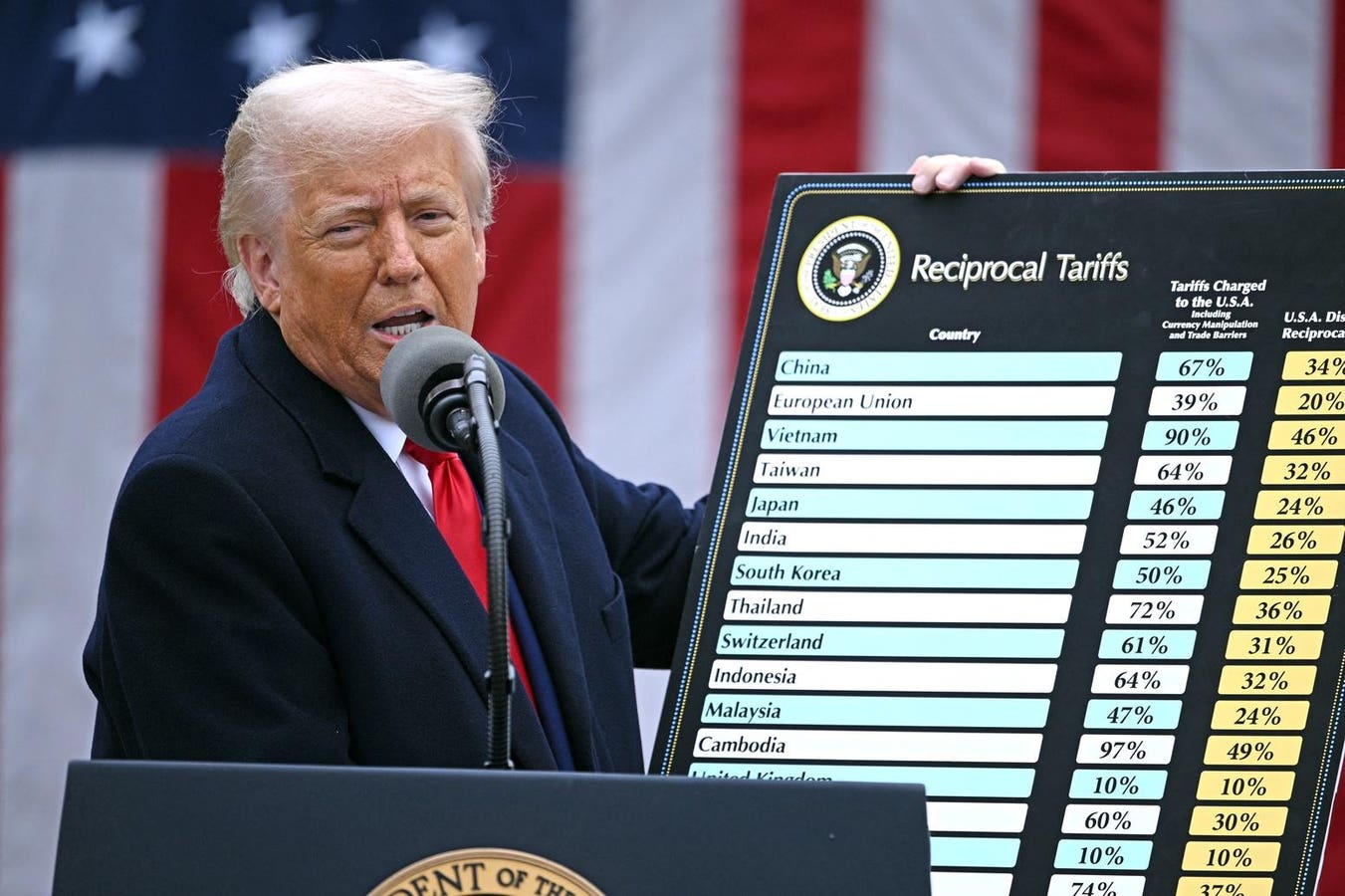
President Donald Trump holds a chart about reciprocal tariffs. (Photo by Brendan SMIALOWSKI / AFP) … More
Tariffs by themselves will not send the U.S. economy into recession, though they will hurt the economy by a small amount. Almost all economists, including me, believe they are poor economic policy, but the magnitude of harm won’t be great enough to send us into a nosedive.
Uncertainty about tariffs could trigger a recession, as described in my economic forecast update. Assuming that all of the major trade deals are settled this summer, even high tariff rates will not send the economy into recession. This is a narrow view—tariffs and the short-run economic outlook—that ignores long-term consequences as well as impacts on specifically-impacted businesses, workers and consumers.
Consumer Spending After Tariffs Imposed
After tariffs are implemented, consumers in the U.S. will have lower purchasing power. Usually this means tapering off spending over time, on an inflation-adjusted basis. They may actually spend more dollars, but they will receive less value for their transactions.
An increase in the foreign exchange rate for dollars will mitigate the tariff impact. As our trade deficit falls, foreigners receive fewer dollars that they need to exchange for their own currencies. Supply and demand boosts the greenback, and then our foreign purchases become somewhat cheaper. However, net prices facing consumers will be higher.
Domestic production of consumer goods and services will decline (on an inflation-adjusted basis) a small amount, but the process is complicated.
Consumers will try to substitute domestic for foreign products to avoid high prices, but this ability is limited. In some cases, domestic producers do not currently have capacity to fill the domestic demand. But with consumers looking for better value than they find in imported goods, American businesses will be able to boost prices. Although they will face political pressure against price gouging, they will end discounts and sales, offer less favorable payment terms, and cite increased costs as they pay more to attract workers and compete with other companies for raw materials. (I have described in more detail how this will play out in the automobile industry.)
The most import-intensive sectors illustrate this challenge. According to a Commerce Department study, the manufactured goods categories with the heaviest import percentages are apparel (88% imported), computers and electronics (69%) and electric equipment and appliances (59%). U.S. companies in these industries will enjoy boosted demand—to the extent that they have capacity—but they can hardly produce enough any time soon to replace most imported products. Businesses will need equipment capacity, an expanded supply chain of raw and intermediate materials, and they will have to find qualified workers in a fairly tight labor market.
Most of these imports, though, are discretionary for consumers. People can usually delay or do without new clothes, new phones and new appliances. To the extent that consumers eschew imports with tariffs, they will have money to spend on other things. But those who feel compelled to spend despite the higher prices of imports will have less money available for domestically-produced goods. This effect will dominate, reducing GDP a bit.
The least import-dominated sectors are printing (10% imported), paper (11%) and food and beverages (12%). These domestic producers will probably be able to bump their production up a fair amount relative to past import levels, though labor is generally tight across the entire economy.
In between are the battle-ground industries, such as automobiles, where tariffs will tend to boost domestic demand, up to the industry’s capacity.
All told, consumers will have less purchasing power. They may spend more dollars, but they will receive fewer goods on an inflation-adjusted basis. Substituting domestic goods for imports may provide some short-term stimulus to the economy, offset by the reduced real spending. The spending reduction, though, will likely be gradual. People seldom change their habits suddenly. They tend to adjust to the new reality over time.
Consumer expectations for future tariff changes will also impact current spending. Those people who expect tariffs to come down after President Trump’s term of office ends will try to delay discretionary purchases. Others may perceive higher tariffs to be the new reality, hold their nose and buy the expensive goods. Most likely, many will try to delay big-ticket expenditures on high-tariff products.
Tariffs Will Slow Construction
Tariffs will raise the cost of construction, though less than proportionately to the entire cost of a project. The total cost of erecting and finished a building includes land and labor, neither of which can be subject to tariffs. It’s the materials prices that will feel stiff jolts from tariffs. For large projects, steel and cement will become more expensive. And most electrical components and plumbing products will be more expensive. Residential construction won’t go up in cost as much, due to use of domestic lumber rather than imported steel.
Higher costs won’t clobber construction, but projects that are on the margin, where the developer isn’t sure whether to proceed, will be cancelled, delayed or downsized.
Business Capital Spending
Companies in competition with imports will want to increase production capacity, but they will face a timing quandary. Many corporate equipment purchases entail long lead times. Companies will have to predict whether their tariff-induced demand will continue long enough to justify big-ticket expenditures with long lead times. Some will take the risk, others not.
Companies with little import competition will likely reduce their capital expenditures. They will see higher price tags on imported equipment and also higher prices on domestic equipment. Domestic equipment sales and production will almost certainly drop. This sector totals just five percent of U.S. production, so even a large hit won’t be enough to pull the economy into recession.
U.S. Exports
U.S. exporters will face reduced quantity of goods demanded, as retaliatory tariffs discourage foreign buyers. In some cases, the foreign buyers will have few good options. Where they do, however, they will avoid American products. Exports of goods make up seven percent of our gross domestic product, which means that a decline won’t be awful.
Recession Risk From Tariffs
The tariff hikes present risk to business as total inflation-adjusted spending drops. For likely tariff rates, up to maybe 30%, economic growth will slow but drop into recession. Specific businesses will be hurt harder, and long-term impacts will compound like interest—but negatively. However, companies will continue to find opportunities for growth and profitability.
