


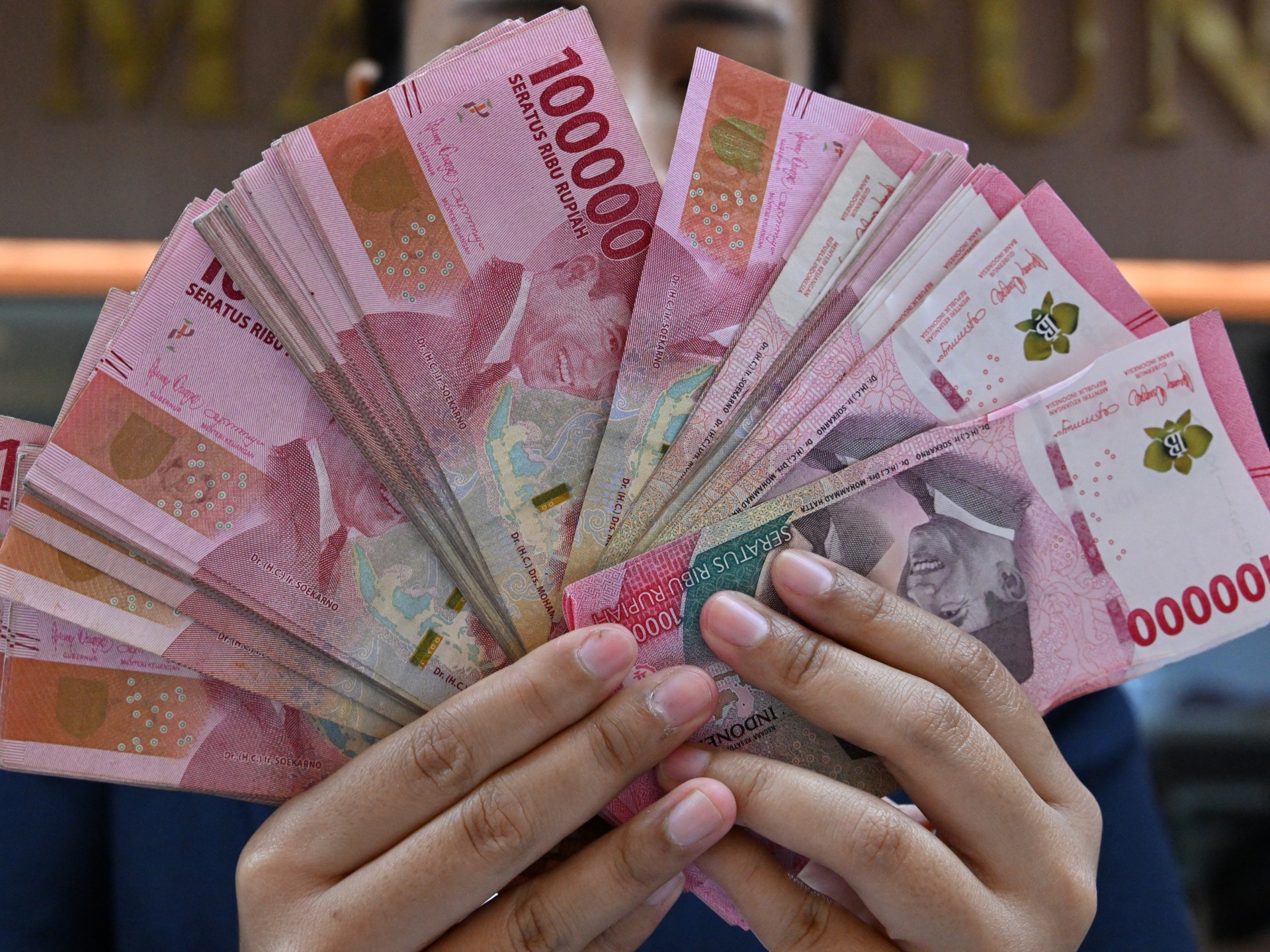
Indonesia’s rupiah is trading at record lows against the US dollar, stirring memories of the 1997-98 Asian financial crisis.
While the rupiah has been battered by the market uncertainty stemming from US President Donald Trump’s sweeping tariffs, the currency’s slide began weeks before Wednesday’s “Liberation Day” announcement.
Since the inauguration of Indonesian President Prabowo Subianto in October, the rupiah has slid about 8 percent against the dollar amid concerns about the former general’s stewardship of Southeast Asia’s biggest economy and most populous nation.
The rupiah’s plunge mirrors the collapse of the currency in 1998, which led to a financial crisis that helped bring about the end of three decades of authoritarian rule by President Soeharto.
“What’s happening in Indonesia now reflects how confident global investors and markets are in the economic decisions of the current leadership,” Achmad Sukarsono, an analyst who covers Indonesia at the Control Risks consultancy firm in Singapore, told Al Jazeera.
When did the slump begin?
The rupiah has been falling steadily since shortly before Prabowo took office, hitting an all-time low of 16,850 on Tuesday.
While the rupiah has seen its share of highs and lows over the past 28 years – including throughout the COVID-19 pandemic – its fall below the 1998 threshold is psychologically important for Indonesians because of the currency’s role in Soeharto’s ouster, according to Hal Hill, a professor emeritus of Southeast Asian economies at the Australian National University (ANU).
“There’s still that memory that if the Indonesia rupiah declines quite a bit, people start to get edgy, and they think it’s a repeat of the earlier crisis,” Hill told Al Jazeera.
What is driving the plunge?
Currencies depreciate for several reasons, including political uncertainty, inflation, trade imbalances with other countries, and speculation by investors.
In the case of Indonesia, Prabowo’s policies – including a $30bn free school lunch programme, plans to weaken the independence of the central bank, and restrictions on foreign companies such as Apple – have shaken investors’ faith in the economy.
“It’s all about heightened uncertainties” and a “significant drop in market confidence”, Arianto Patunru, an economist and fellow at the ANU Indonesia Project, told Al Jazeera.
Prabowo’s establishment of the Danantara sovereign wealth fund using $20bn in government funds, and his push to allow members of the military to hold more civilian posts – a move that critics have said hearkens back to Soeharto’s dictatorial rule – have also stoked concern.
Last month, Finance Minister Sri Mulyani Indrawati, who was widely credited for her role in steering Indonesia through the 2007-09 global financial crisis, was forced to dispel rumours that she planned to resign amid the turmoil in the financial and currency markets.
On top of its domestic challenges, Indonesia, like many developing economies, is at the same time grappling with the double whammy of China’s economic slowdown and the fallout of Trump’s escalating trade war.
In his “Liberation Day” announcement on Wednesday, Trump unveiled a 32 percent tariff on Indonesian imports.
How is Indonesia’s economy faring overall?
Indonesia, a middle-income country with a per capita gross domestic product (GDP) of $4,960 in 2024, has seen its economy grow at a solid pace in recent years.
GDP rose by more than 5 percent last year, after similar expansions in 2023 and 2023.
But those headline figures do not capture a marked deterioration in living standards for large numbers of Indonesians.
The number of Indonesians classified as middle class by Jakarta’s Central Bureau of Statistics – defined as those with monthly outgoings of between 2 million rupiahs ($118) and 9.9 million rupiahs ($585) – fell from 57.3 million in 2019 to 47.8 million last year, a decline attributed to factors including higher inflation and the lingering effect of COVID-19.
In March, former finance Minister Muhammad Chatib Basri described the country’s middle class as an “economically distressed population” with a weakening purchasing power and limited savings.
“Indonesia is in its most challenging and difficult period since the 1997-98 Asian financial crisis and there are both domestic and international reasons for that,” ANU’s Hill said.
“The domestic reason is a new president. The business community is still trying to work out where he wants to go and manage the fiscal situation, and that’s combined with the external environment.”
Control Risks’ Sukarsono said the country’s economic challenges raised questions about Prabowo’s priorities.
“When the government should focus more on factors that have caused the current shrinking of the middle class, it is bafflingly more preoccupied with programmes that do not address the decline in purchasing power and the waves of layoffs amid the deteriorating condition of the labour-intensive segment of the manufacturing sector,” Sukarsono said.
