


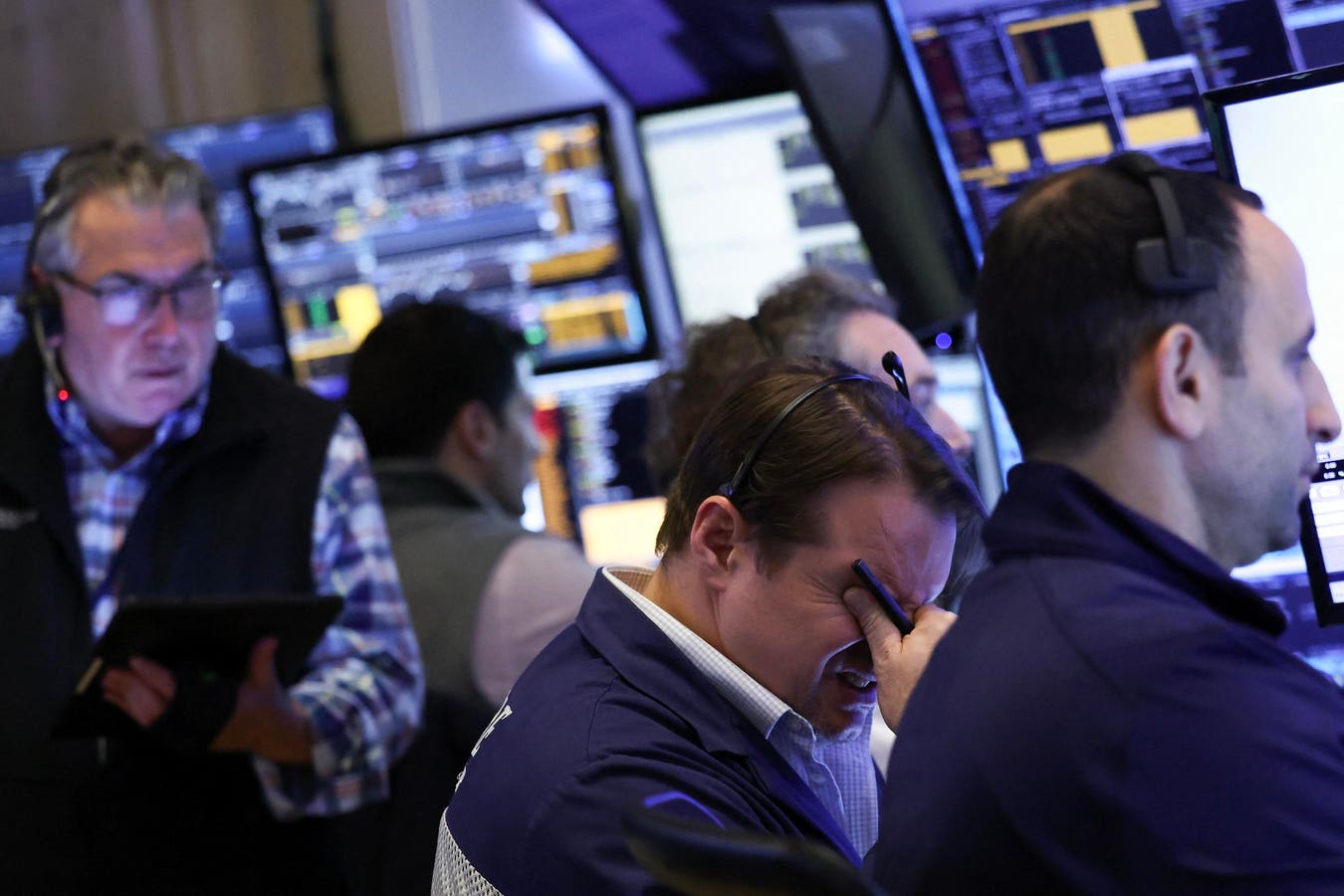

TOPSHOT – Traders work on the floor of the New York Stock Exchange (NYSE) at the opening bell in New York City, on April 3, 2025. Wall Street stocks sank in early trading on April 3,2025, joining a global equity selloff after President Donald Trump’s latest tariff announcement exacerbated worries about a trade war and global economic downturn. (Photo by CHARLY TRIBALLEAU / AFP) (Photo by CHARLY TRIBALLEAU/AFP via Getty Images)
AFP via Getty Images
2025 looks to be a relatively strong year with the S&P 500 with the index currently up 17% year-to-date with less than four full weeks remaining. This is fairly standard for a good year for the index. Historically, returns of even 30% in a good year are not uncommon.
However, what’s relatively unusual is that the largest stocks make up such as large proportion of the S&P 500 index. Most of those stocks are tech firms. In addition, the index appears somewhat richly valued as we approach 2026.
A Top-Heavy S&P 500
The intent of the S&P 500 index is to track the a broad cross-section of largest U.S. listed companies. However, in recent years, arguably that’s entirely what’s happening. The index is increasingly skewed towards a handful of its largest members, mostly in tech. The 10 largest stocks in the S&P 500 currently make up approximately 40% of the index. For comparison between 2000 and 2010 the 10 largest companies typically represented between 10% and 15% of the S&P 500. This means that even though there are 500 companies in the index, the returns of the S&P 500 can be driven by just a few stocks to a greater extent than in much of recent history.
The Dominance of Tech
Relatedly, tech is dominant. Tech currently makes up roughly a third of the index, that’s a similar weight to the height of the tech bubble. However, that may be an understatement the sector definition of the tech sector excludes some companies that might also be considered tech, such as Tesla which is considered automotive, or Amazon, which is considered retail. The high weighting to tech is not necessarily a bad sign for the S&P 500, but it does suggest a relatively lack of diversity. That can mean higher potential volatility.
As a result, the fate of the S&P 500 in 2026 appears likely to be heavily influenced by the likes of Nvidia, Google and Microsoft and tech more generally. If tech doesn’t have a good year in 2026, then the S&P 500 may struggle, too.
Rich Valuations
Based on historical valuations, the U.S. stock market is expensive. Warren Buffett likes to look at the valuation of the S&P 500 compared to the size of the U.S. economy (Gross Domestic Product). Currently the index is valued at approximately twice the size of the U.S. economy according to World Bank data. That’s the highest level going back to 1980. Valuations relative to earnings also appear rich. The index is higher than most other periods in recent history, with the exception being the peak of the tech bubble in 2000.
Now, this does not necessarily mean a crash is coming. Historically stock market declines are often driven by negative events rather than simply high valuations. Still, it does create a headwind for stocks to continue to strongly outperform for the medium term. That’s because expanding valuations are often a significant component of stock market returns. From here, stocks could still rise beyond levels we’ve seen historically, but maybe that’s less probable. If valuations were to revert to more average levels, that could be a drag on performance.
Of course, the alternate argument is that maybe tech stocks will continue to grow and create enormous profits for investors since these are exceptional business with strong returns on capital. In addition, U.S. companies today are delivering global leadership in areas such as AI, to perhaps a greater extent than in recent history. Should these trends continue, then the S&P 500 is well-positioned to benefit. Plus valuation metrics are at best a medium-term driver of stock returns, they seldom predict what the market will do in any given year.
What To Expect
Despite many predictions, determining what the S&P 500 will do in 2026 is almost impossible to predict and will include many factors such as the fate of the economy, the Fed’s decision making, government policy and earnings growth trends. However, it appears reasonable to suggest that the fate of the markets will be bound to the fate of tech stocks more so than in many prior years. Today, the U.S. market may also be considered fairly expensive compared to history, which could mean medium-term returns are a little lower than average if history is any guide.
