


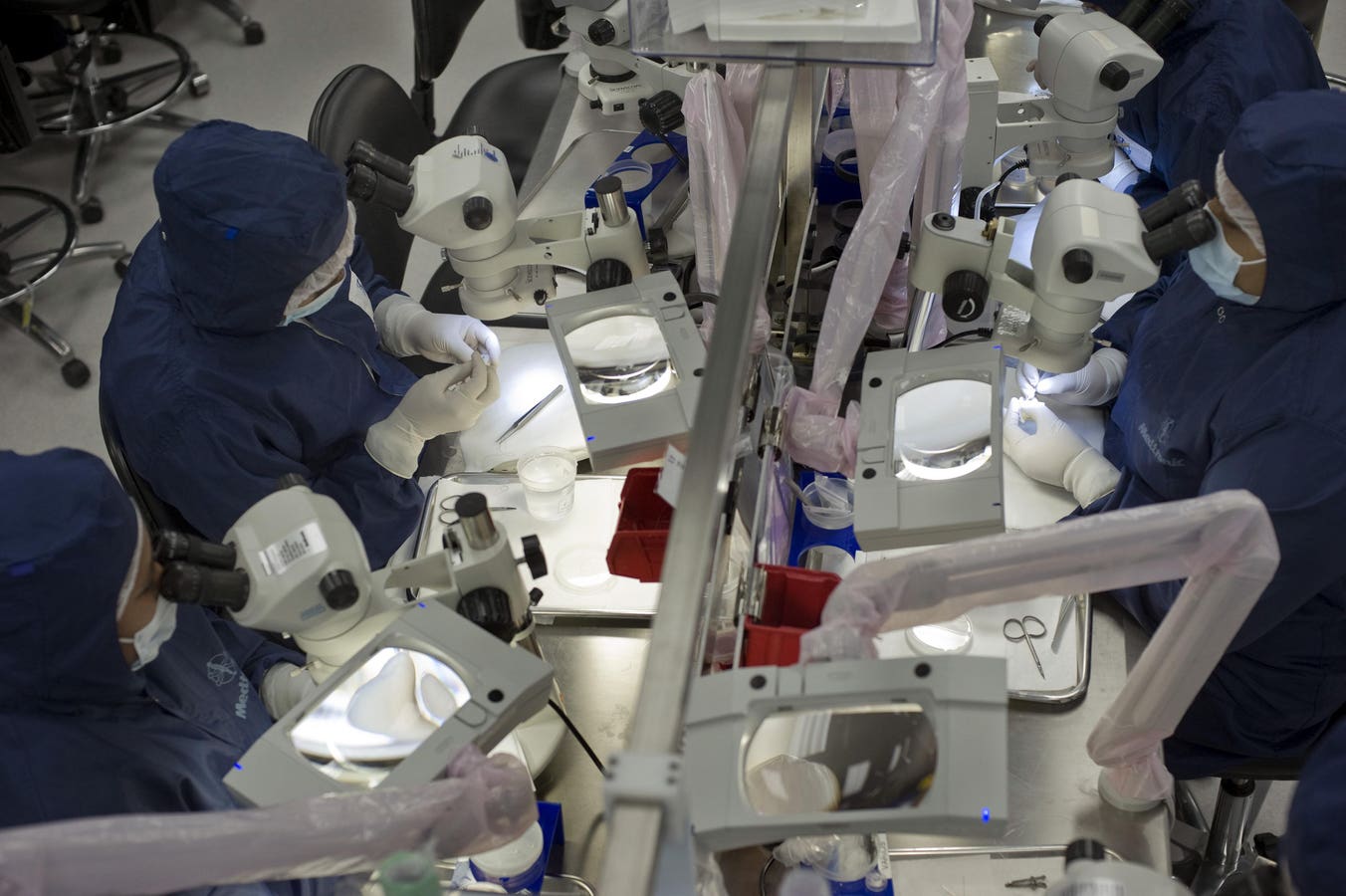
At a Medtronic assembly plant in Tijuana, Mexico, in 2014, employees work on a stent graft production line.
Bloomberg Finance
Pacemakers. Insulin pumps. Hearing aids. These are just some of the basic medical devices that hospitals and patients rely on—and that could see higher prices due to President Trump’s tariffs.
Despite months of aggressive lobbying, medical device makers did not get the carveout that pharmaceutical companies did. And with perhaps 40% of all devices manufactured overseas, they’re likely headed for a heavy hit that will ripple out through device manufacturers, hospitals, insurers and the millions of people whose health relies on them. Mexico, where the tariff rate has been set at 25%, is a major hub for manufacturing, while other devices are made in Europe, where the rate is now 20%.
Erik Wexler, CEO of Providence, a non-profit Catholic health system based near Seattle that includes 51 hospitals, told Forbes by email that early estimates show tariffs could increase costs by $10 million to $25 million a year. That’s a significant number for the health system, whose network also includes more than 1,000 clinics, which reported a $644 million operating loss in 2024.
“The healthcare supply chain is fragile,” said Wexler, who took over the health system’s top job in January. He pointed to the difficulties getting masks and ventilators during the pandemic and the shortages of critical IV fluids after the destruction of medical products maker Baxter’s facilities during last year’s hurricanes. But while Wexler welcomed efforts to diversify the healthcare supply and increase domestic manufacturing, he pointed to compounding problems for healthcare from the Trump Administration’s policies. “Potential cuts to Medicaid on top of tariffs will cripple health systems across the country, which could create a national emergency in terms of access to health care, especially for those who are most vulnerable.”
Because supply chains are complex and intertwined, even devices assembled in the U.S. may rely on foreign parts. Electronic devices, for example, may include chips imported from Asia. “The components could also be subject to tariffs,” said Douglas Kent, an executive vice president of the Association for Supply Chain Management. “You have to break it down to the bill of materials level, not just the final product.”
“The healthcare supply chain is fragile.”
Lobbying groups like the American Hospital Association and AdvaMed, a medical device group, had pushed heavily for an exemption for medical devices in the months leading up to the tariffs’ enactment on Wednesday. And they continued to call for help afterwards. In a statement on Thursday, Akin Deehan, the American Hospital Association’s VP for quality and patient safety, said that it was “critical” to have exemptions for medical products in shortage and for which foreign production is a big part of the supply. Items that are currently on shortage include intra-aortic balloons and oxygenator devices, according to the FDA’s device shortage list.
“Tariffs aren’t just price hikes—they’re a pressure test for the healthcare supply chain,” Ash Shehata, leader of KPMG’s U.S. healthcare sector, told trade publication Chief Healthcare Executive,
But price increases are inevitable, across every industry. A recent Association for Supply Chain Management survey of 400 supply-chain professionals found that 65% planned to pass on increased costs to their customers., The association’s Kent told Forbes that he expected medical devices would follow the broader pattern. In the case of medical devices, that could mean higher costs for stressed hospitals or increased prices for strapped consumers.
“There’s already a strain on the sector to try to reduce the cost of healthcare, and now you have this added stress on top of that,” he said.
MORE FROM FORBES
