


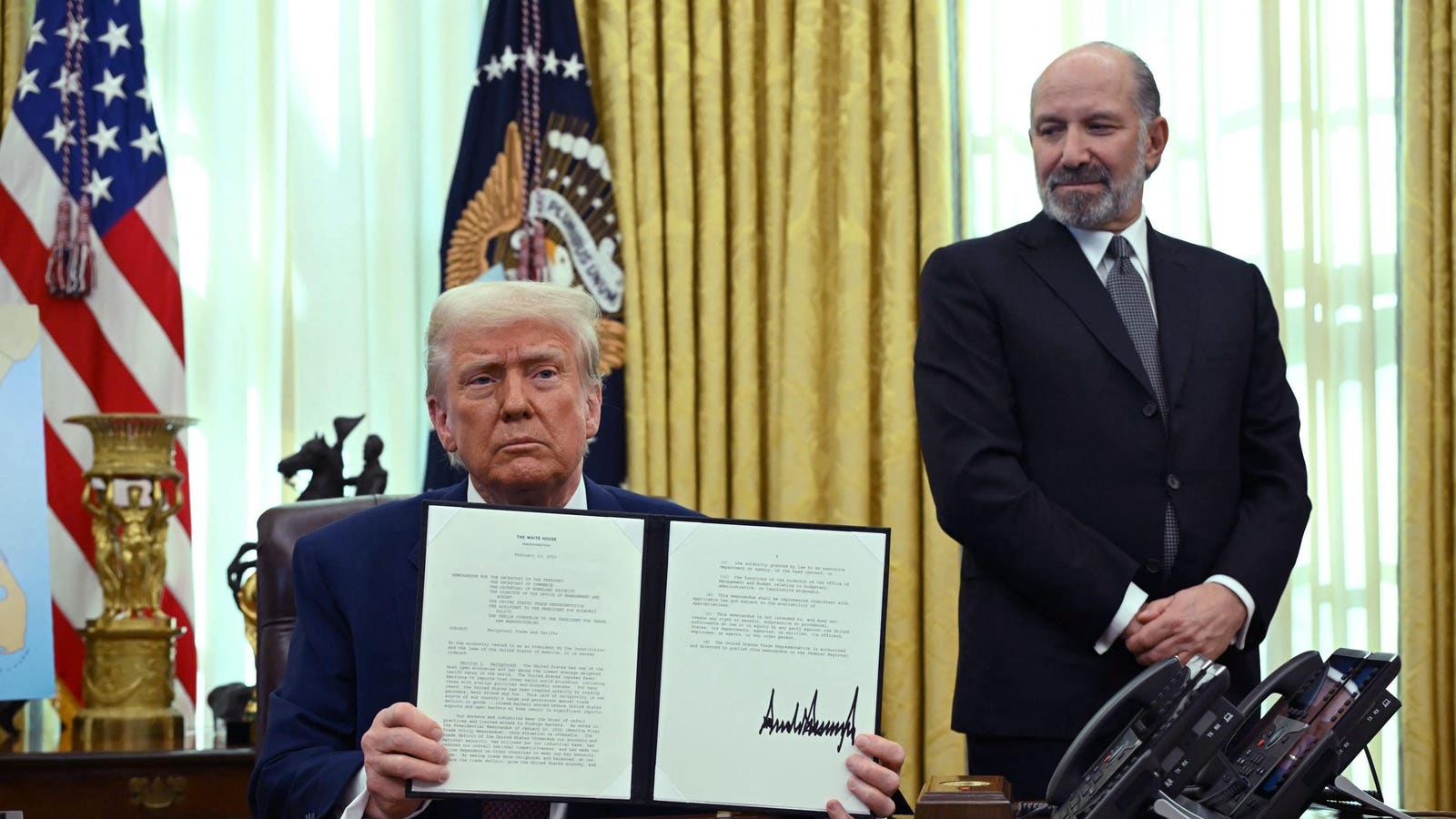
Donald Trump displays his signature on an executive order on reciprocal tariffs in the Oval Office … More
Donald Trump wants to increase trade with Russia while imposing tariffs to reduce trade with other nations. Economists say Canada, Mexico and Europe offer many more business opportunities than Russia. They question whether Trump’s policy of imposing tariffs to reduce trade deficits with other countries is a sensible goal. Ironically, for years, the United States has run a large trade deficit with Russia, the country Trump wants to embrace the most.
More Tariffs And Less Trade
On March 27, 2025, the Trump administration imposed a 25% tariff on auto imports that could raise the average price of a new car by $3,000 to $12,500. While these are the latest tariffs, more are expected.
“Mr. Trump wants every car sold in America to be made in America, all 16 million a year,” according to the Wall Street Journal editorial. “Even if this goal were economically rational, it would take many years and hundreds of billions of dollars in new investment.” The Journal notes that auto companies have invested billions in supply chains, including a well-integrated system involving the private sector in the U.S., Canada and Mexico. “They will now have to spend hundreds of billions more that could be invested in more productive ways. And all because Mr. Trump has an economic development model based on the fantasy of ‘import substitution.’ That model kept India poor for decades.”
Even before the action against auto imports, the Trump administration imposed tariffs on approximately $800 billion of goods, with more tariffs scheduled to begin on April 2. “Tariffs laid down by the Trump administration are meant to boost some domestic industries and extract concessions from other countries,” reported the Washington Post. “But economists say that the new taxes may drive up consumer prices and threaten key American industries. Retaliatory tariffs from targeted countries like Canada and China could impact millions of jobs in the U.S.”
Trump’s tariffs and trade rhetoric have generated a wave of anti-American sentiment across Canada and Europe. Before professional sporting events, Canadians have booed during the U.S. national anthem, an unprecedented action.
While news reports have covered the fallout from the tariffs, less attention has focused on the economic premise of Trump’s trade policy: Trump has argued that the existence of trade deficits with individual countries requires tariffs.
Jeremy Siegel, a professor emeritus of finance at UPENN’s Wharton School and chief economist at Wisdomtree, explains that the $918.4 billion trade deficit in 2024 equals a $918.4 billion capital surplus. “In other words, foreigners are buying $918.4 billion more in U.S. assets—such as stocks, bonds and real estate—than U.S. citizens are buying in foreign assets.” That boosted U.S. stock values. “Imposing excessive tariffs to curb the trade deficit stanches foreign demand for U.S. assets, leading to lower stock prices and higher interest rates for U.S. firms and consumers,” wrote Siegel in the Wall Street Journal.
“It cannot be said too often that in a world of three or more countries, there is absolutely no reason to expect any pair of countries to have ‘balanced’ trade with each other even if no country ran a trade deficit or trade surplus,” according to George Mason University economics professor Don Boudreaux. “Yet the President of the United States now wants to conduct trade policy in pursuit of the U.S. having balanced trade with every individual country. Forget that a host of practical realities . . . would prevent the achievement of Trump’s ridiculous goal.”
Countries have retaliated against U.S. tariffs, and foreign leaders have vowed to escalate further. During Trump’s first term, to compensate for economic harm caused by the trade war with China, the Trump administration paid American farmers up to $30 billion in taxpayer funds—more than the U.S. government spends annually on nuclear delivery systems and weapons.
Donald Trump and Vladimir Putin arrive to waiting media during a joint press conference after their … More
Trump Welcomes Russian Trade With Open Arms
Following a phone call between Donald Trump and Russian leader Vladimir Putin on March 18, 2025, the White House stated, “The two leaders agreed that a future with an improved bilateral relationship between the United States and Russia has huge upside. This includes enormous economic deals and geopolitical stability when peace has been achieved.” Trump has spoken of deals and increased trade with Russia several times and is considering sanctions relief despite Russia’s ongoing invasion of Ukraine and what a UN report called crimes against humanity that include disappearances of and attacks on civilians and the abduction of approximately 20,000 Ukrainian children.
Two ironies emerge from examining U.S.-Russia trade data. First, U.S.-Russia trade flows in goods are small, only about $3.5 billion in 2024 and $36 billion in 2021. In comparison, total trade in goods between Canada and the United States reached $762 billion in 2024.
Second, the United States runs a significant trade deficit with Russia, something Donald Trump has opposed in dealing with other countries. In 2021, before America imposed sanctions after Russia invaded Ukraine, the United States exported $6.4 billion worth of goods to Russia and imported $29.6 billion for a trade deficit of $23 billion. The statistics are similar in other years. The United States has exported chiefly chemicals, machinery and transportation equipment to Russia and imported mainly oils, chemicals and metals.
Experts say Russia’s business climate is unhospitable and even life-threatening for foreign businesspeople. American Michael Calvey invested in Russia for 25 years until a commercial dispute landed him in prison for two months, followed by two years of monitoring with an electronic device. “When he developed a cancerous tumor in one leg, the court refused to allow him to remove the device, so doctors operated without benefit of an M.R.I.,” reported the New York Times. He was convicted and given a suspended sentence. Calvey said he would no longer consider investing in Russia.
Alexandra Prokopenko, a Carnegie Russia Eurasia Center fellow, believes “Russia remains distinctly uninvestable.” She cites Russia’s frozen foreign currency reserves, which put “any new investments at risk of seizure or expropriation.” She also notes, “Russia has enacted a series of laws that effectively repress foreign businesses,” and the government has continued to expropriate the assets of domestic and foreign owners forcibly.
In The Sunday Times, Mark Galeotti, author of Forged in War: A Military History Of Russia From Its Beginnings To Today, details how Putin has played on Donald Trump’s “obsession with being seen as a master dealmaker.” Putin has encouraged Trump to seize Greenland, use American investors to take over the damaged Nord Stream 2 gas pipeline and partner with Russia on energy projects despite sanctions and the invasion of Ukraine. He quotes a veteran British diplomat who says Putin is “helping Trump be the worst version of himself he can.”
Bryan Riley, director of the National Taxpayers Union’s Free Trade Initiative, said, “If the United States is going to ignore the trade balance with Russia, surely it can do the same with Canada, the European Union and other countries that are simply guilty of supplying Americans with goods we need and want.”
