


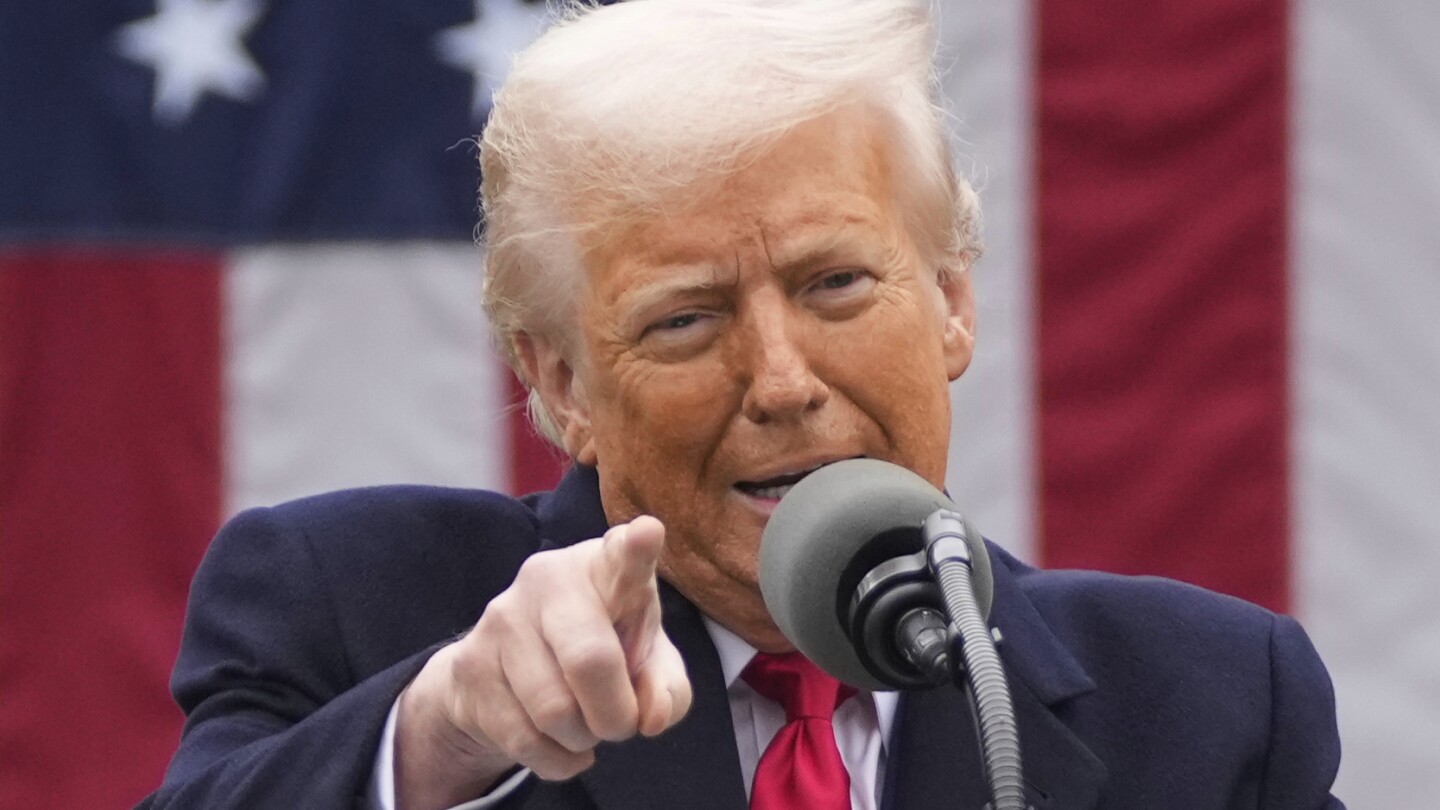
WASHINGTON (AP) — By declaring a trade war on the rest of the world, President Donald Trump has panicked global financial markets, raised the risk of a recession and broken the political and economic alliances that made much of the world stable for business after World War II.
Trump’s latest round of tariffs went into full effect at midnight Wednesday, with higher import tax rates on dozens of countries and territories taking hold.
Economists are puzzled to see Trump trying to overhaul the existing economic order and doing it so soon after inheriting the strongest economy in the world. Many of the trading partners he accuses of ripping off U.S. businesses and workers were already floundering.
“There is a deep irony in Trump claiming unfair treatment of the American economy at a time when it was growing robustly while every other major economy had stalled or was losing growth momentum,” said Eswar Prasad, professor of trade policy at Cornell University. “In an even greater irony, the Trump tariffs are likely to end America’s remarkable run of success and crash the economy, job growth and financial markets.’’
Trump and his trade advisers insist that the rules governing global commerce put the United States at a distinct disadvantage. But mainstream economists — whose views Trump and his advisers disdain — say the president has a warped idea of world trade, especially a preoccupation with trade deficits, which they say do nothing to impede growth.
The administration accuses other countries of erecting unfair trade barriers to keep out American exports and using underhanded tactics to promote their own. In Trump’s telling, his tariffs are a long-overdue reckoning: The U.S. is the victim of an economic mugging by Europe, China, Mexico, Japan and even Canada.
It’s true that some countries charge higher taxes on imports than the United States does. Some manipulate their currencies lower to ensure that their goods are price-competitive in international markets. Some governments lavish their industries with subsidies to give them an edge.
However, the United States is still the second-largest exporter in the world, after China. The U.S. exported $3.1 trillion of goods and services in 2023, far ahead of third-place Germany at $2 trillion.
The fear that Trump’s remedies are deadlier than the maladies he’s trying to cure has sent investors fleeing American stocks. Since Trump announced sweeping import taxes on April 2, the S&P 500 has cratered 12%.
Despite high trade deficits, the US economy is strong
Trump and his advisers point to America’s lopsided trade numbers — year after year of huge deficits — as proof of foreigners’ perfidy. He’s seeking to restore justice and millions of long-gone U.S. factory jobs by taxing imports at rates not seen in America since the days of the horse and buggy.
“They’ve taken so much of our wealth away from us,” the president declared last week at a White House Rose Garden ceremony to celebrate the tariffs announcement. “We’re not going to let that happen. We truly can be very wealthy. We can be so much wealthier than any country.’’
But the U.S. is already the wealthiest major economy in the world. And the International Monetary Fund in January forecast that the United States would outgrow every other major advanced economy this year.
China and India did grow faster than the United States over the past decade, but their living standards still don’t come close to those in the U.S.
Manufacturing in the U.S. has been fading for decades. There is widespread agreement that many American manufacturers couldn’t compete with an influx of cheap imports after China joined the World Trade Organization in 2001. Factories closed, workers were laid off and heartland communities withered.
Four years later, nearly 3 million manufacturing jobs had been lost, though robots and other forms of automation probably did at least as much to reduce factory jobs as the “China shock.’’
Tariffs are Trump’s all-purpose weapon
To turn around this long decline, Trump has repeatedly unsheathed the tariffs that are his weapon of choice. Since returning to the White House in January, he’s plastered 25% taxes on foreign cars, steel and aluminum. He’s hit Chinese imports with 20% levies, on top of hefty tariffs he imposed on China during his first term.
On Wednesday, he blasted his big bazooka: 10% “baseline’’ tariffs on just about everybody and “reciprocal’’ tariffs on everyone else that the Trump team identified as bad actors, including tiny Lesotho (a 50% import tax) and China (34% before adding earlier levies).
Trump views tariffs as an all-purpose economic fix that will protect American industries, encourage companies to open factories in America, raise money for the U.S. Treasury and give him leverage to bend other countries to his will, even on issues that have nothing to do with trade, such as drug trafficking and immigration.
The president also sees a smoking gun: The United States has bought more from other countries than it has sold them every year for the past half-century. In 2024, the U.S. trade deficit in goods and services came to a whopping $918 billion, the second-highest amount on record.
Trump trade adviser Peter Navarro calls America’s trade deficits “the sum of all cheating’’ by other countries.
However, economists say trade deficits aren’t a sign of national weakness. The U.S. economy has nearly quadrupled in size, adjusted for inflation, during that half-century of trade deficits.
“There is no reason to think that a bigger trade deficit means lower growth,” said former IMF chief economist Maurice Obstfeld, senior fellow at the Peterson Institute of International Economics and an economist at the University of California, Berkeley. “In fact, the opposite is closer to the truth in many countries.”
A trade deficit, Obstfeld said, does not mean a country is losing through trade or being “ripped off.”
Spend a lot, save a little and see trade deficits swell
The faster the U.S. economy grows, in fact, the more imports Americans tend to buy and the wider the trade deficit tends to get. The U.S. trade deficit — the gap between what it sells and what it buys from foreign countries — hit a record $945 billion in 2022 as the American economy roared back from COVID-19 lockdowns. Trade deficits typically fall sharply in recessions.
Nor are trade deficits primarily inflicted on America by other countries’ unfair trading practices. To economists, they’re a homegrown product, the result of Americans’ propensity to save little and consume more than they produce.
American shoppers’ famous appetite for spending more than the country makes means that a chunk of the spending is used for imports. If the United States boosted its saving — for example, by reducing its budget deficits — then that would reduce its trade deficit as well, economists say.
“It’s not like the rest of the world has been ripping us off for decades,” said Jay Bryson, chief economist at Wells Fargo. “It’s because we don’t save enough.”
The flip side of America’s low savings and big trade deficits is a steady inflow of foreign investment as other countries sink their export earnings into the United States. Direct foreign investment into the U.S. came to $349 billion in 2023, the World Bank reported, nearly double No. 2 Singapore’s inflows.
The only scenario in which tariffs reduce the U.S. deficit is if they cause investment in the U.S. to crash, said Barry Eichengreen, an economist at the University of California, Berkeley. That “would be a disaster.’’
Harvard University economist Dani Rodrik said a “well-designed industrial policy” supported by select tariffs “might have fostered increased investment and capacity in manufacturing.”
Instead, Rodrik said, Trump’s actions just “throw up a lot of uncertainty” and alienate America’s best allies, making for “a terrible policy all in all.’’
___
AP Economics Writer Christopher Rugaber contributed to this report.
