


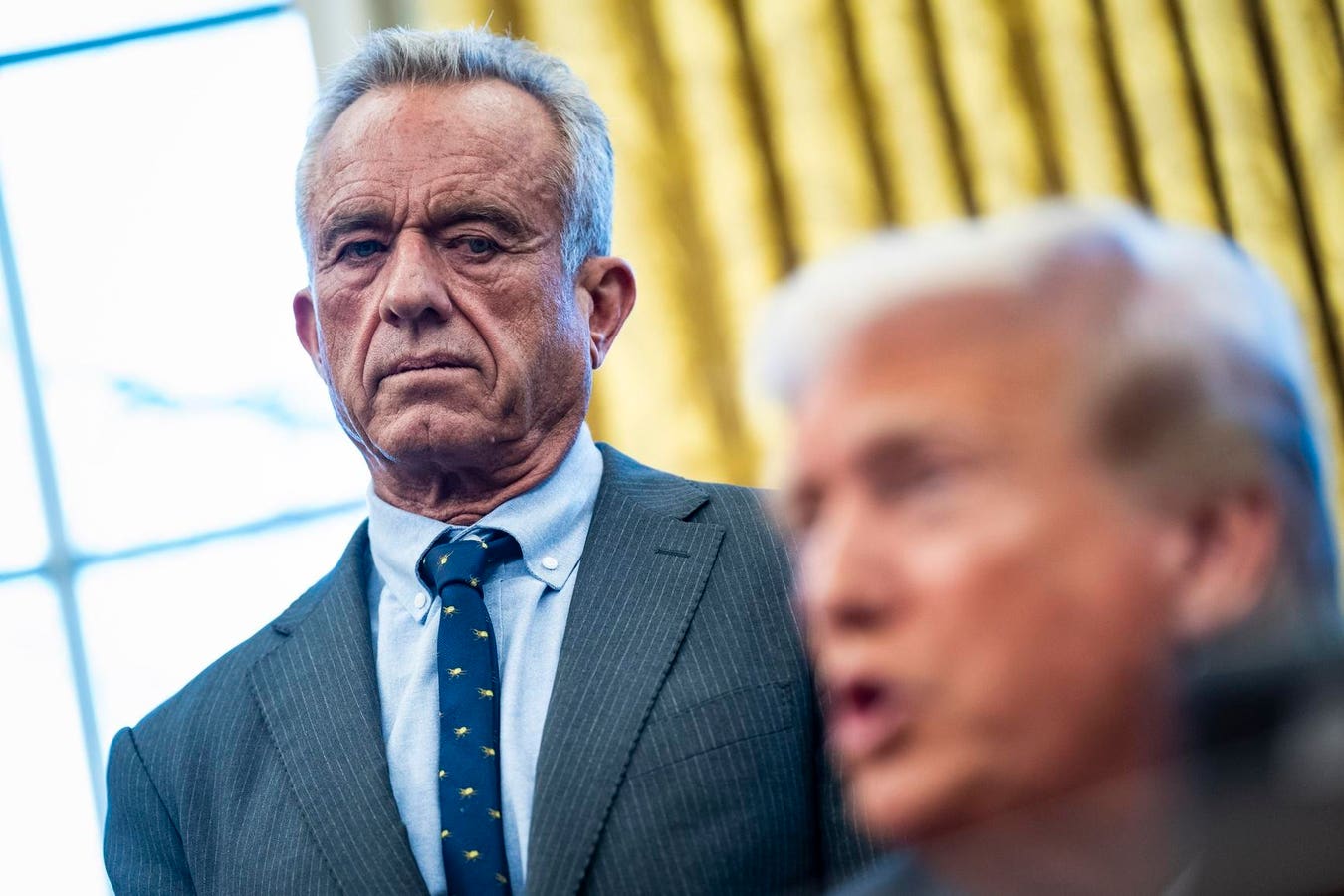
Robert F. Kennedy, Jr. was a top spreader of vaccine misinformation during the pandemic. Now he leads America’s health efforts.
The Washington Post via Getty Images
Less than a year after COVID-19 upended life as we know it and killed the first of what would become more than 7 million people, the FDA and other regulators around the world authorized the first mRNA vaccine. Co-developed by Pfizer and BioNTech, the vaccine was based on new biotechnology that uses the body’s own machinery to produce disease-fighting antibodies. Authorization for a second mRNA vaccine from Moderna followed shortly after. The speed with which they were developed and distributed was unprecedented; The mumps vaccine had taken four years.
The speed was only possible thanks to the more than $330 million in federal NIH grants that had supported three decades of underlying research into mRNA. Much of the heavy lifting of discovery and even testing had been done by the time the Biden and Trump Administrations spent over $30 billion to develop, purchase and distribute the vaccines. Today underlying mRNA technology, which helped save millions of lives, prevent hospitalizations and mitigate instances of long Covid, is now also being used to tackle a wide range of diseases — bird flu, cancer, heart failure.
But despite those COVID successes — and Trump’s ongoing attempts for take credit for them — the president’s administration and base are now attacking mRNA. And they’re doing it in a way that might threaten not only next-generation vaccines for the pandemics to come, but U.S. biotechnology leadership in a market estimated to be worth almost $20 billion.
Misinformation about mRNA vaccines is widespread, false claims that they are deadly, change people’s DNA or somehow enable mind control. And though widely debunked, these conspiracies have inspired concerted efforts around the country to end federal funding for the development of vaccines and other treatments based on mRNA.
“Removing federal funding of mRNA vaccine technology would compromise pandemic preparedness greatly.”
Kentucky lawmakers don’t want mRNA vaccines given to minors. Idaho legislators want to ban their use for the next 10 years; Texas legislators want to ban them entirely. And, under the leadership of one of the biggest spreaders of mRNA vaccine misinformation, Robert F. Kennedy, Jr., the National Institutes of Health (NIH) has begun a review of its investments in related vaccine research as part of a looming gutting of the Department of Health and Human Services that will see over 10,000 jobs cut in addition to 10,000 workers who’ve already taken a voluntary layoff. .
Dr. Amesh Adalja, an infectious disease physician and assistant professor at Johns Hopkins University, told Forbes that efforts to pull funding for mRNA vaccine research would hamstring scientists preparing for outbreaks of new diseases with pandemic risk like avian flu. “Removing federal funding of mRNA vaccine technology would compromise pandemic preparedness greatly,” he said. “There are multiple projects aimed at using this vaccine platform against potential pandemic threats.”
For the American biotech industry, which currently has the lead in a market that could be worth over $70 billion by 2032, that’s bad news. Already, the Department of Health and Human Services is said to be reevaluating a $590 million contract with Moderna to develop vaccines against bird flu and other flu viruses with pandemic potential. The NIH has already terminated one grant studying the immune effects of mRNA vaccines, and researchers fear more cuts will follow.
If threats to mRNA technology from American lawmakers escalate and slow its development, it could lead to a loss of American leadership in pharmaceuticals as a whole, Pitchbook Analyst Kaz Helal told Forbes. Right now, he explained, “if the FDA approves, the world follows.” But should the U.S. slow or abandon entirely the development of new vaccines, that development will almost certainly continue abroad in Europe or China. That, Helal said, “might be a long-term disaster for the U.S.” diminishing its stature and power in biotech.
What makes mRNA therapies so promising is exactly why they were so successful in their first use against COVID 19: They can be created or adjusted and scaled far more quickly than conventional vaccines. mRNA therapies are simply faster and cheaper to produce than antibodies or other proteins. And they don’t remain in the body for very long, reducing the risk of side effects. They work by injecting bits of mRNA, which contain genetic instructions for your body to make a particular protein. In vaccines, they stimulate your immune system to produce antibodies against disease, elegantly turning the human body into a factory for the medicine that heals it.
InnovationRx is your weekly digest of healthcare news. To get it in your inbox every Wednesday, subscribe here.
The federal government recognized the promise of mRNA years ago, and has funded several programs working on next generation vaccines for Covid and related coronaviruses, as well as flu viruses, that could emerge as pandemic threats. The NIH has been funding projects to develop mRNA vaccines and treatments for diseases like HIV, Oropouche fever, and cancer. Trump’s first administration invested in developing better vaccines with an executive order that led to the funding for mRNA vaccines. But his second now threatens to slow or even stop that work.
This will directly impact entrepreneurs building companies off the government’s research. Jacob Glanville, CEO of Centivax, which is developing a universal flu vaccine using mRNA technology, depends in part on funding from the NIH. He told Forbes his company could continue its work without federal support, but much more slowly, forfeiting the rapid progress that was so crucial during COVID.
Other mRNA biotechs may not be so lucky. Helal noted that if NIH decides to stop funding mRNA research, venture emerging from smaller universities without the large endowments or industry connections of places like Stanford and Harvard will inevitably struggle — ultimately leading to fewer new companies, and fewer advances.
The backlash against mRNA vaccines will likely impact other therapies being developed from the same science. A recent study found that an mRNA treatment helped keep pancreatic cancer from returning after surgery. An mRNA therapeutic co-developed by Merck and Moderna significantly improved survival rates among patients with advanced skin cancer. Astrazeneca and Moderna have seen positive results in an mRNA drug they’re co-developing that regenerates damaged tissue in the heart. If a bill pending in the Texas legislature were to pass, all these medicines would be banned within the state.
If the U.S. pulls support for mRNA therapy development, it likely won’t impact drugs that are already undergoing clinical trials, Helal said, because drugmakers will simply sell them in Asia and Europe. Big pharma companies could also shift mRNA development to friendlier places like Denmark or Germany, and just wait four years for the next administration to see if things change.
But four years is a long time — potentially long enough to seriously damage American biotech’s lead. “Europe will be a solution,” Helal said. “But the risk is that it will challenge U.S. dominance in terms of medicine.”
MORE AT FORBES
