


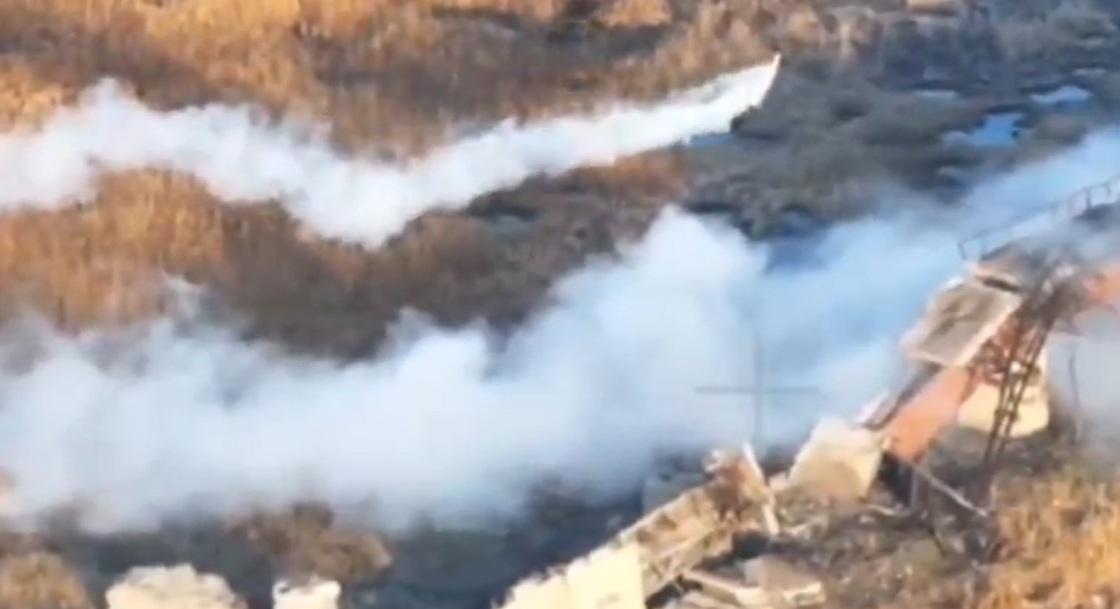
A small FPV drone at the upper right of image lays a dense smokescreen before a Russian attack
A new video shows a Russian FPV drone laying a smoke screen prior to an assault in the Zaporizhzhia area. The novel tactic uses the drone’s speed and maneuverability to put down smoke quickly in a precise pattern, and the results are impressive. Could smokescreen drones become a regular feature of future battlefields?
The Smoke Of War
Smoke has a long history in warfare, but only really emerged into prominence in WW1 and WW2, with a wide array of different devices being deployed, from traditional smoke pots, to smoke generators using vehicle exhausts and smoke rounds fired by artillery and mortars.
“Smoke can assist a unit to succeed in battle or lead to its failure,” states a U.S. Army manual on the use of battlefield obscurants. “Smoke is a great combat multiplier, but it can be a two-edged sword.”
U.S. artillery lays down a smoke screen on Okinawa during WWII
Smoke can be an offensive weapon. In WW2, U.S. tank crews learned to fire smoke rounds first against the heavier German panzers, blinding them for the first few minutes of an encounter. The Germans described this fire as “maddeningly accurate,” and it gave the Americans a chance to outflank their superior opponents or get out their field of fire.
More often smoke is used for screening, placing a thick curtain of smoke between friendly and enemy forces. This allows troops to advance or withdraw without being seen, preventing both direct fire and artillery observers from spotting them.
After WW2, many tanks were fitting with multibarreled smoke dischargers. These are for defensive use, laying down instant smoke in front of a vehicle under attack by anti-tank guided missiles. All U.S. tanks and infantry fighting vehicles now have such smoke grenades which can swathe them in an obscuring cloud before a missile can reach them.
Smoke In Ukraine
While Russian doctrine calls for the use of smoke on a massive scale, it has not been seen much in the conflict in Ukraine. There have been a few notable examples, such as a Russian assault in April 2024 covered by several vehicle-mounted smoke generations dispersing smoke over a wide area, but these have been exceptions. (The Kerch Bridge is protected by a variety of defensive measures, including smoke generators which have been tested on several occasions.)
Some videos show Russian vehicles generating smoke, either from exhaust generators or with smoke grenades, when they are attacked by drones.
Because a vehicle generating smoke makes itself a visible target, the Russian have also experimented with putting smoke generators on small, tracked robots (Uncrewed Ground Vehicles or UGVs). A video from 2024 shows one such UGVs being tested. Another from earlier this year shows a UGV placing a row of smoke generators along a road and activating them to create a smokescreen.
Generally speaking though, smoke has not featured as much as might be expected. This may be for a number of reasons. One is that using smoke requires intelligence. The effectiveness of smoke depends large on where it is placed in relation to the prevailing wind. As the U.S. manual noted, it can be a double-edged sword and can blind friendly troops as much as the enemy.
Another is that obscuration by smoke increases battlefield confusion. Advancing through a smokescreen may prevent the enemy from seeing you, it also prevents you from seeing where you are going. In a force with questionable command and co-ordination this may present too much of a challenge. For the same reason we have seen relatively few night attacks; good visibility keeps things simple.
Thirdly, smoke is generally not effective against thermal imagers which are increasingly common on the battlefield. A 1998 paper questioned whether smoke might have outlived its usefulness, and that was long before the era of numerous FPV attack drones with $250 thermal vision.
This highlights the final point. While it may block observation from the ground, smoke screening is less effective at preventing surveillance from the air. Drones can fly over a smokescreen and look behind it. And while observers on the ground have to see through a considerable thickness of smoke horizontally, looking vertically downwards it presents less of a visual barrier. All of which is likely why smoke does not seem to be as effective against drones as it is against guided missiles.
Everything Is Better With Drones
Putting a smoke generator on an FPV drone adds a new dimension. In the video, the drone travels up and down to reinforce the smoke screen, so it is only applied to the area needed. The drone can move freely compensate for wind direction and start producing smoke exactly when and where needed.
IDF multicopter dispensing tear gas
However, due to the limitations described above, drone smokescreens may not have much impact in Ukraine. They would be far more useful in a conflict where the other side did not also have drones.
What it does show though is how much benefit can be gained from the creative use of drones as delivery platforms. The flame-spewing ‘Dragon Drone’ transformed the thermite grenade from a niche munition only suitable for demolition to a weapon capable of burning down hundreds of meters of tree line. Drone placement turns low-cost consumer Trail Cams into useful battlefield sensors.
Smokescreen drones may not be a game changer. Tear gas drones might be more significant, and Russia has already trialed them in Ukraine. But it seems likely that other devices will also find their way on to drones and we are likely to see many more such experiments, some of which may be more successful.
