


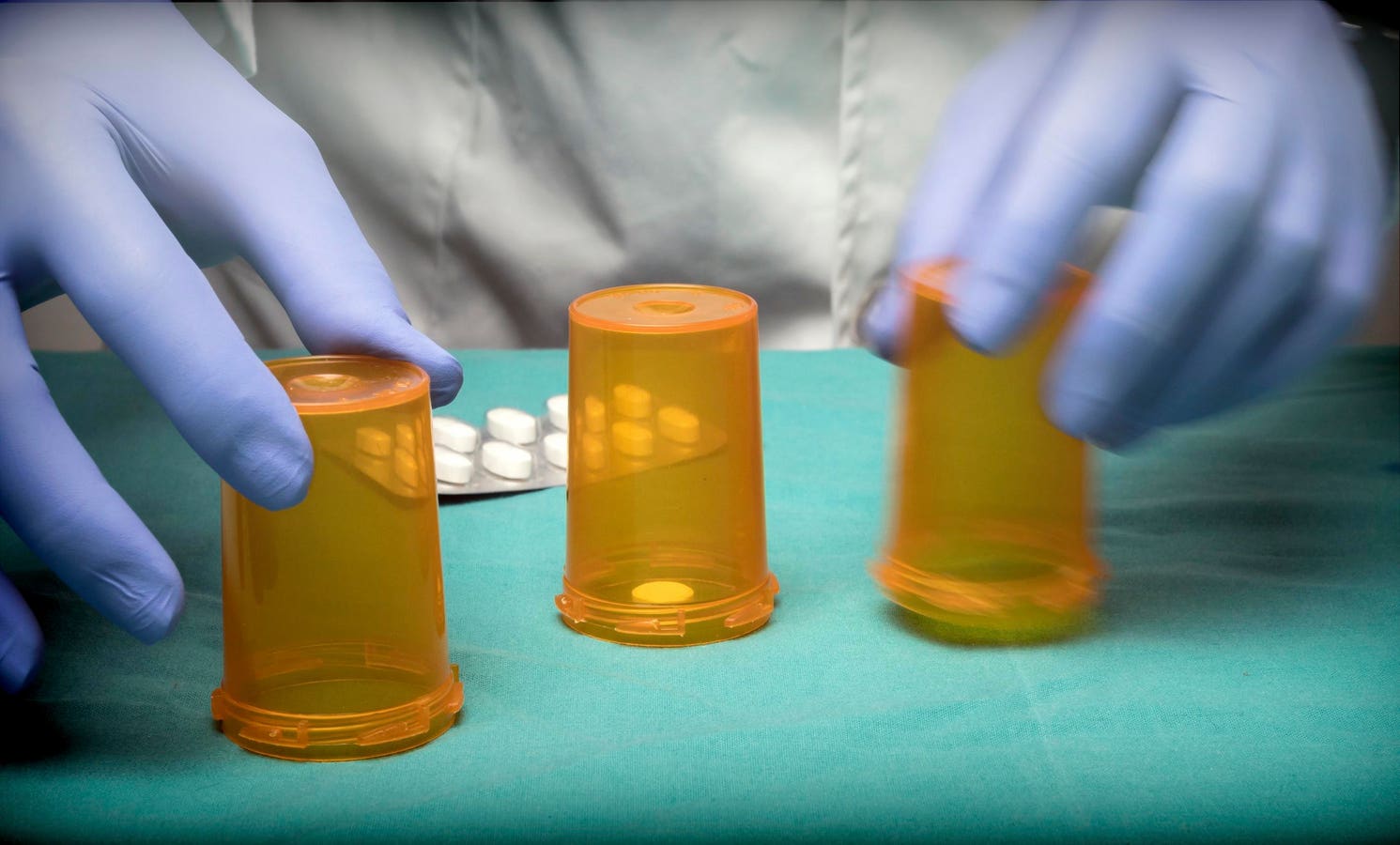
Doctor plays to Thimblerig with boats of medicine, conceptual image
President Donald Trump acted with restraint in his New Liberation Day tariffs when he deferred imposing tariffs on pharmaceutical products from China, India and Europe. But, so long as these tariffs are being considered, their potential threat to the pharmaceutical industry and the people it serves remains.
These are difficult times for drug discovery and manufacturing. John Crowley. CEO of the Biotechnology Innovation Organization, a trade group for companies that create, manufacture and market drugs derived from biological components, which are some of the most sophisticated and advanced drugs, was recently asked about the state of the health industry. “I don’t know if it’s broken, but it’s dangerously close,” he said, adding “these tariffs potentially could be an existential threat to our industry.”
The stated goal of drug tariffs from non-U.S. sources is to encourage domestic manufacturing. Even if the administration imposed tariffs, their cost would be passed on to the consumers. The greater issue would be: Can the price difference between foreign and domestically produced pharmaceuticals be large enough to encourage the aggregate tens of billions of dollars necessary to build and equip the buildings, install equipment, hire and train staff to produce and package the products?
To complicate matters further, imposing tariffs on drugs at any time could have dire consequences. At the end of 2024, 128 drugs were in short supply, including drugs for chemotherapy and to treat central nervous system and microbial infections. Even before Trump announced the tariffs, drug companies were stockpiling critical products. Once three- to six-month stockpiles are depleted, drugs needed to sustain life or even quality of life would become expensive and perhaps unavailable.
What also makes this more complicated is that nearly 70% of the basic and other drug ingredients used by U.S. firms comes from China. Their unavailability would affect production of high cost “biologic” drugs as well as the price of generic drugs.
Of equal importance, close to 40% of generic drugs consumed in the U.S. are imported from India, and if the U.S. imposes tariffs on Indian pharmaceuticals there is also another party to consider. As the U.S. imposes these tariffs there will be significant impact on our insurance system that now requires no- or low-cost copays for many commonly used drugs. The added cost for these life-sustaining drugs must be paid by someone and would likely put an additional financial burden on people now struggling to meet costs for housing, food, utilities and insurance.
Europe would also be affected by tariffs on pharmaceuticals. In 2024, more than one-third of the $560 billion of pharmaceutical products consumed in the U.S. came from Europe, primarily from Ireland, Germany and Switzerland. Imposing these tariffs could stimulate significant reprisals to U.S. businesses operating abroad.
The World Trade Organization’s 1994 Pharma Agreement stipulates that the majority of pharmaceutical products and the substances used to produce them are exempt from tariffs, binding them at duty-free levels. For all products, the WTO’s agreement between trading partners is that “WTO members extend any trade advantage granted to one trading partner to all other partners.” The U.S. is the second largest exporter of medical goods, selling $189.6 billion of medical goods in 2022. The U.S. is also the largest importer of medical goods at $306 billion in 2022. Precipitously imposing tariffs on this market sector could upset the balance of trade in this necessary global market segment.
The initial key to really effect change must be U.S. drug companies themselves. They must play a critical function in addressing this issue. With some of largest U.S. drug companies like Abbott, AbbVie, Baxter, Eli Lilly, and Pfizer still among the top 10 drug companies in the generic market, they will need to expand their operations significantly to serve this market. And of equal importance, they will have to partner with smaller U.S. pharma manufacturers to make up the difference.
In 2022, the global market size of generic drugs was valued at $411.99 billion. It is envisioned to reach $613.34 billion by 2030 with a CAGR of 5.10%. Increasing the U.S. presence in the generic drug market is a worthwhile goal that may require strategic partnerships or joint ventures with drug firms in India, which imports more than 40% of generic drugs consumed in the U.S.
If the U.S. decides to go down this manufacturing path, it will require the technical sophistication and time equivalent to sending astronauts to Mars and returning them safely to Earth. As an example, sciences like process chemistry and organic chemistry are a dying art in the U.S., and there have been a dearth of students going into these disciplines. We have literally lost the art of scale-up in the manufacturing of small molecule drugs. This then begs the last question: Are we prepared for the expenditures, effort and sacrifices necessary in the next decade for the revival of U.S. pharmaceutical manufacturing?
