


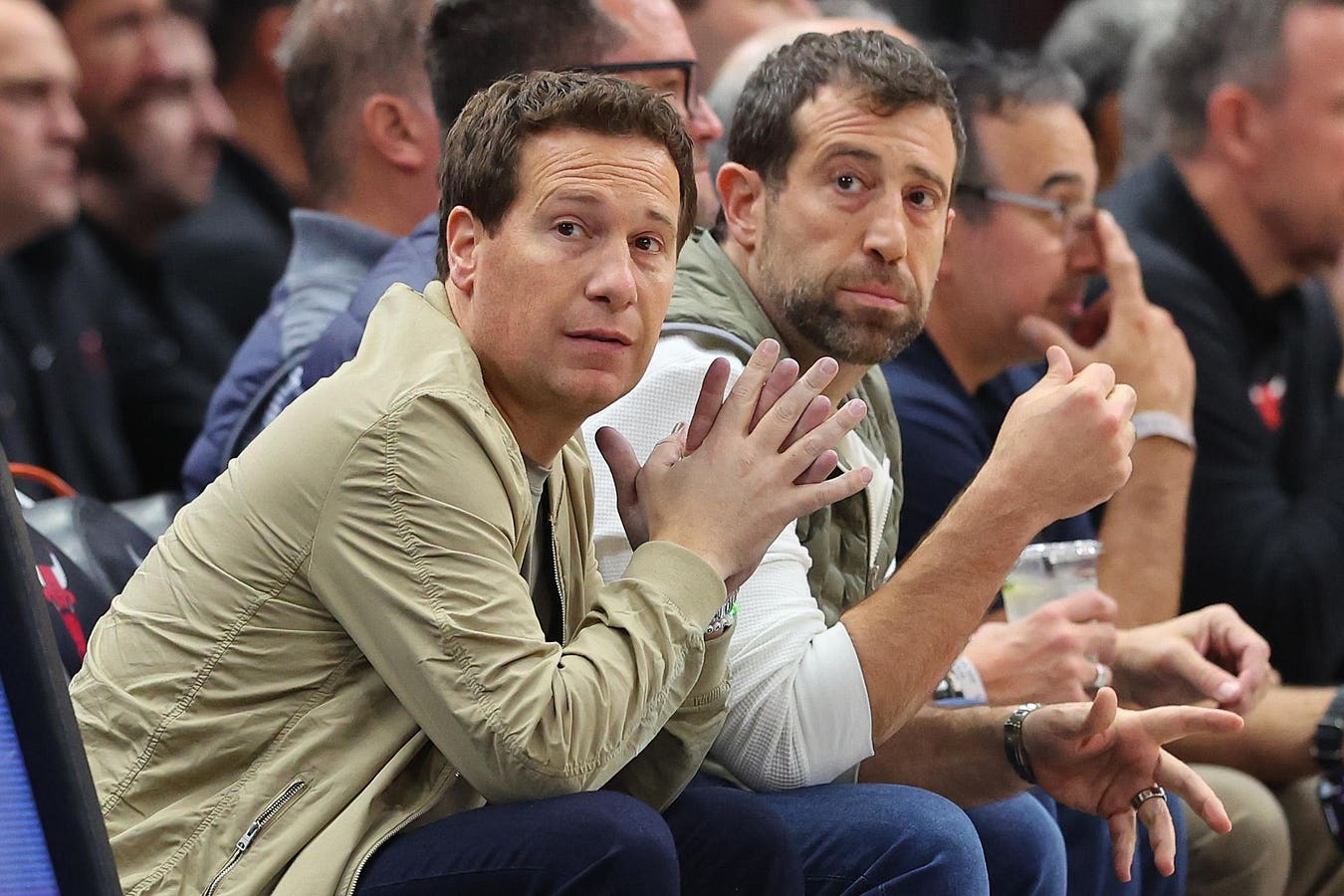
CHICAGO, ILLINOIS – NOVEMBER 08: Owners Mat Ishbia and Justin Ishbia of the Phoenix Suns look on … More
With his 90th birthday looming just over the horizon, Jerry Reinsdorf has almost completely lost the confidence of Chicago White Sox fans. Experience should be a major asset, as only the Steinbrenner family has controlled its franchise longer, but Reinsdorf’s leadership has left his team in dire straits for both the short and long terms.
A savior has appeared in the narrative, with private equity billionaire Justin Ishbia pulling out of a pursuit to buy the Minnesota Twins to increase his minority share in the White Sox. But one plus one doesn’t necessarily equal two with Reinsdorf, who famously signed Albert Belle to a then-record contract shortly after joining Bud Selig in the labor war that left baseball without a World Series in 1994.
Punxsutawney Phil likely has a better record with his forecasts than those who try to anticipate Reinsdorf’s next moves.
That said, the White Sox have never entered a season with such low expectations as they do 2025. Not only did they lose an MLB-record 121 games last season but Reinsdorf himself has questioned if they can ever sustain a competitive team based at Rate Field, their home on the South Side since 1991. His focus remains largely on searching for public funding to build a new stadium on a site in the South Loop, along the Chicago River.
As far as the roster itself, Reinsdorf and a front office overhauled by second-year general manager Chris Getz seem to have the Sox built for a sale in the near future. They have cut the Opening Day payroll from $123.1 million to $74.1 million, which ranks ahead of only the Miami Marlins among MLB’s 30 franchises.
Reinsdorf and his partners invested $181.2 million in payroll only two seasons ago, which ranked 13th, and have been in the top 10 six times in the last two decade. But, the Belle signing aside, Reinsdorf has rarely bought into the value of major free agents. His two most costly commitments have been for middle-rung outfielders Andrew Benintendi (five years, $75 million) and Alex Rios (claimed on waivers from Toronto while owed about $60 million), and at some point you get what you pay for.
When the White Sox host the Los Angeles Angels in Thursday’s season opener, they’ll have a new manager — Will Venable replaces interim manager Grady Sizemore, who took over for Pedro Grifol last August — and a new goal: avoid a third consecutive 100-loss season. They had lost 100 games only four times in 118 seasons before going 61-101 in 2023 and 41-121 last season. That’s a whole new level of losing.
The White Sox finished last in the American League Central by 41 games a year ago, when they had three streaks losing at least 12 consecutive games, (including an AL-record-tying 21-game losing streak from July 10 through Aug. 5. They did this even though starting pitchers Garrett Crochet, Erick Fedde and Chris Flexen pitched well, compiling a combined 10.3 WAR before they were traded.
The Sox open this season minus 19 veteran players who earned a combined $83.1 million last season. That list includes low-floor, high ceiling players Yoan Moncada and Eloy Jimenez, with Luis Robert Jr., the team’s most explosive hitter, still on the roster only because his performance has slipped enough to make the remaining $17 million on his contract a concern. He has had a big spring, hitting .300 with four home runs, so maybe it won’t be long until a team meets Getz’s asking price for him.
Getz acquired talent cautiously in the off-season, guaranteeing $5 million for lefty starter Martin Perez and $3.5 million for infielder Josh Rojas, who was non-tendered by Seattle. But the White Sox have accumulated enough young talent through the draft and trades that Baseball Prospectus’ Pecota rankings project them to go 62-100 season, with Miami (60-102) and Colorado (55-107) expected to lose more games.
The White Sox are starting 25-year-old Sean Burke, a third-round pick in the 2021 draft from the University of Maryland, in Thursday’s opener. Their rotation will include homegrown starters Jonathan Cannon and Davis Martin along with Shane Smith, a 25-year-old selected from Milwaukee in the Rule 5 draft.
There are no new, flashy names in the lineup — although it’s interesting that career .175 hitter Miguel Vargas, acquired from the Dodgers last season, is the likely leadoff hitter after hitting .341 in spring training — with the most intriguing players likely to arrive later in the season. Shortstop Colson Montgomery and catchers Kyle Teel and Edgar Quero are the most potentially impactful position players in the wings. The pitching staff could get a jolt from lefties Noah Schultz and Hagen Smith but Getz plans to be patient with their development.
At least Reinsdorf’s marketing staff knows these are different days. The team is offering a $125 pass for all 27 home games through May, including Opening Day.
It’s the ownership picture itself that is the most interesting. Will Reinsdorf sell his controlling interest in a franchise that Forbes valued at $2.05 billion last March? And if he does, will Ishbia, a part-owner in the NBA’s Phoenix Suns and WNBA’s Mercury, head the group of buyers?
Reinsdorf was confirmed to be in discussions to sell the team to a partnership headed by former Oakland A’s pitcher Dave Stewart early in 2024 but those talks did not gain much public traction, perhaps because of Stewart’s interest in bringing a team to Nashville. Ishbia, who is a founding member in the Chicago-based private equity firm Shore Capital Partners, presents no obvious complications.
Forbes listed Ishbia’s net worth at $5.4 billion last June. He’s been reported to be building a family compound worth $80 million in Winnetka, along Lake Michigan, and offers the type of Chicago roots that comfort White Sox fans.
But Reinsdorf has tried to cool enthusiasm for Ishbia. He downplayed the increased investment that was reported in February. White Sox vice president of communications Scott Reifert said it only provided “liquidity for the limited partners on their long-term investment in the club.”
Reifert said Ishbia’s increased level of ownership “has no impact on the leadership or operations of the Chicago White Sox and does not provide a path to control.” But the Athletic reported that Reinsdorf’s representatives approached Ishbia about increasing his share of the White Sox while he was a frontrunner to purchase the Twins.
Sportico first reported that Ishbia and his brother Mat had bought into the Sox limited partnership four years.
Ishbia isn’t talking but fans are certainly talking about him. This season could be a tipping point, on and off the field.
