


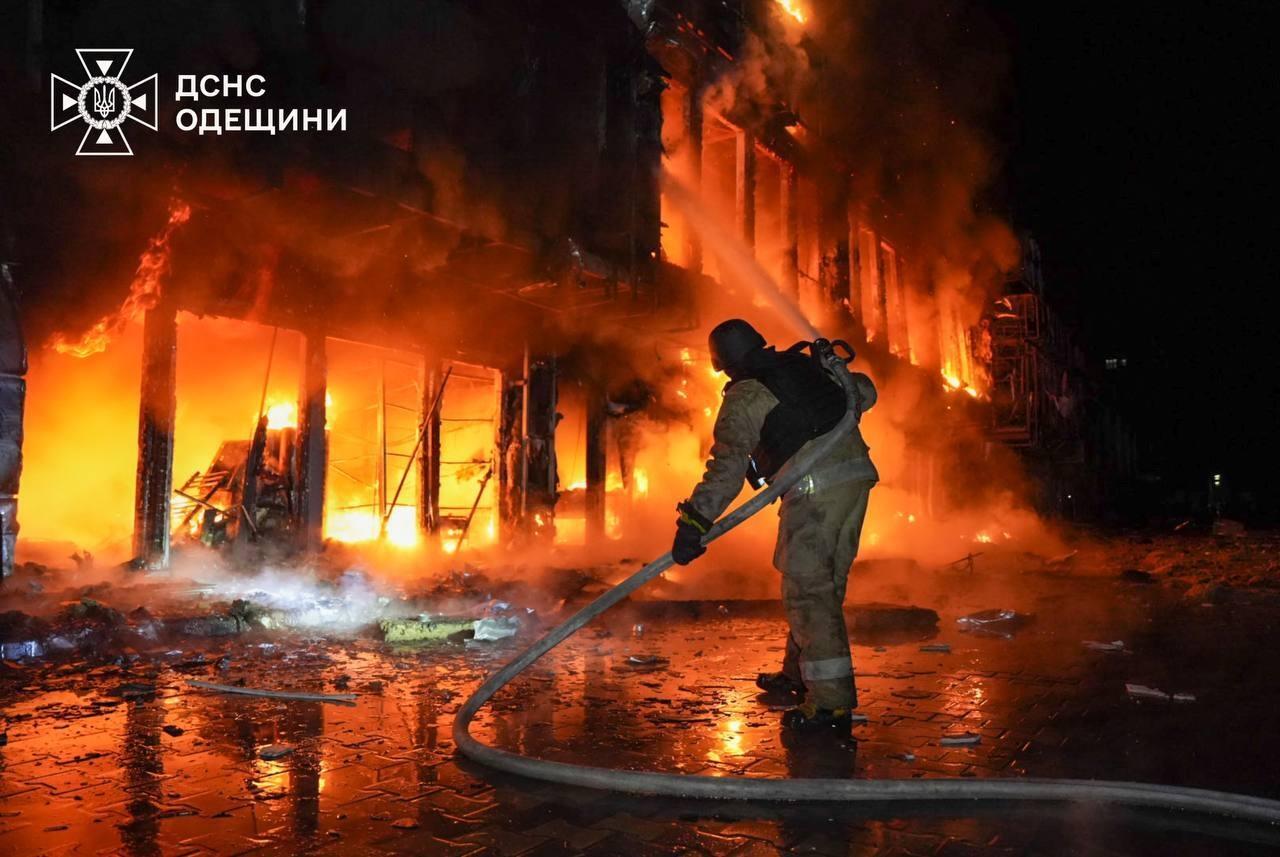
ODESA, UKRAINE – MARCH 21: (——EDITORIAL USE ONLY – MANDATORY CREDIT – ‘STATE EMERGENCY SERVICE OF … More
Dispatches from Ukraine. Day 1,122.
Russia’s Attacks on Ukraine
Odesa. Russia launched a mass drone strike on Odesa during a visit to the city by Czech President Petr Pavel on March 20. It has been one of the biggest drone attacks on Odessa that injured three teenagers and sparked fires.
Donetsk region. Russian forces launched an artillery attack on Kostiantynivka on March 19 in this eastern province, killing one person and wounding two others.
Kharkiv region. A Russian glide bomb strike in the country’s east on March 19 killed a 54-year-old man and wounded a woman.
Sumy region. On March 20, Russian forces launched an airstrike on this northeastern border region, killing two civilians.
Kirovohrad region. Late on March 19, Russian forces unleashed the most intense drone attack yet on Ukraine’s central regional capital. The 20 drones in the assault wounded at least ten people, including four children.
Ukrainian drones attacked the Engels airbase in Russia’s Saratov region on March 20, setting off explosions and detonating munitions. Engels, which is used for launching missile strikes on Ukrainian territory, houses bombers capable of carrying nuclear weapons. The latest assault likely destroyed some of Russia’s cruise missile stockpiles.
Ukraine has brought home 175 soldiers from Russian captivity, with an additional 22 returning through separate non-exchange efforts. Among those freed are severely wounded servicemen persecuted on trumped-up charges by Russia. The released soldiers served in various military branches and fought in the battles for besieged Mariupol. The last prisoner swap took place in February, when Ukraine and Russia each released 150 POWs.
Ukraine has received an additional batch of F-16 fighter jets, President Volodymyr Zelenskyy announced on March 19. Zelenskyy denied Russian claims of having shot down any of the aircraft. “Russians lie that they shot something down – they didn’t shoot down anything,” Zelenskyy said. Although the exact number remains undisclosed, this latest delivery marks another milestone in the Western fighter jet coalition led by the U.S., Denmark and the Netherlands. Ukraine first received Dutch F-16s in October, 2024.
Despite claims from U.S. President Donald Trump and Russia’s President Vladimir Putin, Ukrainian forces in Russia’s Kursk region are not encircled, though they have lost positions, according to U.S. and European intelligence officials. Trump, echoing Putin’s March 13 assertion that Ukrainian troops were “cut off” and would have to “surrender or die,” urged the Russian leader to spare their lives. The Pentagon and Ukraine’s military dismissed these statements as political manipulation, with Kyiv stating such narratives aim to pressure Ukraine and its allies.
During an hour-long call with President Trump on March 19, Zelenskyy agreed to a partial ceasefire with Russia. After Putin agreed during a call with Trump the day before to desist from attacks on Ukraine’s energy grid for one month, Zelenskyy said that Ukraine would not carry out attacks on Russia’s energy system. Each side maintains that the other has launched such attacks since the announcements.
A recent survey reveals that 78% of Ukrainians strongly oppose territorial concessions for peace, with just 8% in favor of compromises. The poll, conducted between February 28 and March 6, shows regional variations, with 14% support for territorial concessions in the south and 6% in the western part of the country. Additionally, 82% reject recognition of Russian annexation of Ukrainian regions, including Crimea, while only 5% would accept recognition of these territories as Russian. The majority also opposes lifting Western sanctions against Russia, and 56% are against including a neutral status for Ukraine in its constitution as a peace condition.
The European Union decided at its March 20 summit against confiscating more than $215 billion in frozen Russian assets, opting instead to use the interest generated from these funds to support Ukraine. According to the EU’s conclusions, the assets will remain untouched until Russia ends its war against Ukraine and provides compensation for the damages inflicted. Some nations objected to confiscation, citing risks to Europe’s financial sector and the value of these funds in future peace negotiations. Despite this decision, the EU reaffirmed its commitment to increasing pressure on Moscow through tighter and additional sanctions.
Culture Front.
A new exhibition, “Bakhmut – The Face of Genocide 1942|2022,” opens in Lviv, in western Ukraine, on March 15, drawing parallels between Nazi Germany’s atrocities in 1942 and Russia’s destruction of eastern Bakhmut in 2022-2023. Organized by the Babyn Yar National Historical and Memorial Reserve, the exhibition presents documentary photography, archival materials, and video installations that chronicle the devastation of the city under two totalitarian regimes. Featuring works by renowned photojournalists and archival footage, the exhibit serves as a record of war crimes committed eight decades apart yet eerily similar in brutality. Mixing contemporary and historical artifacts, the exhibition is divided into two sections: documentation of the city’s obliteration by Russian forces and a historical account of the Nazi-led genocide of its Jewish population.
In the eastern city of Kharkiv, the Faktor-Druk printing house has resumed operations nearly a year after a Russian missile strike in May, 2024, which killed seven people. The $10 million reconstruction was funded by American Howard Buffett’s foundation. Before the attack, Faktor-Druk was one of Ukraine’s largest printing complexes, producing up to 50% of the country’s textbooks. Its temporary shutdown cut national printing capacity by 40%, driving up book prices.
By Danylo Nosov, Alan Sacks
