


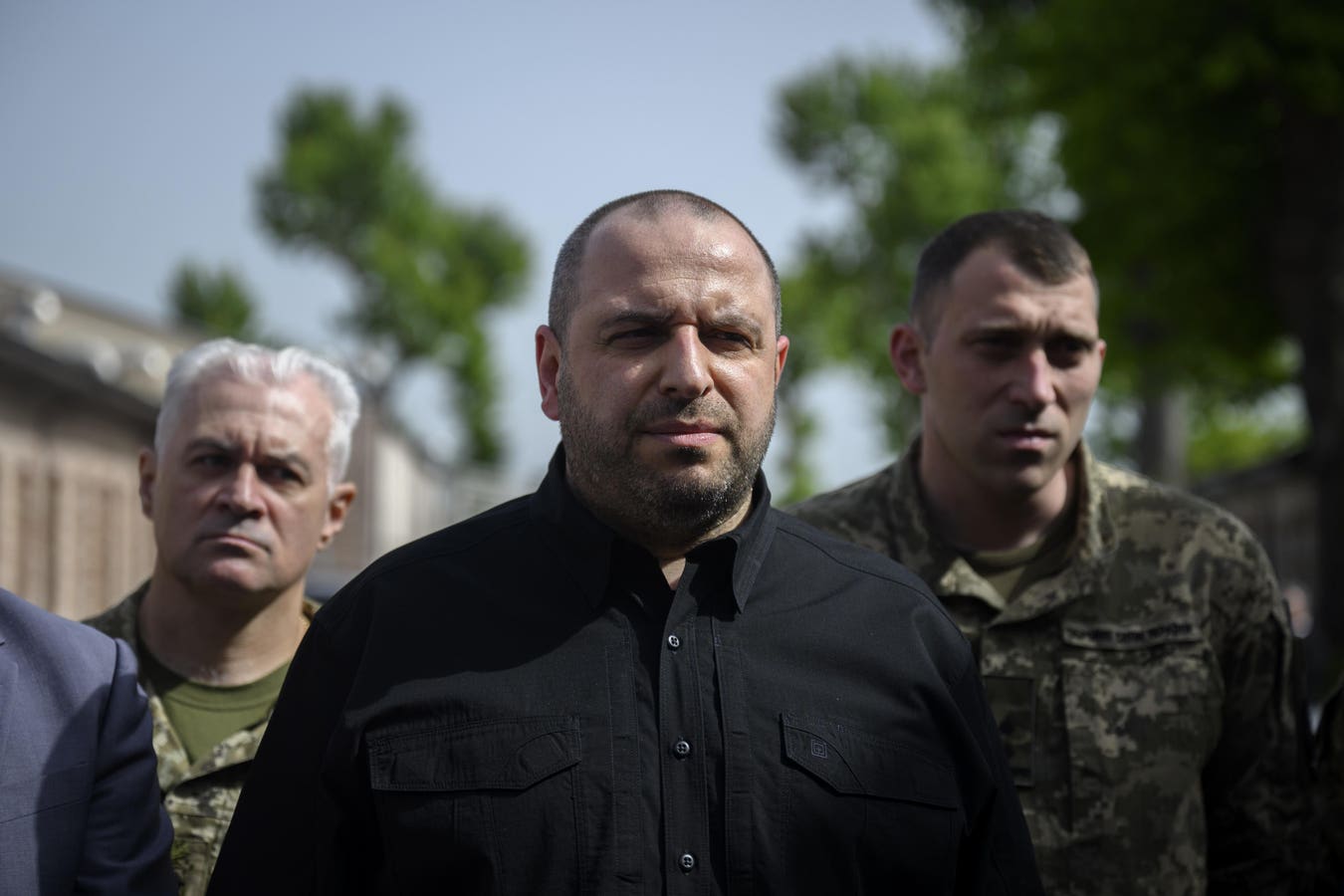
ISTANBUL, TURKIYE – MAY 16: Ukrainian Defense Minister Rustem Umerov speaks to press after the … More
Dispatches from Ukraine. Day 1,179.
Diplomatic Efforts in Turkey.
Ukrainian and Russian delegations concluded their talks in Istanbul on May 16, with no agreement reached on a 30-day ceasefire. Moscow demanded Kyiv withdraw completely from Ukraine’s four regions, currently occupied by Russia. Reportedly, Ukraine offered an immediate ceasefire, an all-for-all prisoner exchange and to hold a face-to-face meeting between President Volodymyr Zelensky and Putin.
Russia’s attacks on Ukraine.
Kherson region. Russian artillery fire killed a 49-year-old woman on May 15 in southern Ukraine.
Sumy region. A Russian strike on an industrial facility in this northern province killed three people and wounded six others on May 14.
Kharkiv region. On May 13, Russian forces launched a series of drone and air strikes across Ukraine’s Kharkiv region, killing two civilians and wounding seven others.
Donetsk region. From May 12 to 14, systematic Russian drone and artillery attacks killed four residents and wounded 16 others in Ukraine’s eastern region.
U.S. officials warn that Russia is amassing troops and equipment for what might become the largest offense in months. The offensive, aimed at capturing new territories, comes as Ukraine faces mounting manpower shortages and increasing reliance on drones to stall Russian advances. While U.S. assessments suggest that Russia is struggling to mobilize ideal force levels, surveillance has revealed extensive troop movements and entrenchments just behind front-line positions, indicating that a preliminary buildup might already be underway.
Despite international pressure, including calls from the Trump administration for a ceasefire, Russia’s strategic objective in the war in Ukraine remains unchanged: to seize more ground, even up to the outskirts of Kyiv.
Economic Updates
The European Bank for Reconstruction and Development (EBRD) has lowered its 2025 real GDP growth forecast for Ukraine from 3.5% to 3.3%, citing war-driven economic headwinds, energy shortages and labor scarcity. Despite the downgrade, the EBRD maintained Ukraine’s 2026 growth forecast at 5%, assuming that a ceasefire and postwar recovery materialize. The organization also cut its 2025 regional growth outlook to 3% amid increasing global trade and policy uncertainty.
Russia’s revenues from oil exports declined to a near two-year low in April, earning $13.2 billion from crude and petroleum sales. The decline stems primarily from a drop in global crude prices and weak demand. The average price for Russian crude, mirroring a trend for global benchmarks, fell to $55.6 per barrel, a level below the G7-imposed price cap.
Despite the decrease in revenues, Russian oil exports remained steady at around 7.5 million barrels per day. Exports of Russian ESPO crude hit a record high of more than 1 million barrels per day; increased discounts have attracted alternative buyers, even as Chinese refiners have scaled back purchases. Russia’s crude output also increased to 9.3 million barrels per day, boosted by a rebound in refining activity after a pause in Ukrainian drone attacks.
Culture Front
Ukraine’s genre-blending band Ziferblat secured its place in the Eurovision 2025 Grand Final, set for May 17 in Basel, Switzerland. Performing its retro-infused disco-funk song Bird of Pray, a reflection on the personal toll of war and separation, the group delivered a visually striking show under the direction of Ukrainian scenographer Maria Korosteliova. Renowned Ukrainian fashion designer Ivan Frolov created the performers’ costumes.
Even so, opinions among Ukrainians divided over the song’s message and the performers’ outfits. Some argued that the performance did not capture the struggle of wartime reality while others feared that Ukraine, for the first time in the history of Europe’s biggest song contest, might not qualify for the final. In fact, the group qualified for the final.
By Danylo Nosov, Alan Sacks
