


WASHINGTON (AP) — Most U.S. adults think personal choices are a major driver of poverty and homelessness, according to a new poll, while fewer blame a lack of government support.
However, just over half also think the government spends too little on those in need, the new poll from the University of Chicago Harris School of Public Policy and The Associated Press-NORC Center for Public Affairs Research shows.
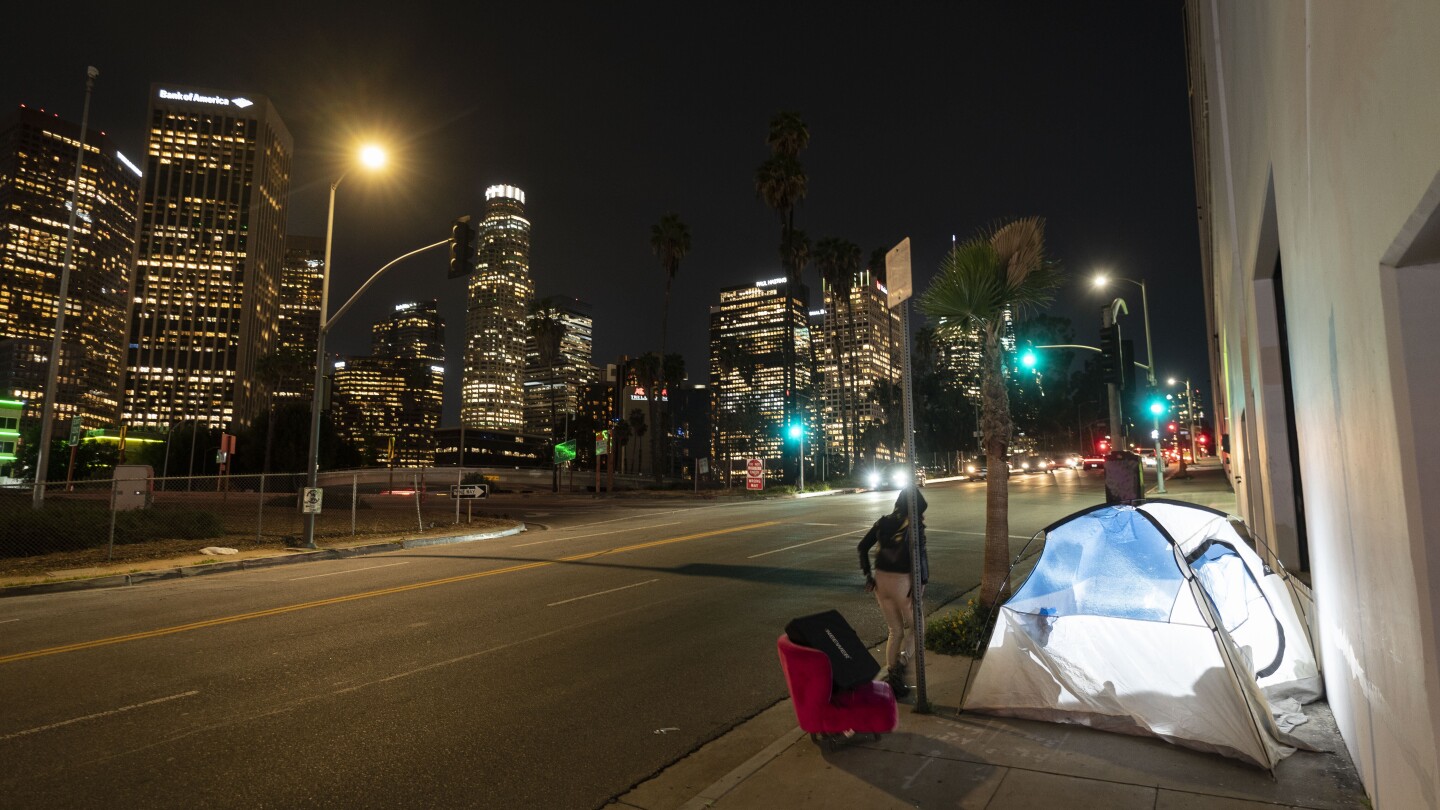
The poll comes as homelessness is on the rise and as officials across the country, including Republican President Donald Trump in the nation’s capital, push to clear encampments where unhoused people live. At the same time, the GOP tax and spending cut bill signed into law by Trump in July is expected to reduce benefits for low-income people.
“It seems like people are a little conflicted,” said Bruce Meyer, a professor at the University of Chicago Harris School who helped craft and analyze the poll. “I think people probably realize, in part at least, the complexity of what leads people to get in trouble in terms of their economic circumstances. And I think a lot of people are generous at heart and will help people out and think the government should as well, even when individuals aren’t blameless.”
Most see homelessness and poverty as a rising problem
Most U.S. adults — 68% — say poverty has increased in the country as a whole over the past 25 years, while 19% say it’s stayed the same and about 12% say it has decreased.
People living in urban areas, such as 60-year-old Baltimore resident Dwayne Byrd, are more likely to say poverty has increased in their local community, compared with people in suburban or rural areas.
“It’s dilapidated buildings, dirty streets, businesses closing up left and right,” Byrd said of the poverty in his city. “You got to choose between keeping the lights on and putting something in your belly. … People with jobs don’t have enough money.”
Yet the rate of people living under the poverty line has actually decreased “by almost every measure” over the past 25 years, according to Meyer, the University of Chicago professor.
The discrepancy between the poverty data and Americans’ perceptions may stem from the fact that unsheltered homelessness has increased.
“It is the most visible form of poverty,” Meyer said. “I think, quite reasonably, people are extrapolating from what they see in the way of people in tents and on sidewalks. But that is very different from the bulk of the low-income population.”
About 8 in 10 Americans say that homelessness has increased in the United States over the last 25 years, and roughly 7 in 10 say it’s increased in their state. Slightly more than half — 55% — say it’s increased in their own community.
According to federal officials, homelessness increased 18% last year, driven largely by a lack of affordable housing as well as devastating natural disasters and a surge of migrants in several parts of the country.
That rise came on top of a 12% increase in 2023, which federal housing officials blamed on soaring rents and the end of coronavirus pandemic assistance.
“I’ve never seen as many homeless camps,” said Pittsburgh resident Ashlyn White, a 38-year-old Democrat. “After COVID is when they really start popping up.”
More support than opposition for removing homeless encampments
More Americans favor than oppose removing homeless encampments in U.S. cities, the poll found. About 43% U.S. adults favor their removal, while about 25% oppose it. Roughly 3 in 10 Americans don’t have an opinion, saying they neither favor nor oppose removing the encampments.
The U.S. Supreme Court ruled last year that cities can enforce bans on people sleeping outside in public places.
Most Republicans, 64%, favor removing homeless encampments, while independents and Democrats are divided, with a substantial share saying they don’t have an opinion.
“There does need to be some sort of rules,” said Ami Tate, a 43-year-old resident of Hesperia, California, who leans conservative, adding that “the government also needs to help out.”
White, the Pittsburgh resident, said she opposed removing encampments.
“Where are these people supposed to go?” she said, noting that shelters are often full.
Meanwhile, in Fort Collins, Colorado, 61-year-old Rob Haas, who describes himself as a moderate who leans Democrat, strongly favors encampment removals. “I just think it’s bad for the homeless to be in that type of environment, and I think it’s bad for us to tolerate that,” he said.
Divisions over root causes
About 6 in 10 Americans say personal choices are a “major factor” in why people remain in poverty, while just under half say unfair systems are a major factor and about 4 in 10 blame lack of government support.
Most Republicans, 77%, say personal choices are a “major factor” in why people remain in poverty, compared with 56% of independents and 49% of Democrats.
Adam Kutzer, a 22-year-old living in Cranford, New Jersey, said not paying off credit card debt or spending too much money were examples of “poor financial choices that can clearly be avoided.”
Democrats, meanwhile, are much likelier than Republicans or independents to say lack of government support is a “major factor.”
When it comes to homelessness, most Americans are likely to see substance abuse and mental health issues as key drivers, with about three-quarters citing them as a “major factor.” Still, about 6 in 10 adults say that personal choices are responsible, with a similar share blaming a lack of affordable housing.
Just under half of U.S. adults — 45% — believe a lack of government support is a major factor in why people are homeless.
Who’s responsible for addressing the issues?
A majority of Americans — 54% — believe that the government is spending “too little” on assistance for those in need. That includes Tate, the Hesperia resident, who said more money should go toward school programs and helping children in low-income communities.
Americans are also more likely to think federal and state governments have a major role to play in tackling homelessness and poverty, compared with charities or very wealthy individuals.
About 4 in 10 U.S. adults say federal and state government have “a great deal” of responsibility for addressing poverty and homelessness, compared with about one-quarter who say this about charities or very wealthy people.
In Tate’s view, state and local governments “should be figuring out an action plan of how to … get people off the streets.”
___
Rush reported from Portland, Oregon.
___
The AP-NORC poll of 1,121 U.S. adults was conducted Aug. 21-25, using a sample drawn from NORC’s probability-based AmeriSpeak Panel, which is designed to be representative of the U.S. population. The margin of sampling error for adults overall is plus or minus 4.0 percentage points.
