


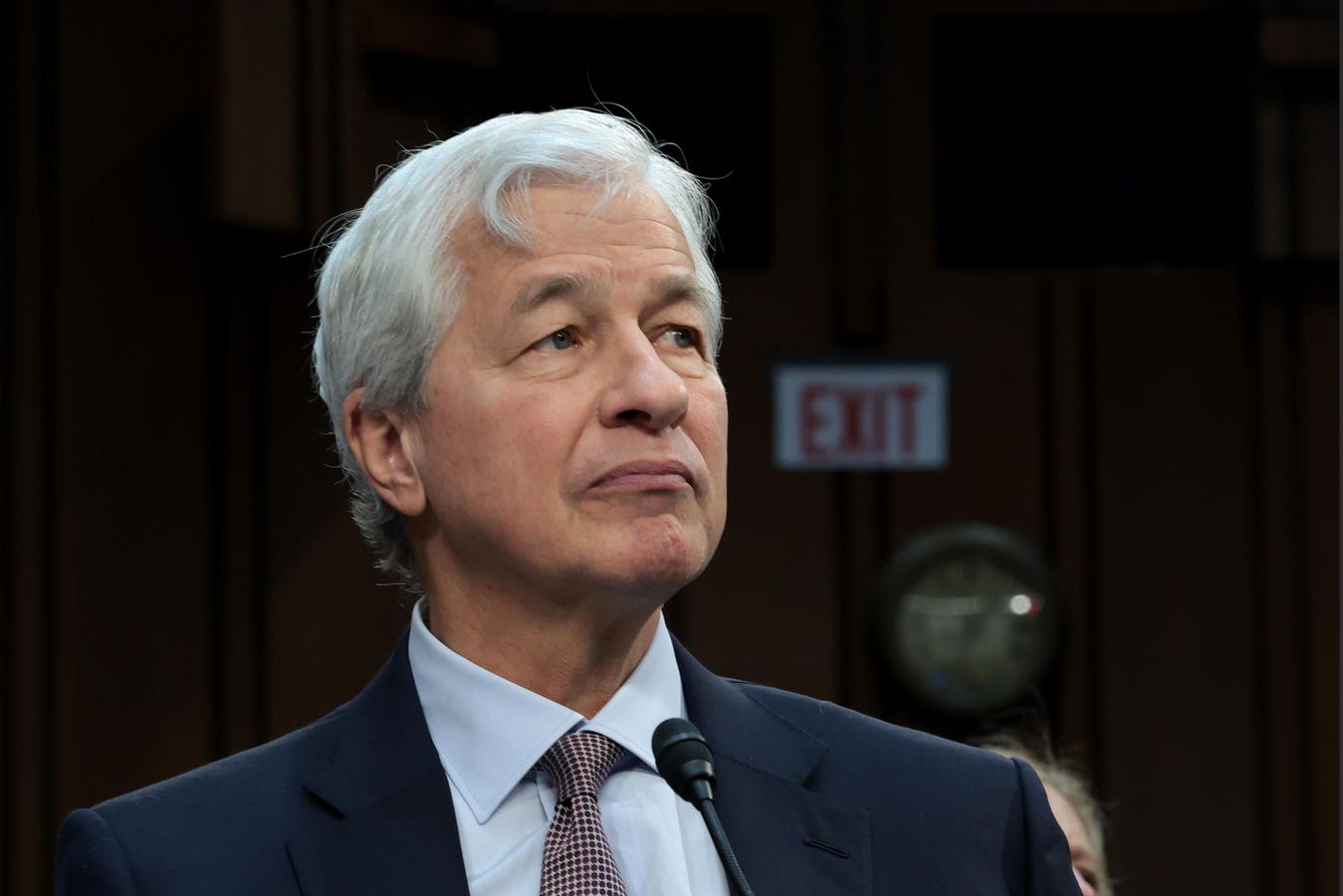
Jamie Dimon, Chair and CEO of JPMorgan Chase, testified during a 2023 Senate Banking Committee … More
Over the past decade, the United States continued to distinguished itself with superior economic growth, technological innovation, and abundant energy resources that outpaced virtually all other developed economies. This economic dominance, often referred to as “American exceptionalism,” attracted global investors seeking strong returns in a stable environment.
However, recent policy shifts have altered this perception. While America’s economic fundamentals remain robust, increasing unpredictability in trade policies, a more confrontational diplomatic stance, and growing economic isolationism have eroded investor confidence in U.S. markets as a safe haven.
The S&P 500 peaked on February 19 and then began slipping as President Donald Trump rolled out tariffs on Canada, Mexico and China, aluminum and steel, and autos. The selloff gathered force after he slapped “reciprocal” tariffs on almost every country on April 2, and China retaliated. In all the S&P 500 fell 19% through midday Wednesday — just before Trump announced a 90-day pause on the recent “reciprocal” tariffs, except on China.
The stock-market meltdown that accompanied Trump’s intensifying trade war in recent weeks was unsettling enough. The fall in the dollar and rise in bond yields that went with it have been truly ominous. So ominous, it might be why Trump changed course, at least temporarily, by pausing some of his tariffs Wednesday.
Historically, during periods of market turbulence and economic uncertainty, investors typically seek refuge in safe-haven assets—with U.S. Treasury bonds and the dollar being the traditional gold standards of security. However, despite growing recession concerns, we’re witnessing an unusual phenomenon: the expected flight to safety in dollar-denominated assets has failed to materialize as strongly as anticipated. This unexpected market behavior stems from multiple factors—some are short-term considerations like inflation risks that erode real returns, while a more fundamental shift may be occurring in how global investors perceive America’s economic stability in the current political climate.
Adding to these concerns, Jamie Dimon, Chair and CEO of JPMorgan, has signaled that a potential economic slowdown may be coming in the second half of this year. While this has sparked concerns among investors, understanding the typical duration of bear markets and recessions can provide valuable context for making informed financial decisions.
Defining The Terms
Bear markets occur when major stock indices fall at least 20% from their recent highs. Recessions, on the other hand, are typically defined as two consecutive quarters of declining economic activity, though the National Bureau of Economic Research uses a broader definition that considers multiple factors.
The Typical Timeline
Bear markets typically last around nine to 12 months on average, while recessions generally last for about 11 months, according to the NBER. It’s important to note that these two phenomena, while often connected, don’t always coincide perfectly. Sometimes bear markets can occur without a recession following, and in other cases, the stock market might begin to recover before a recession officially ends.
Different Types Of Bear Markets
Not all bear markets are created equal. They can be categorized into three main types, each with distinctive characteristics and recovery patterns:
Cyclical bear markets are tied to the normal business cycle and economic contractions. These typically last an average of around two years and take about five years to fully rebound to their starting point. These are the most common type of bear markets and often present buying opportunities for long-term investors who can weather the volatility.
Event-driven bear markets are triggered by specific, often unexpected occurrences such as wars, pandemics, or oil price shocks. These tend to be shorter, lasting around eight months, and recover in about a year. The COVID-19 market crash of 2020 is a recent example of an event-driven bear market that saw a remarkably swift recovery.
Structural bear markets are the most severe, resulting from fundamental economic imbalances and financial bubbles. The 2008 financial crisis and the dot-com crash of 2000 were structural bear markets. These can take many years to fully recover from and often lead to significant regulatory and economic reforms.
Historical Perspective
Looking back at history provides some reassurance. Since 1950, the S&P 500 has experienced 11 bear markets. Despite these downturns, the market has still provided average annual returns of about 10% over the long term.
During the Great Recession of 2007-2009, the bear market lasted for approximately 17 months, while the recession itself continued for about 18 months. In contrast, the COVID-19 bear market in 2020 lasted just 33 days—the shortest on record—though its impact was profound.
WASHINGTON, DC – FEBRUARY 03: U.S. Secretary of Treasury Scott Bessent (L) and Howard Lutnick, U.S. … More
What This Means For Investors
When markets decline, it’s natural to feel anxious. However, attempting to time market exits and entries has proven nearly impossible, even for professional money managers. Data consistently shows that missing just a few of the best days in the market can significantly reduce long-term returns.
The Psychology Of Market Downturns
During bear markets, fear can drive irrational decision-making. Studies in behavioral finance show that investors feel the pain of losses more acutely than the pleasure of equivalent gains—a phenomenon known as loss aversion. This often leads to selling at market bottoms, precisely when long-term investors should be considering buying opportunities.
The Path Forward
While Dimon’s warnings deserve attention, they should be placed in the context of the cyclical nature of markets. Bear markets and recessions, though challenging, are normal parts of the economic cycle.
As the old adage goes, it’s not timing the market that is important, but time in the market. The most successful investors approach stocks as though they’re buying the whole company—understanding who their customers are, why they buy from the company, and how much profit it will make during both good times and bad. This fundamentals-focused approach tends to win out over the long term, regardless of how long the current market cycle might last.
