


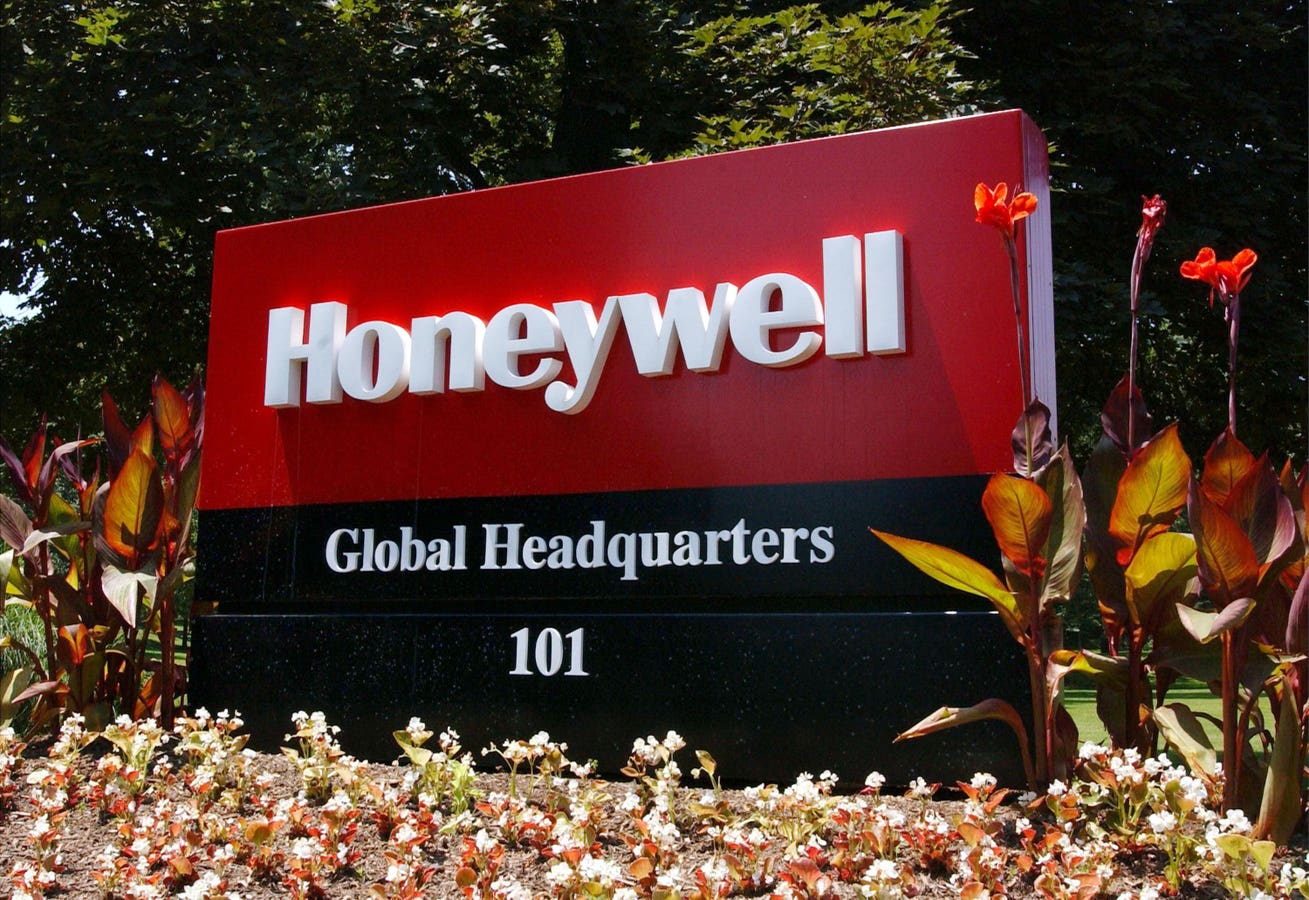
A Honeywell sign is displayed June 28, 2001 outside their offices in Murray Hill, NJ. (Photo by … [+]
On February 6, Honeywell announced it would be splitting its operations in aerospace and home automation. It had previously indicated it would be spinning out its advanced materials business. The total split was prompted by an activist position taken by Elliott Investment Management in November of last year.
The breakup completes a string of similar splits by such notable industry leaders as General Electric, Alcoa and United Technologies. The rationale for such moves is that shareholder value will be enhanced by clearer transparency of the performance of the constituent unit, tightened focus of management on its singular industry, and unlocking of valuation that is depressed by shareholders’ inability to buy a pure play stock – the so called “conglomerate discount.”
All of these can be true, but like the fashion industry, big business has its own waves of collective behavior. In the 1960’s many of the “nifty fifty” companies were conglomerates that traded above 50 times earnings and were “one decision” stocks – they were presumed to continue to grow and one would never need to sell. The thinking then was that “modern management” teams could apply their superior wisdom across multiple industry holdings and achieve returns superior to that of a stand alone unit.
Many of those companies, such as Avco, Teledyne, Litton, Textron, International Telephone and Telegraph (ITT) – all of which included substantial aerospace units, underwent breakups long ago. The diversity of holdings was remarkable: Textron owned EZ Go golf carts and Speidel watch bands. Avco made jet engines and produced Hollywood films. ITT acquired 350 companies and had a portfolio that included Sheraton Hotels, Hartford Insurance, Avis Rent-a-Car and Wonder Bread, as well as aerospace controls and actuators.
But lest we laugh at these sprawling enterprises we must recognize that many of the most successful current industry leaders are also conglomerates. Perhaps the most profound example is that of Berkshire Hathaway. but also Meta, Alphabet, Amazon, and Procter & Gamble are on the list.
Honeywell History
Honeywell itself originated in 1885 based on a damper invention for coal furnaces, eventually maturing into a thermostat climate controls business. After developing an autopilot for the Army Air Force which enabled precision bombing, it formed an Aero division in Chicago in October, 1942 which went on to develop autopilot systems and fuel indicators. Eventually Honeywell became a premier supplier of cockpit avionics systems.
In 1999, AlliedSignal acquired Honeywell for $14.9 Billion. AlliedSignal had become a major aerospace company through the acquisition of Bendix by Allied Chemical and then a merger with The Signal Companies which included Garrett AiResearch, maker of smaller aircraft engines. Taking the Honeywell name, the company initially moved to AlliedSignal’s headquarters in Morristown, NJ – which was a blow to the State of Minnesota, where Honeywell had been a corporate marquee for over 100 years, before finally ending in North Carolina.
John “Jack” Welch, chairman and chief executive officer of General Electric Corporation, attends a … [+]
In October of 2000 Honeywell accepted a takeover bid from CEO Jack Welch of General Electric. The deal was approved by US regulators but was denied nine months later by the European Union’s anti-trust authorities on the grounds that it would create a “horizontal monopoly” between GE’s large commercial engines and aircraft leasing arm, and Honeywell’s avionics and regional jet engines. During the interim, GE had effectively taken over Honeywell, and was then forced to withdraw leaving the company in disarray. The CEO of Honeywell was fired.
Break Up or Stay the Course?
At the end of the day, the question is whether management can effectively add value to two disparate businesses by spurring growth, and exploiting potential synergies. At $15 Billion in revenue, Honeywell Aerospace is of sufficient size to allow for critical functions such as capital allocation to occur within its corporate boundaries. And with its heavy focus in the profitable aftermarket, it has been a strong support to corporate profits through the years.
But the recent performance of companies like GE Aerospace lends weight to the argument for break up. Since its spinoff, its shares climbed 63% in 2024. It doesn’t hurt to have industry tailwinds such as growing air traffic demand, shortage of new aircraft due to Boeing and supply chain issues and perhaps the best CEO in the industry in Larry Culp. But it sill is an impressive performance.
However, United Technologies trajectory paints a different, but also positive, picture. In 2018, after acquiring Rockwell Collins, UTC announced it would split into three separate units – Otis Elevator, Carrier (climate controls and security) and UTC (Pratt & Whitney and Collins Aerospace). However, in 2020 the surviving UTC unit combined with Raytheon in a merger of equals – creating a broader conglomerate – albeit focused on the somewhat more related domains of commercial aerospace and defense.
The simple answer is that there is no sure fire M&A formula for creating success. While some companies are breaking up to unleash the growth spirits, others are building on the discards of previous entities, such as L3 which spun out of Lockheed and was the platform for the creation of a new prime, L3Harris.
The aerospace industry has largely been characterized by eras of consolidation. It now appears we are in an era of disaggregation, many of which create new conglomerates with a tighter industry focus. But when one of the major issues hanging in the air is whether Boeing should split commercial and defense, the question is profound.
