


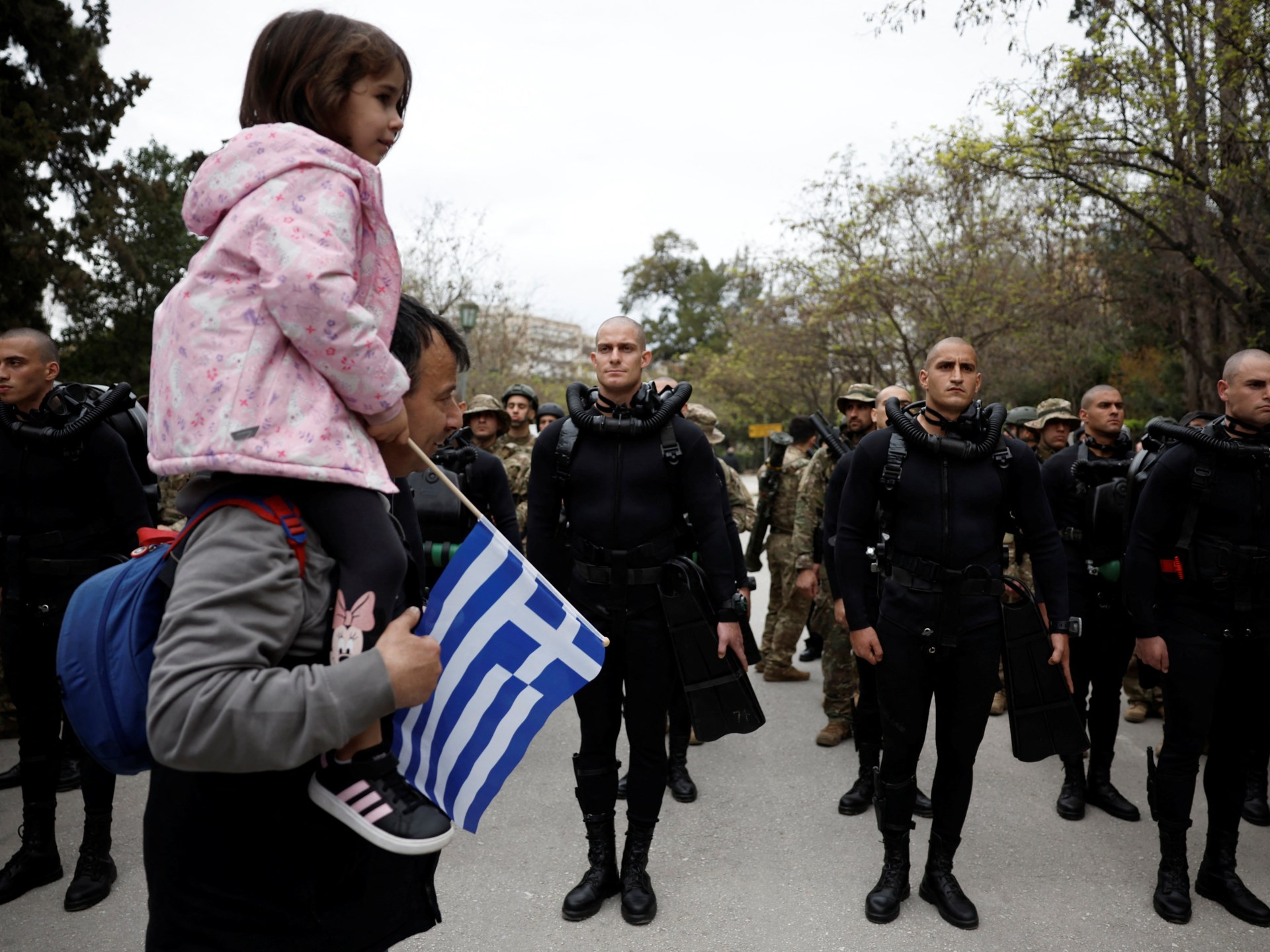
Athens, Greece – Greece on Wednesday became the first European Union member to take advantage of relaxed spending rules for defence, announcing a 25bn-euro ($27bn) multi-year rearmament programme.
The centrepiece of the programme was a multi-layered defence system called the Shield of Achilles, which Prime Minister Kyriakos Mitsotakis told parliament was “essentially a dome combining existing air defences with new systems, offering protection on five levels – anti-missile, anti-ballistic, anti-aircraft, anti-ship, anti-submarine and anti-drone”.
It was Greece’s first multi-year, comprehensive rearmament, and was part of a broader overhaul of the armed forces called Agenda 2030.
Mitsotakis described the shift as the “most drastic transformation in the history of the country’s armed forces”.
As the world is changing at an “unpredictable pace”, he said, “We are now facing a different kind of war than we were used to – at least the kind our armed forces were prepared for.”
Greece is a consistent high defence spender due to its adversarial relationship with Turkiye, and is this year set to spend 3 percent of its gross domestic product (GDP) on defence.
That is significantly above the European average of 1.9 percent, as estimated by the Stockholm International Peace Research Institute.
Amid a Russian war in Europe and contentious United States fidelity to NATO, the EU last month decided to raise up to 650bn euros ($705bn) in off-the-books additional defence spending.
Europe’s total defence spending in 2023 was $569bn.
The EU also offered member states 150bn euros ($163bn) in low-interest loans to strengthen European defence industries.

Front-line states Greece and Poland fought hard for the relaxed fiscal rules, and Mitsotakis went further in parliament.
“The Greek government believes that at some point Europe needs to create a fund focused on shared [defence] benefits such as a European anti-missile shield that will cover all European countries and can be funded by European grants to member states, not loans. But we are not there yet,” Mitsotakis said.
Mitsotakis’s reasoning was that Brussels could raise money more cheaply than most individual member states, so underwriting collective debt was more cost-effective than borrowing individually.
The EU issued its first mutualised debt during the COVID-19 pandemic in 2020, creating a 730bn-euro ($805bn) stimulus fund.
Its 150bn-euro ($165bn) rearmament fund, called Security Action for Europe (SAFE) is made of money left over in that fund.
From bankruptcy to European autonomy
Greece has traditionally bought mostly US weapons, but its bankruptcy in the post-2008 global financial crisis has catalysed a more pro-European trajectory.
Years of austerity halved its defence budget to $4.6bn by between 2010 and 2014. Meanwhile, Turkiye’s economy and defence budgets grew.
As it rearmed on carefully balanced budgets, Greece decided to replace quantity, where it could no longer compete with Turkiye, with quality, and sought more sophisticated weapons systems.
The US did not oblige, wanting to maintain a balance between its two east Mediterranean allies, so Greece migrated towards European systems Turkiye did not have.
That helped make it an early convert to the cause of European strategic autonomy championed by France’s President Emmanuel Macron.
In September 2019, Greece announced it would buy 18 French Rafale fighter-bombers for $2.5bn, and raised that number to 24 a year later.
In 2021, Greece penned a strategic defence treaty with France, ordering three state-of-the-art Belharra frigates from France’s Group Naval for 2.26bn-euro ($2.5bn), with an option for a fourth.
PM Mitsotakis hailed the agreement in parliament as the cornerstone of an independent European defence policy.
“The defence of European interests in the Mediterranean now acquires new substance,” Mitsotakis told parliament four years ago. “If attacked, our country will have at its side the most powerful military on the continent, the sole European nuclear power.”
All 24 Rafales were delivered in record time, and the first frigate, originally laid down for the French navy, is to be delivered this year.
The Belharra carry French-made weapons and radar from MBDA, Thales and Dassault. Those include the Aster-30 hypersonic, surface-to-air missiles, capable of travelling at four and a half times the speed of sound and striking aircraft, drones and guided ballistic missiles, MU90 torpedoes, the latest 200km-range (124-mile) Exocet antiship missiles and the Thales Sea Fire radar.
The Rafale also carry French weapons, including 100km-range (60 mile) Meteor air-to-air missiles and 500km-range (310 mile) air-to-surface Scalp EG missiles.
Last September, Greek Minister of National Defence Nikos Dendias said the second, third and fourth Belharra frigates would also carry the SCALP Naval strategic missile, with a range of more than 1,000km (620 miles).
None of these weapons have been sold to Turkiye, although the United Kingdom, a part of the MBDA consortium, now seeks to sell the Meteor missile to Ankara.
“After 1976, we had the 7:10 rule,” said Angelos Syrigos, a professor of international law at Panteion University in Athens, referring to a US pledge to supply Greece and Turkiye according to fixed proportions.
“That permeated all systems. In recent years this has changed. We don’t seek a proportionality but a qualitative edge. The SCALP and Meteor missiles are qualitative advantages on the Greek side,” he told Al Jazeera.
A top priority for Greece is to build up its own defence industrial base, and 12 percent of the Belharra contracts go to Greek companies. Dendias said he aimed to put Greek companies in a consortium building the European Patrol Corvette as well.
But Greece is not turning its back on the US.
In 2018, Greece penned a $1.3bn deal with the US’s Lockheed Martin to upgrade 85 of its F-16 fighter jets to Viper level, installing advanced radar and weapons systems on board.
Last year it ordered 20 fifth-generation F-35 planes from Lockheed Martin, and wants Greek companies to co-develop the next-generation US Constellation frigate.
“Greece is obliged to balance between the US and Europe in defence, because that better consolidates its position,” Konstantinos Filis, a professor of international relations at the American College of Greece, told Al Jazeera. “It cannot be one-track. And the EU and US also need Greece, because it’s in an area of strategic interest to both.”
