One of the many challenges facing markets in recent days is a lack of clarity on exactly what President Trump is negotiating as he pushes forward with his trade war.
The president has been perhaps most clear about what isn’t an acceptable outcome in his mind: simple tit-for-tat tariff reductions.
But the president has offered shifting definitions of what he would like instead in any final deal as negotiations commence with Japan and South Korea. Other countries are promised to soon follow.
The variety of positions — perhaps in part about positioning ahead of these talks — is nonetheless yet another mixed message for jittery markets. The confusion is amplified by starkly conflicting messages from Trump’s aides.
Markets are nervously watching a series of tariff deadlines this week — including a new threat from Trump of additional 50% duties on Chinese goods that could be announced as soon as today in addition to the president’s full reciprocal tariffs plan set to come into effect on Wednesday.
The varied messages from Trump and different aides come after the past weekend when, according to new reporting from Politico, Treasury Secretary Scott Bessent traveled to Mar-a Lago to try and get Trump to focus his message on possible avenues for negotiation — including the “endgame” of his tariff plans.
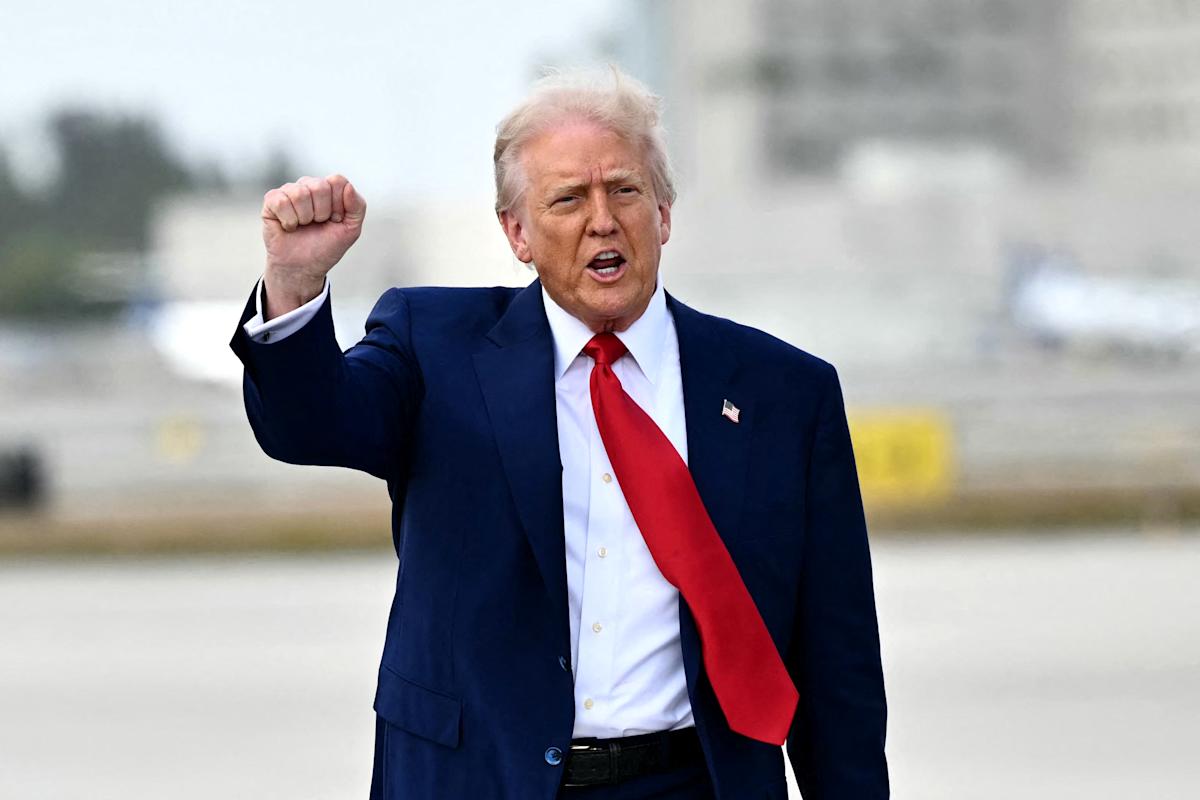
President Donald Trump at Miami International Airport on April 3. (MANDEL NGAN/AFP via Getty Images) ·MANDEL NGAN via Getty Images
It’s a message Bessent has often sent, adding Tuesday morning in a CNBC appearance of negotiations, “If they come to the table with solid proposals, I think we can end up with some good deals.”
It was a comment that helped stocks jump on Tuesday morning.
But Trump has only partly cooperated in echoing that message in recent days.
He announced Tuesday morning that “things are looking good” in talks with South Korea and listed an array of issues to be negotiated as “one-stop shopping.” The president has likewise signaled at times that a variety of issues could be on the table.
But he has also offered a more absolutist position at other times — sometimes even within the same set of remarks.
On Sunday night, speaking to reporters as he returned to Washington (and with Secretary Bessent looking on), Trump suggested he had a single bottom line for negotiations: trade deficits.
“They’re dying to make a deal, but I said we’re not going to have deficits with your country,” the president said of talks with foreign leaders, “because to me a deficit is a loss: We’re going to have surpluses or we’re at worst going to be breaking even.”
But the next morning — in a social media post — the president offered a summary of talks with Japan without a mention of deficits, offering instead a focus on things like automobile and agriculture issues.
By Monday afternoon — during an appearance with Israeli Prime Minister Benjamin Netanyahu — Trump was somewhere in the middle.
In those comments, he repeatedly said his goal was to “reset the table” on trade but also noted, “We have a lot of things that we’re talking about.”
Trump was pressed directly at one point on the mixed messages and responded, “They can both be true; there can be permanent tariffs and there could also be negotiations because there are things that we need beyond tariffs.”
It is a dynamic that has also been starkly in evidence among Trump’s aides.
On Monday afternoon, the competing messages were clear, with two developments in a single hour encapsulating the confusion.
At 2:16 pm ET, Secretary Bessent announced that, with respect to Japan, he had been asked “to open negotiations to implement the President’s vision.”
That came literally minutes after an op-ed was published in the Financial Times by another top Trump aide, senior counselor for trade Peter Navarro, that read in part, “this is not a negotiation…it is a national emergency triggered by trade deficits caused by a rigged system.”
It was a mixed message echoed again and again in recent days.
Hard-line messages were abundant, such as Commerce Secretary Howard Lutnick’s promise recently that “the tariffs are coming.” As were signs of flexibility, such as a post from Council of Economic Advisers chair Stephen Miran that listed five ways countries might dodge some tariffs through increased “burden sharing.”
Yet another perspective came Tuesday morning from Jamieson Greer, Trump’s trade representative, who told senators during testimony on Capitol Hill that Trump’s negotiations were “already bearing fruit” but also that they would differ country by country.
The ongoing confusion also came as the market fluctuated on every twist and turn, with traders clearly hungry for any signs of tariff lessening.
The jitters were in evidence Monday after a false report circulated online claiming that National Economic Council Director Kevin Hassett had said Trump was open to a 90-day pause on this week’s April 9 deadline.
It sent buyers into a frenzy, and stocks shot up several percentage points before immediately returning to previous levels once the administration forcefully batted down the false headlines.
It was a stretch that lasted for just a few minutes but, according to Wall Street Journal calculations, added $2.4 trillion in value before erasing it almost as quickly.
Ben Werschkul is a Washington correspondent for Yahoo Finance.
Click here for political news related to business and money policies that will shape tomorrow’s stock prices
Read the latest financial and business news from Yahoo Finance