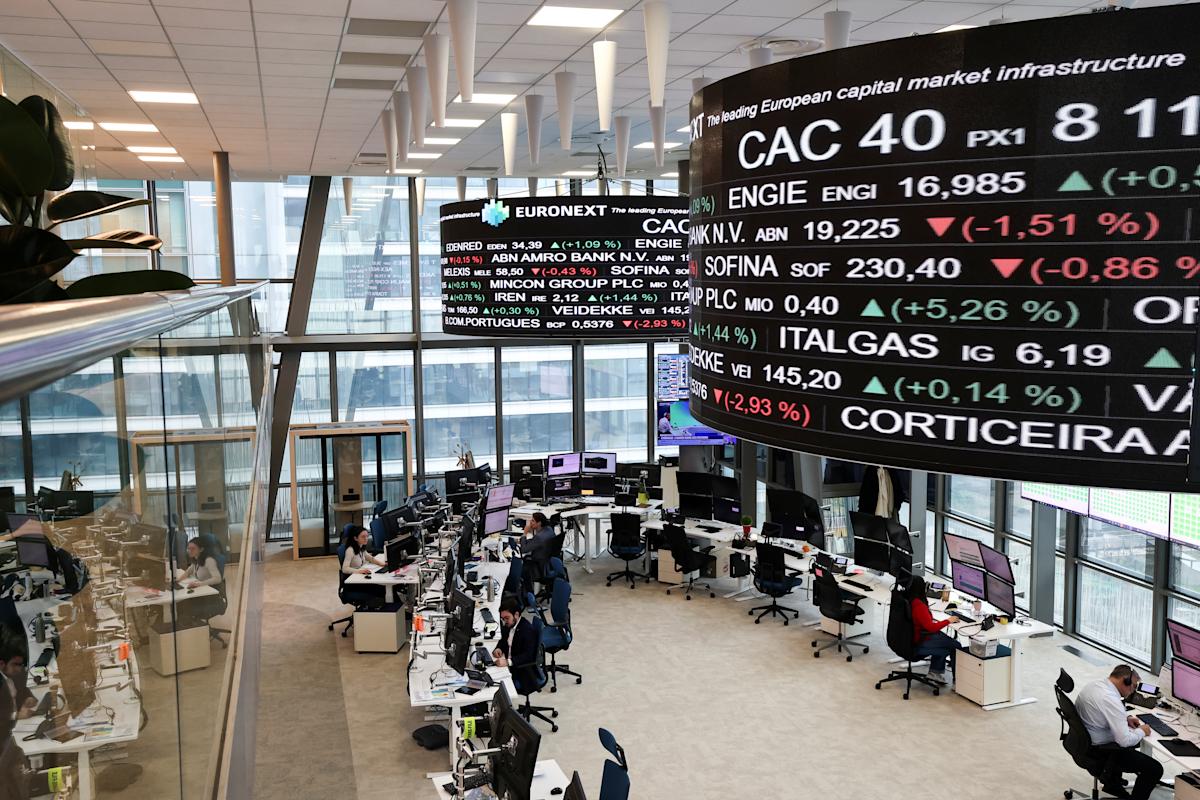
(Bloomberg) — European stocks suffered their worst day in eight months after US President Donald Trump announced the steepest tariffs in a century, including a 20% rate for the European Union.
Most Read from Bloomberg
The Stoxx Europe 600 Index sank 2.6% at the close. The major regional stock exchanges were all in the red, with France’s CAC 40 down 3.3%, Germany’s DAX slipping 3% and Denmark’s OMXC25 Index dropping 2.4% into a bear market.
European banks — which led the rally this year — were among the hardest-hit sectors, falling 5.5%. Carmakers were also affected, extending their year-to-date losses to 7.2%, after Trump’s tariffs on US auto imports took effect shortly after midnight in Washington.
Listen to the Here’s Why podcast on Apple, Spotify or anywhere you listen.
France and Germany are pushing for a more aggressive tariff response that could strengthen the EU’s negotiating position. The dramatic escalation in Trump’s global trade war threatens to wipe out much of the euro-area expansion that the European Central Bank forecasts for this year and next.
“The question is how fast this translates into hard economic data,” said Kevin Thozet, a member of the investment committee at Carmignac in Paris.
Bond proxies like utilities and real estate rose as investors cut risk and moved money into safe havens and defensive shares.
“Investors are turning toward income as a source of refuge in these times of uncertainty as they wait and watch how countries essentially come back with their countermeasures,” said Aneeka Gupta, head of macroeconomic research at Wisdom Tree UK Ltd.
Tariff concerns have replaced the positive mood that had boosted European stocks this year on hopes of increased government spending in Germany, lower interest rates and cheaper valuations. The Stoxx Europe 600 Index had outpaced the S&P 500 by a record of almost 15 percentage points in dollar terms in the first quarter.
The correlation between stocks and bond yields is now at the highest level in two years. But unlike in 2023, this time they’re falling in concert, a sign that economic growth expectations are being downgraded.
Here’s what market participants are saying:
Evgenia Molotova, senior investment manager at Pictet Asset Management:
“It’s very difficult to comprehend the exact consequences at the moment. It’s a lot of uncertainty, so we’re not going to make any large moves. We marginally prefer Europe, but the thing is that Europe will also get hit by this trade war. It doesn’t look great for either.”
Altaf Kassam, managing director and Europe head of investment strategy & research at State Street Global Advisors:
“If the UK can remain ‘under the radar’ and the EU play its relatively stronger hand to bring the US to the negotiating table, then the outperformance of European vs. US equities we have seen YTD could continue.”
Joaquin Cascallar, CIO at Targa 5 Advisors:
“It is important to remember that tariffs on sectors such as pharmaceuticals, timber, semiconductors, and possibly others, are still pending. In light of these developments, we recommend maintaining a cautious approach for now. As such, we continue to favor Treasury bonds, high-quality bonds and gold.”
Wolf von Rotberg, equity strategist at Bank J. Safra Sarasin:
“The announcement was close to being the worst-case scenario for markets. The size of reciprocal tariffs and their immediacy will put substantial strains on trade globally. A global economic slowdown seems almost inevitable, which the US won’t be spared from. As European and global equity markets had not been priced for such a scenario, they will likely have to adjust further to the downside.”
Thomas Wille, chief investment officer at Copernicus Wealth Management:
“Right now, this is a shock for the whole market. The best thing to do in this moment is to go to the sidelines and wait until the storm has passed. It’s more of a selection game right now than an allocation game and about identifying the companies that will be able to circumvent the tariffs or will be be able to pass on the tariffs to their customers to protect their margins.”
Christina Carlsten, senior fund manager at Banque Piguet Galland & Cie SA:
“For us, a correction/consolidation of European stock markets due to this announcement of tariffs would be an opportunity to reinforce our exposure. The latest developments in Germany and in Europe are extremely positive for the growth outlook.”
Neil Birrell, chief investment officer at Premier Miton Investors:
“It’s hard to see where the winners are, but there will be relative winners. When it comes to money flows, the UK and Europe will be seen as relatively attractive places to go.”
Michael Field, European strategist at Morningstar:
“A 20% tariff on all European goods is potentially devastating for many industries, if indeed these tariffs are permanent and fixed in nature. This is unlikely, given that administration officials have intimated that negotiation will be possible.”
Rory McPherson, chief investment officer at Magnus Financial Discretionary Management:
“This is not a time to be making snap decisions. We’re not buying the dip at the moment but are looking to buy on further weakness. We still like the US versus Europe. We still think equities are a good asset to own. Even if there’s a recession, it won’t be a deep one.”
Roberto Scholtes, head of strategy at Singular Bank:
“The clue for the economy and markets will be Fed’s and Treasury yield reactions. As interest rates are coming down, the net effect on markets would be cushioned. Given recent adjustments in valuations, expectations and investor positioning, we think US equities are becoming attractive again, and we’re seeing today’s slump as an opportunity to add positions by closing our underweight stance.”
Alexandre Baradez, chief market analyst at IG in Paris:
“There will be further escalation ahead before compromises can be found later on. All in all, I don’t see how markets can hope for an upturn in the short term; there’s no visible positive catalyst on the horizon, and especially not from the Fed.”
Florian Ielpo, head of macro research at Lombard Odier Investment Managers:
“It’s crucial to note that markets had anticipated a significant rise in tariffs, and the effective tariff increase of 10% or 17% do not alter the broader economic narrative: free trade, as a concept, seems to be out of favor for an extended period.”
Nicolas Forest, CIO at Candriam:
“Until the last minutes investors were living in the hope that the trade policy would end up to be reasonable and pro-business and that it would avoid the risk of a recession. We’re entering what we call the ‘Hard Trump’ scenario which implies slowing global growth even if a recession can be avoided for now.”
Stephan Kemper, chief investment strategist at BNP Paribas Wealth Management:
“The fact that they introduced these 10% baseline tariffs underlines that there is not much chance to negotiate tariffs away and that Trump is not only using them as a bargaining tool, but really wants to collect money from them.”
–With assistance from Sangmi Cha, Allegra Catelli, Macarena Muñoz, Kit Rees and Joe Easton.
Most Read from Bloomberg Businessweek
©2025 Bloomberg L.P.