


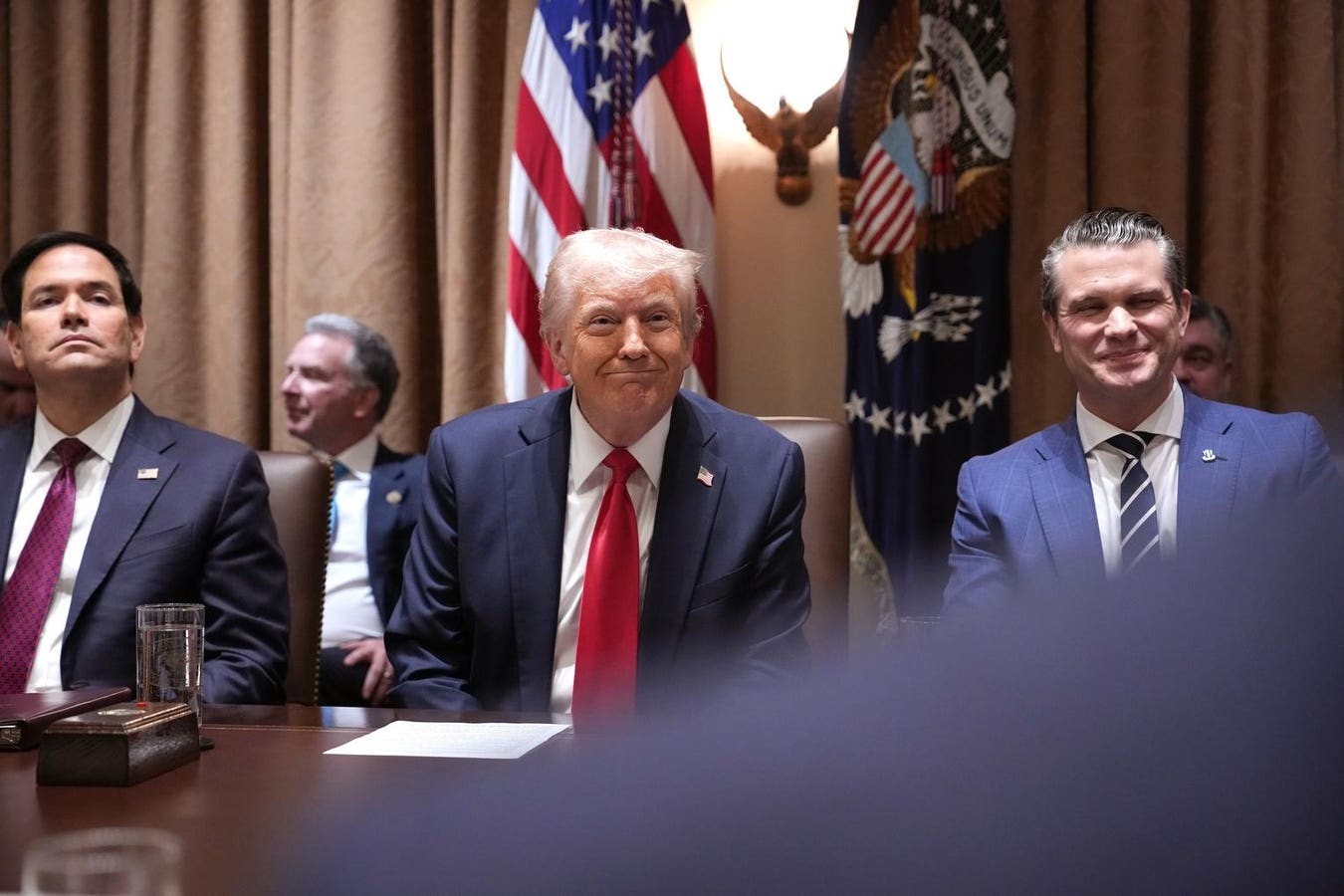
WASHINGTON, DC – FEBRUARY 26: U.S. President Donald Trump delivers remarks during a Cabinet Meeting … More
President Trump’s announcement that he would seek a $1 trillion Department of Defense budget has dashed the hopes of those who thought his talk of finding efficiencies in the department would slow the relentless growth of Pentagon spending.
What’s behind the proposed surge in spending? The president argued that “the military is something that we have to build, and we have to be strong, because you have a lot of bad forces out there now.”
Analyst Roman Schweizer of TD Cowen has suggested that while there were advocates for restraining Pentagon spending within the administration and Congress, the $1 trillion proposal means “at least for now . . . the hawks have won.”
A generic fear of “bad forces” is a weak argument for ramping up Pentagon spending. What is needed now more than ever is a realistic assessment of what military force can and cannot accomplish in an increasingly unpredictable global environment, coupled with a more balanced approach to the most pressing challenges to the security of America and its allies.
The evidence of this century does not bode well for an approach that throws ever more money at the Pentagon while decimating non-military tools of statecraft, as has happened with the virtual elimination of the Agency for International Development (AID). As the Costs of War Project at Brown University has determined, America’s post-9/11 wars have cost $8 trillion, led to the deaths of hundreds of thousands of civilians, destabilized key regions, and resulted in physical and psychological injuries to hundreds of thousands of U.S. military personnel. This grim record should prompt second thoughts about doubling down on force and the threat of force as the primary tools of U.S. foreign policy.
The Pentagon regularly asserts that its primary rival is China. The official line is that only by outpacing Beijing in the development of next generation weapons can the U.S. dissuade China from aggressive action in Asia, or, in the extreme case, win a war against it. This mindset ignores the fact that the most effective way to manage the U.S.-China relationship and prevent a potentially devastating war is to restore a common understanding on the status of Taiwan and enter into dialogue about other issues of mutual concern, from nuclear forces and AI-driven weapons to climate change, outbreaks of disease, and the precarious state of the global economy.
Building more nuclear weapons, or combat ships, or an immensely costly but unproved missile defense system will do little to address America’s most urgent security challenges. In fact, doing so could well make things worse by promoting a dangerous arms race that will only make war between the world’s two most powerful nations more likely. And a war between the United States and China – two nuclear-armed powers – could be an unprecedented disaster for all concerned.
And the notion that the administration’s allies in Silicon Valley can quickly produce large numbers of nimble, affordable, and lethal next generation weapons that will give America a decisive edge should be treated with a large grain of salt. Claims that “miracle weapons” and superior military technology will save us pop up every generation, from the electronic battlefield in Vietnam to Ronald Reagan’s failed dream of an impervious missile shield to the failure of precision guided munitions and superior battlefield awareness to win the day against smaller, less technologically sophisticated adversaries in Iraq and Afghanistan. In every case these claims failed to bear out in the face of technical limitations and complex conflicts in which motivation and knowledge of the local terrain have proven more important to the ultimate outcome than the possession of costly, complex weapons systems.
In short, there is nothing in the recent record of U.S. strategy and spending to suggest that doubling down on a military-first approach to foreign policy will make America safer, and much to indicate that neglecting non-military tools of international relations will make the world a more dangerous place. Specifically, it will make the solution of non-traditional security challenges, from climate change to potential pandemics to rampant inequality increasingly difficult, if not impossible.
A $1 trillion Pentagon budget sounds impressive, but pursuing it at a time when too many of our most urgent national needs are being neglected would be a colossal error. Congress and the administration need to hear that message loud and clear from their constituents if there is to be any hope of forging an effective, affordable defense strategy. Given the nature of the challenges we face – most of which do not have military solutions – pushing for a trillion dollar Pentagon budget would be a trillion dollar blunder.
