


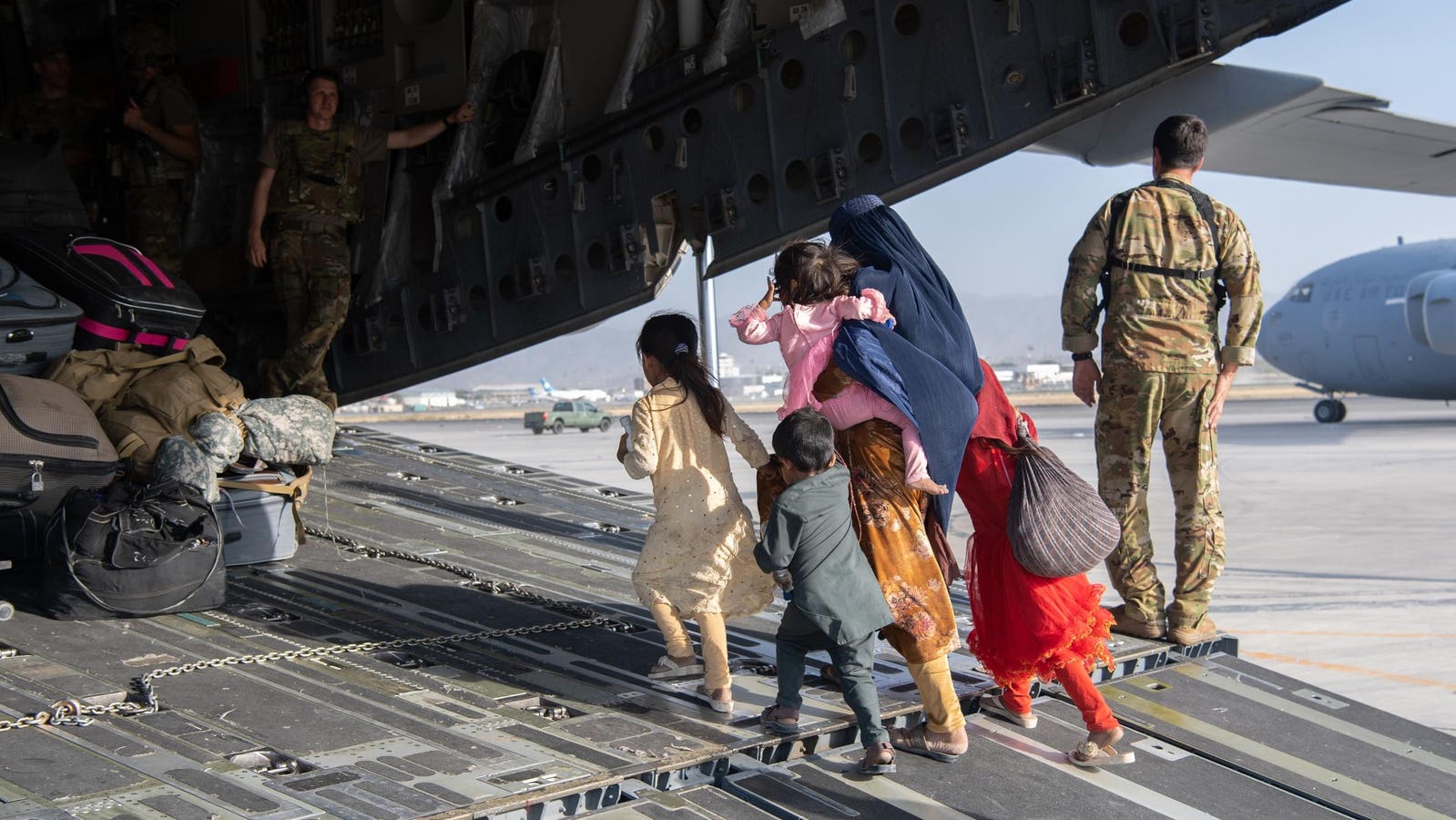
U.S. Air Force loadmasters and pilots assigned to the 816th Expeditionary Airlift Squadron load … More
To justify ending immigration protections for Afghans, Trump officials have cited increased tourism to the violent and impoverished country. The justification indicates the Trump administration had already decided to end Temporary Protected Status for Afghanistan and scrambled to find details to support the decision. Human rights reports conclude Afghanistan under the Taliban remains an oppressive place, particularly for girls and women, who are prohibited from educational and employment opportunities enjoyed in the rest of the world. The Trump administration made similar decisions to end TPS for Haiti and Venezuela despite the conditions in those countries.
The Trump Administration’s Decision To Stop Immigration Protections For Afghans
The Department of Homeland Security released its official notice ending Temporary Protected Status for Afghanistan on May 13, 2025. DHS reported that Homeland Security Secretary Kristi Noem decided to end TPS for Afghans almost two months earlier, on March 21, 2025.
“Based on her review and consultation with the Department of State, the Secretary determined that, overall, there are notable improvements in the security and economic situation such that requiring the return of Afghan nationals to Afghanistan does not pose a threat to their personal safety due to armed conflict or extraordinary and temporary conditions,” according to a Federal Register notice published May 13, 2025. “She further determined that permitting Afghan nationals to remain temporarily in the United States is contrary to the national interest of the United States.”
Groups supporting Afghan evacuees criticized the Trump administration’s action. “The decision to terminate TPS for Afghanistan is not rooted in reality—it’s rooted in politics,” said the group #AfghanEvac in a statement. “Afghanistan remains under control of the Taliban . . . There are still assassinations, arbitrary arrests and ongoing human rights abuses, especially against women and ethnic minorities . . . The United States cannot abandon its allies and call that immigration policy.”
Objective analysis indicates Afghanistan is not a place where the U.S. government would typically force individuals to return or face deportation. The decision on Afghanistan fits a pattern with other countries deemed safe by Trump officials, in spite of evidence to the contrary.
“In deciding that Afghanistan is a safe place for men, women and children to return, Trump officials have delivered a predetermined outcome based on a motivation to end Temporary Protected Status without regard to country conditions,” according to a National Foundation for American Policy analysis. “The Trump administration’s actions on Afghanistan follow other predetermined outcomes on Temporary Protected Status, where the Department of Homeland Security claimed that conditions in Haiti and Venezuela had improved sufficiently to warrant ending TPS.”
NFAP noted the administration has also blocked the entry of refugees from Afghanistan who fear returning to a country ruled by the Taliban.
The Federal Register notice includes proof that DHS decided to end Temporary Protected Status for Afghanistan before conducting a serious analysis. The notice cites an executive order published on January 20, 2025, that calls for ensuring TPS designations are “made for only so long as may be necessary to fulfill the textual requirements of that statute.”
Taliban supporters parade through the streets of Kabul on August 15, 2023, in Kabul, Afghanistan. … More
DHS Claims Tourism To Afghanistan A Reason To End Immigration Protections
Given the conditions in Afghanistan, it could not have been easy for Trump officials to gather supporting facts to justify ending protection from deportation to a country ruled by the Taliban. As a result, the Federal Register notice touts an improbable and modest increase in tourism to Afghanistan and hails a reduced rate of kidnappings.
“The Taliban government is promoting tourism to shift its global image,” according to the DHS Federal Register notice. “Tourism to Afghanistan has increased, as the rates of kidnappings have reduced. In 2021, there were 691 foreign tourists; in 2022, that figure rose to 2,300 and continued to rise to 7,000 in 2023. Foreign visitors, particularly from China, have increased by 913% since the Taliban took control of the country in August 2021. Tourists are sharing their experiences on social media, highlighting the peaceful countryside, welcoming locals and the cultural heritage, according to some reports.”
To place the 7,000 foreign tourists visiting Afghanistan in context, note that France attracted approximately 100 million foreign tourists in 2024.
“Citing Taliban-promoted tourism as a basis for ending TPS is dangerously out of touch with the realities facing thousands of Afghan allies in the U.S.,” said Krish O’Mara Vignarajah, president and CEO of Global Refuge, in an interview. “A handful of curated travel blogs do not change the fact that Afghanistan remains the most repressive regime in the world for women and girls, who have been stripped of the right to learn, work and move freely.”
The Congressional Research Service reported, “Afghanistan under the renewed rule of the Taliban is ‘the most repressive country in the world regarding women’s rights,’” citing the head of the UN Assistance Mission in Afghanistan. Global Refuge’s Vignarajah said, “Humanitarian protections should be based on credible assessments of safety and human rights, not on image-building efforts by the very regime people are fleeing.”
