


By Ella Cao and Naveen Thukral
BEIJING/SINGAPORE (Reuters) -China’s retaliation on Friday against new U.S. tariffs is poised to accelerate Beijing’s move towards alternative suppliers for agricultural goods including Brazil, a shift that began during the trade war of U.S. President Donald Trump’s first term.
Beijing unveiled a slew of countermeasures, including additional duties of 34% on all U.S. goods, which are on top of the 10-15% tariffs placed on roughly $21 billion worth of agricultural trade in early March.
“It is like shutting down all U.S. agricultural imports. We are not sure if any imports will be viable with 34% duty,” said a Singapore-based trader at an international trading company which sells grains and oilseeds to China.
“The main impact will be on products like soybeans and sorghum. It is not going to be so much on wheat and corn as China has not been buying much of wheat and corn from the U.S. this year anyway,” the trader added.
The most-active soybean contract on the Chicago Board of Trade (CBOT) was down 4% by 1450 GMT at $9.70-3/4 a bushel. The market was heading for its biggest daily fall since September 2023.
A European grains trader said the European Union, which has also vowed to retaliate, was also likely to put tariffs on U.S. soybeans.
“It’s all about soybeans. A major concern is if there is no agreement before the new crop for U.S. soy,” the trader said.
“As a big picture conclusion, all this trade war is bearish U.S. ags and bullish other origin ags,” the trader said.
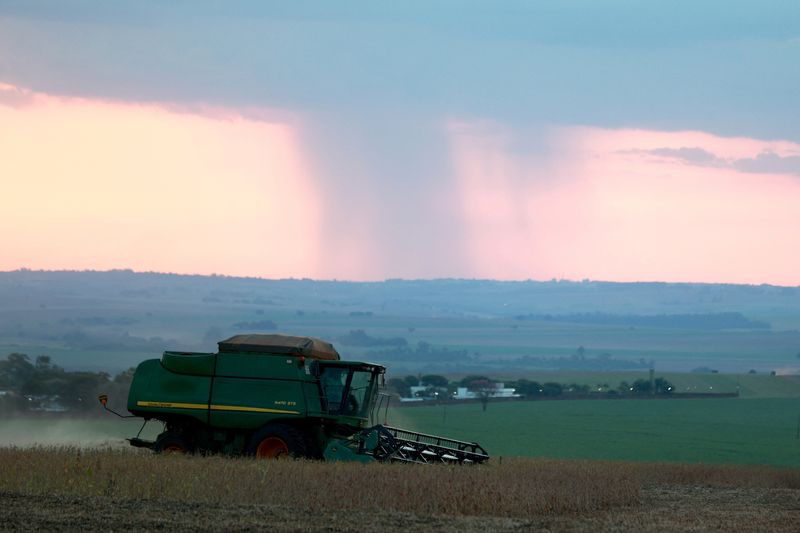
The March levies have accelerated a pivot away from U.S. soybean imports and shifted demand to Brazil, where a bumper harvest puts it on track to deliver a record-breaking second-quarter import surge for China.
“Brazil will be by far the main beneficiary, the biggest supplier that can replace U.S. soybeans to China. But others could benefit too, including Argentina and Paraguay. On wheat, Australia and Argentina should benefit,” said Carlos Mera, head of Agricultural Market Research at Rabobank.
Sol Arcidiacono, head of Latam grains sales at HedgePoint Global Markets, said the basis for South American soybeans will get stronger for the full year, despite seasonality and record crops as the trade war escalates.
She added that current geopolitics will likely drive an increase in acreage for soybeans, mainly in Brazil, where expansion had been slowing lately.
On Thursday, a day after Trump’s tariffs announcement, Brazil port premiums reached a dollar per bushel over Chicago benchmark prices.
