


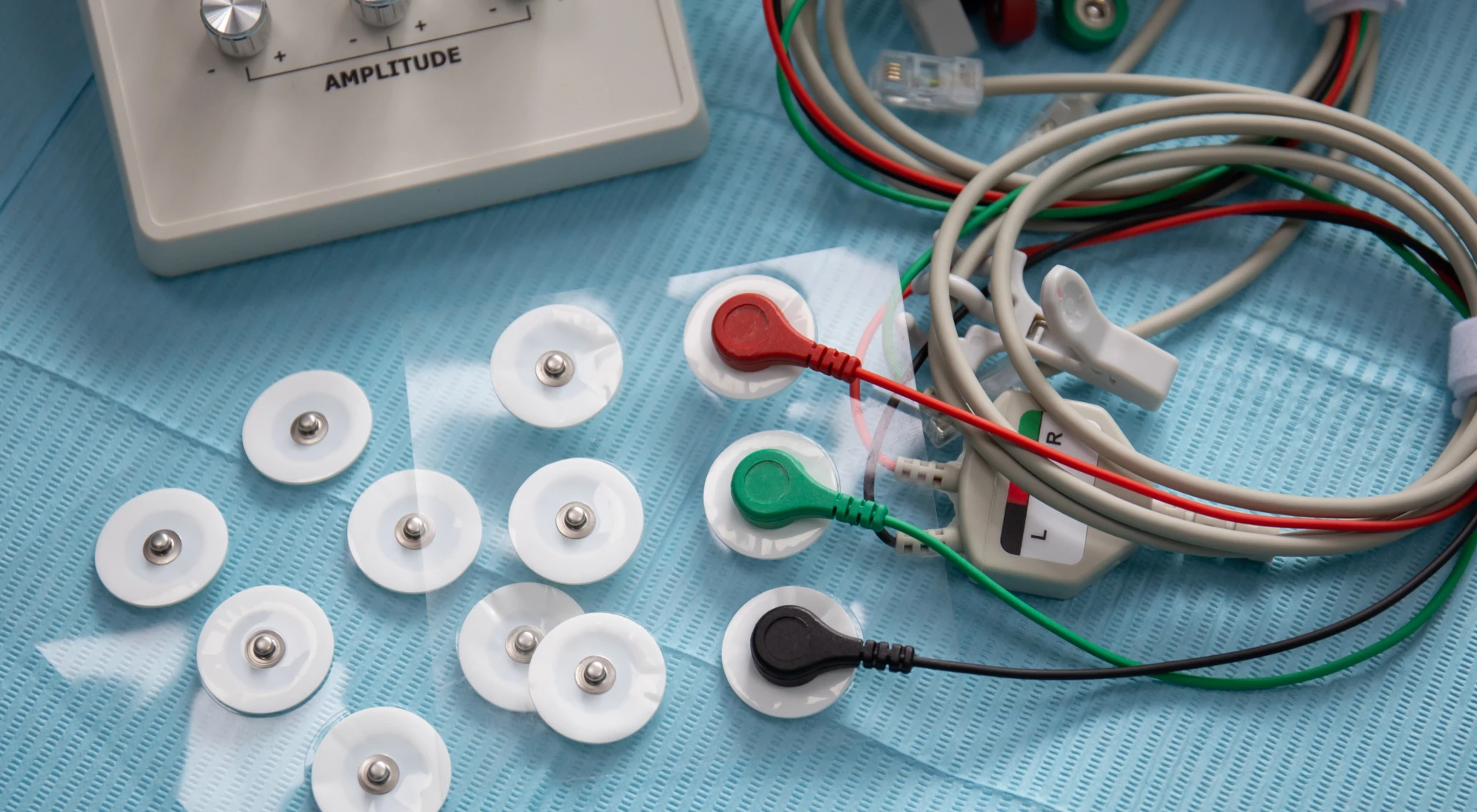
If building muscle was as simple as sending electrical signals to your body, would you offer it to your members and clients?
A new meta-analysis suggests that adding neuromuscular electrical stimulation (NMES) to resistance training could enhance muscle growth and strength gains, offering an interesting glimpse into the potential future of performance training.
While NMES has long been used in rehabilitation and recovery settings, this new research published in the European Journal of Applied Physiology suggests its benefits may extend beyond therapy and into the gym. With fitness enthusiasts and athletes constantly looking for an edge, could NMES be the next evolution in strength training?
What is NMES?
Neuromuscular electrical stimulation (NMES), also known as electrical muscle stimulation (EMS), works by using electrical currents to trigger muscle contractions, mimicking the natural signals sent by the brain. While many associate NMES primarily with rehabilitation and recovery, the technology has a much deeper and more complex history — one that dates back centuries.
The foundation for electrical muscle stimulation can be traced back to Luigi Galvani in 1761, who was the first to provide scientific evidence that electrical currents could activate muscles. Throughout the 19th and 20th centuries, researchers continued to study and document the electrical properties that generate muscle movement, discovering that electrical stimulation could induce long-term physiological changes in muscle tissue.
In medicine, EMS is used in rehabilitation settings and within medical applications to prevent muscle atrophy, particularly in individuals suffering from neuromuscular imbalances, mobility restrictions, or prolonged inactivity due to injury or illness.
NMES has also been utilized to aid recovery after musculoskeletal injuries — including damage to bones, joints, ligaments, and tendons — and even as a tool for individuals with chronic conditions, such as cancer or chronic obstructive pulmonary disease (COPD), or post-stroke patients.
Despite its use in medical and therapeutic settings, NMES has largely remained on the sidelines of active strength training — until now.
Breaking Down the Study
Researchers at the University of Texas at El Paso conducted a meta-analysis, examining data from multiple studies that investigated NMES in combination with traditional resistance training. The review included more than a dozen studies and focused on individuals who performed weight training exercises — such as bench presses and squats — while using NMES devices in comparison to those who did the same weight training routines without NMES.
The key takeaway? Participants who combined NMES with resistance training saw greater muscle growth and strength gains compared to those who trained without electrical stimulation.
Additional findings included:
Training duration matters: Training periods for participants ranged from two to 16 weeks. Participants who trained with NMES for longer periods experienced more significant improvements in muscle mass and strength.
How it works: NMES stimulates muscles to contract involuntarily, bypassing the brain’s traditional neural activation pathways and creating an additional stimulus on top of voluntary contractions.
Potential implications: NMES could be particularly useful for individuals looking to break through plateaus or maximize gains in a shorter time frame.
Dr. Sudip Bajpeyi, lead researcher explains, “Under normal conditions, the brain activates muscles by sending signals through the nervous system. NMES mimics this process by delivering external electrical currents to the nerves, causing muscles to contract without direct input from the brain.”
Co-authors on the study are Gabriel Narvaez, a recently graduated master’s student in kinesiology, and Jehu N. Apaflo, a doctoral student in interdisciplinary health sciences.

Bajpeyi is the director of the Metabolic Nutrition and Exercise Research (MiNER) lab at UTEP, where his team studies how NMES or other interventions can improve physical and metabolic health.
Funded by the National Institute of Diabetes and Digestive and Kidney Diseases, part of the National Institutes of Health, Bajpeyi is currently investigating how NMES might help regulate blood glucose levels and reduce the risk for type 2 diabetes.
“NMES has great potential for improving metabolic health by building muscle mass, which can help the body process blood glucose more effectively,” he states.
The Future of Strength Training?
NMES is not a new technology, but its integration into active strength training poses some interesting implications. As wearable technology and AI-driven training platforms continue to make headway, is it possible that NMES could become a standard tool in personalized fitness programs? Could we see gyms incorporating electrically enhanced strength training zones? Will connected fitness devices integrate NMES into smart resistance training programs?
For now, these and other questions remain as research continues into NMES and its many possible real-world applications.
