


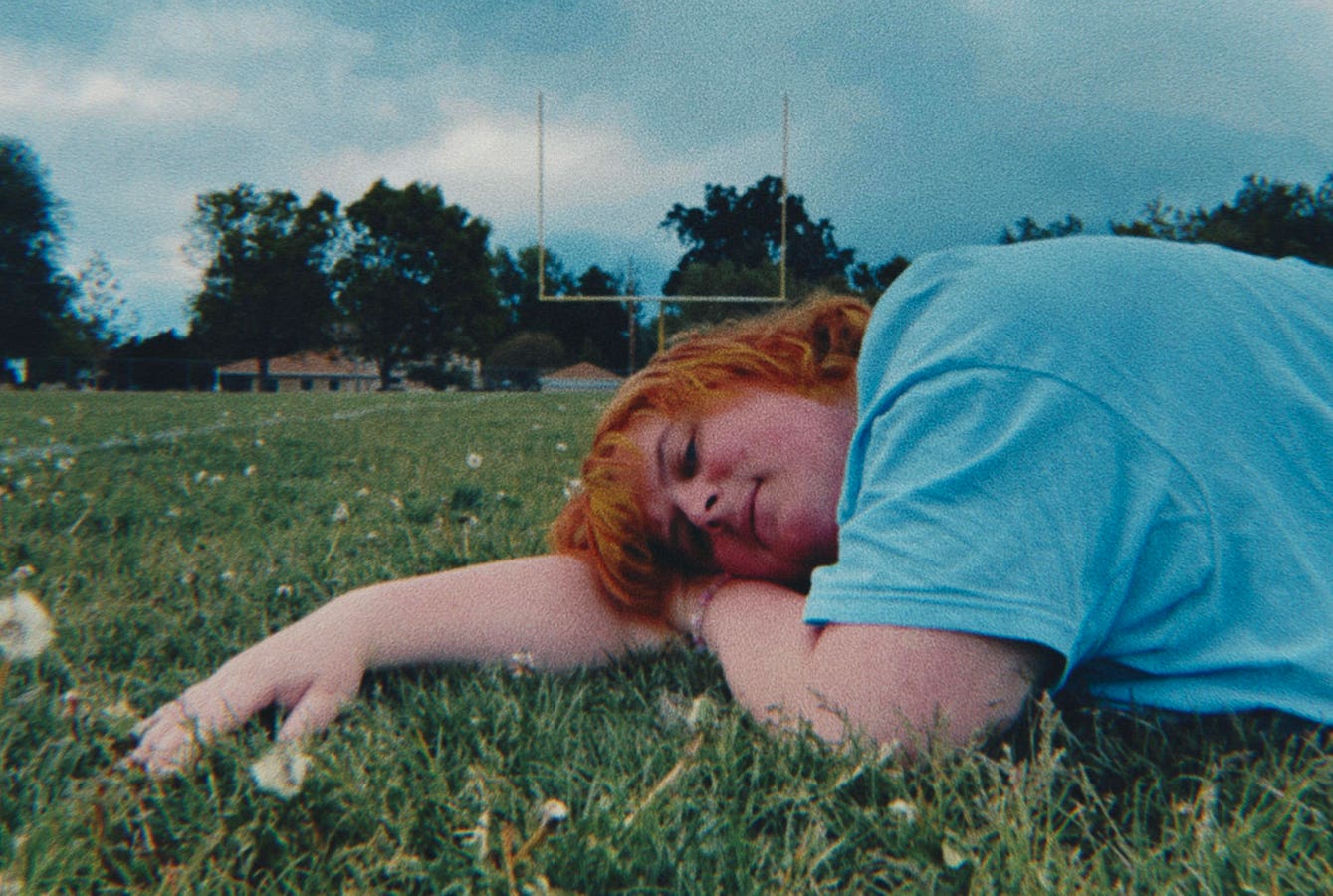
Baby Weight.
Leah Loredo
An executive order has been signed to terminate diversity, equity and inclusion programs within the federal government. Protections for transgender folks have been rolled back. An executive order calls for the federal government to only recognize two sexes—male and female. A rule that allows transgender people to serve in the military has been rescinded. A memo instructed agencies to end “programs that use taxpayer money to promote gender ideology” and take down any related information from their websites, which was done by leading public health agencies, such as the Centers for Disease Control and Prevention (CDC).
There have been many changes since President Trump stepped into office, and more are sure to come. For somebody like Cara Eser, best known behind the decks as Baby Weight, some of these changes affect her life as a transgender woman. However, this wouldn’t be the first time she has been discriminated against.
“I got spit on by protesters walking into EDC Orlando [last] year,” the genre-bending producer says. “The fact that we are dealing with this is enough to make my brain do the spinning rainbow wheel on my Mac thing. To be an artist, to be a trans artist during this time, is important, but it’s also scary as sh**. It’s something that I recognize every day, and if you could have an opportunity to go through some of the [direct messages on social media] that I swim through every day, it would probably make you lose your hair. Like, your wig would just be snatched.”
President Trump’s policies are just a fraction of the puzzle for the tastemaker, who came out as a transgender woman in 2020, as part of the discrimination she faces comes from the dance music community. She sees this discrimination online and at events, but not as much with booking and opportunities. However, she does believe President Trump’s new policies could make it harder for her to travel, which would affect promoters.
The dance music community prides itself on being inclusive for all. The producer says she receives daily harassment from the community, mainly when she speaks out on issues within dance music or tries to hold others accountable within the scene. She also receives “trolling comments” and messages on platforms like TikTok or Instagram and has gotten “very scary” direct messages from people who take it a step further.
Baby Weight has performed at festivals such as Coachella, Lightening in a Bottle, Hard Summer, Dirtybird Campout and EDC Las Vegas.
Juliette Dawson (@_juju.psd)
When discussing these issues, she says, “A lot of people like to dismiss these issues by using ‘PLUR’ as the end all be all argument.” ‘PLUR’ stands for peace, love, unity and respect. But does that really hold true when it comes to how marginalized people are treated within the dance music world? Eser doesn’t think so, particularly with how lineups are created and how valid concerns from those within the LGBTQI+ community—artists and fans alike—are often dismissed by people under this notion.
“[It’s] worth noting that the majority of people, I’ve noticed, who use PLUR as an excuse or want to argue over my lived experience/the experiences of others tend to be white, [cisgender], straight/straight-passing, male or some combination of those things—meaning their lived experience has privilege,” she says.
The sound designer, known for her emotional, cathartic and introspective music, believes the lack of visibility and validation within dance music is also part of the issue. “This industry is a very homogenous industry, and it’s largely white, cisgender, heterosexual dudes, and dance music was not formed in that space,” she says. Dance music was founded on the Black, Latino and queer communities.
Eser thinks artists and industry leaders should be responsible for keeping people educated on this history and helping form a more inclusive community. In addition, she says, music talents can put an inclusivity rider on their bookings, which she does. Inclusivity riders are when an artist can demand that a number of the other performers are of a certain race, sexuality, gender or other identity in a minority group. She adds that an inclusive rider “provides additional perspectives to our spaces as well as uplifts artists who, historically, have less resources statistically than their white, male, [cisgender] peers and, oftentimes, causes them to be overlooked.”
Another step that can be taken is for labels to dig deeper when looking for artists to sign and offer opportunities to marginalized artists. “If more labels sought out diverse talent, that means more music comes out from diverse voices, which means those artists get on lineups from those releases, and that helps foster a more dynamic, more representative music community,” she says.
“Try to pull those people up with you. It’s cool that [some artists] are pulling up their friends by the bootstraps and saying, ‘Hey, come along for the ride,’ but they really should be expanding their purview of who they could be pulling up. That’s how allyship actually happens,” Eser adds. “If you’re going to be invited into someone’s home, you have to be a good guest, and part of being a good guest is speaking up when it’s not convenient. It’s one thing to say [during Pride Month], ‘I stand with this community,’ but when you’re entirely silent the other 11 months out of the year whenever something horrible happens, that’s not really allyship.”
The sonic storyteller helps uplift emerging artists with her imprint, Chub Rub, which is planned to officially relaunch this year after taking a hiatus due to the stresses of navigating the industry post-Covid. She says the label is “an opportunity to pay it forward and to give people that shot” because many labels won’t sign an artist’s music unless they’ve released on other imprints. She adds that this is because “many labels, especially house [music] labels, are independent and have to think about money first. A lot of labels are more willing to take a chance on an established artist with a track record than spend time/resources on a less developed talent. It’s a gamble.”
Eser believes there are many talented artists making forward-thinking and innovative music who just “need that little bit of a push.” There have been producers who have released their first or second record on Chub Rub. Since the imprint started, the label boss says some artists have gone on to release music on notable labels, such as Dirtybird and Night Bass. Not only does she uplift emerging artists, but she also supports marginalized producers.
“We could be doing more to promote women in this industry, queer people in this industry, persons of color in this industry,” she says. “It’s a conversation that we always hear and that we always engage in, but then very few people actually step up to the plate to actually do something about it, which is why I love working with LP Giobbi at Femme House so much because they’re one of the few groups that I feel goes out of their way to make sure that everybody has a seat at the table. In some ways, I want Chub Rub to be an opportunity for that, too—to make things more equitable.”
Baby Weight behind the decks.
MAKO Photography
When it comes to releasing her own records, the Washington, D.C.-based producer says for a long time, she was dropping tunes that she felt would land her gigs and get her music signed to labels. But just before the pandemic, the vanguard says, she realized that the style of music she was producing wasn’t staying true to who she was. Through “a lot of soul searching,” she discovered that she needed to pivot by focusing on what makes her happy instead of what would make her a bookable talent.
“I feel like there was a lot of stress prior to the pandemic for artists in my lane to make more tech house-leaning records,” Eser says. “And I still, from time to time, write records for a club environment, but that never really made me feel whole. And really, the records that I look back on from that time period, that I feel some kind of emotional attachment to, are the ones that sidestep that kind of more mainstream tech house. I made a commitment to myself to really hunker down and work on a bunch of music that just made me happy. Thankfully, now people are reacting to that type of music in a positive way. I think prior to the pandemic, artists like Fred again.., who I feel an emotional attachment to, might not have exploded in the way that they did. I think that really opened up the doors for artists like me now who have always wanted to show that more emotional, vulnerable side of themselves in dance music but never felt like audiences would be able to respond positively to that.”
The independent artist says the records she has since released that are more personal are getting a positive reaction from fans. The beats she has since been dropping and those she will going forward will be a better representation of who she believes she is as an artist. She defines this style as “house adjacent” since she is also creating songs with elements of breaks, garage, indie dance, bass music and disco—as seen on her record “Long Way.” However, she doesn’t describe this new style as open format but more of her experimenting with sounds that make her happy.
“For some people, they might not be too thrilled about it because their favorite tracks are stuff from a few years ago, like the ‘Scooby Dooby Boof’ track I did or ‘The Bread Song,’” she says. “These are kind of like more be-ready tech house tracks or whatever, but to me, those tracks were a means to an end. They were a stepping stone that could get my foot in the door so that when time finally came, I could do my own thing.”
This change is sonic style is exemplified on her Lavender Lemonade EP, released last year via Justin Martin’s What To Do label.
On the three-track body of work, audiophiles hear angelic tunes, staticky sounds, tinkering and swirling synths, playful basslines, powerful and sultry singing, computer-sounding beats, shimmering soundscapes, acid basslines, liquid drum’n’bass and groove-inducing production. The earworm record provokes a sense of longing, one that is uplifting, cathartic and beautiful. For the breakthrough artist, the EP, originally titled No Tears in Heaven, is especially cathartic as it was renamed for Denise, a close friend of Eser’s who passed away. Denise was also known by her stage name, Lavender Lemonde.
“[Denise] was always like the first one at the party,” Eser says. “She was always super supportive [and] the last one there on the dance floor every night. [She] went to every show, every weekend, and had always had dreams of DJing and always had dreams of being at like Dirtybird Campout and all of this other stuff. So when I had the opportunity, when Justin Martin reached back to me and said, ‘Hey, I really like these records,’ and he had told me he was open to releasing some music by artists other than himself on What to Do, I saw it as a sign from the universe to change the name of the song and change the name of the overall EP in her Denise’s honor, because Justin Martin was her favorite artist. I saw it as a way of having some closure. Her artist name was Lavender Lemonade, so that’s kind of where this all comes together. So spiritually, it feels like it fulfills something that she had always wanted.”
Lavender Lemonade keeps in step with what Eser tries to do through her music and performances: take listeners on a sonic journey.
“With my music now, I’m trying to capture that feeling of euphoria. And in some ways, it takes me down this very joyful path. And in other ways, it’s kind of a more melancholy feeling and wrestling with being okay with that feeling,” she says. “So when I’m DJing, I feel like it’s this waltz or this tango between those two emotions, just constantly moving back and forth, and finding that delicate balance between the two because I think that’s where most of us exist naturally in real life. It’s this pull between excitement and joy and happiness and feelings of not being good enough or doubt or just distress. I think finding the balance between the two is where that equilibrium sits. That’s what I’m aiming for when I DJ and when I’m writing records, to be honest. I want my music to feel like a journey for people.”
“I just want to make music that makes people feel something,” Eser adds. “And if I’ve done that, then great. I’ve done my job. Whether it’s laughing, crying, having post-traumatic flashbacks to like the time the ice cream machine was broken at McDonald’s or whatever, I just want people to feel something instead of showing up, paying $50 showing up only to see the headliner because your friends wanted to pregame the entire time. Then you get like an hour of just peak time music. You’ve spent $40 additional on two drinks. You go home, like that. That doesn’t sound like fun to me. Life should feel like a Polaroid photo, not like a JPEG on an iPhone.”
MORE FROM FORBES
