


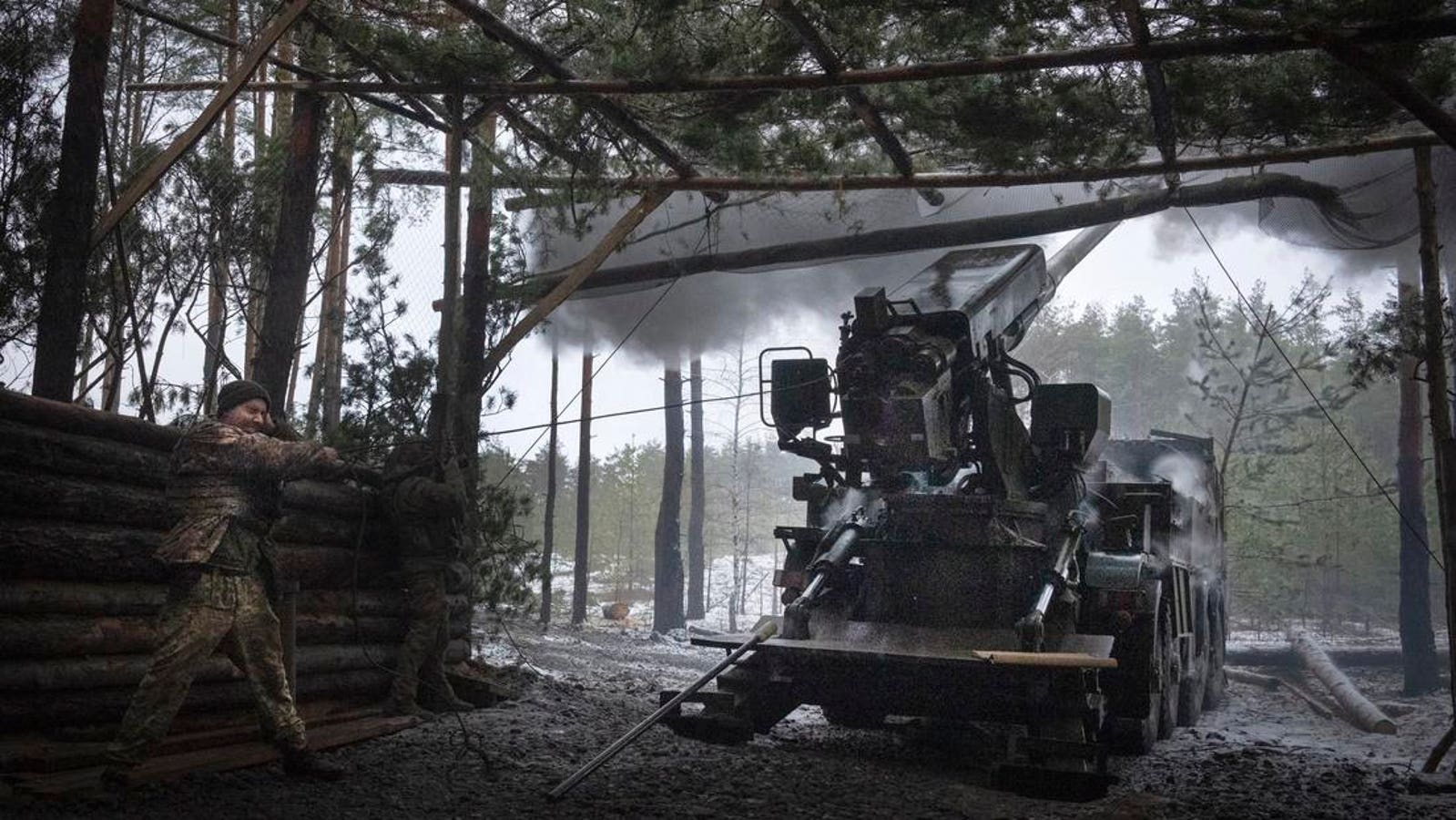
A Ukrainian serviceman fires a self-propelled howitzer “Bohdana” towards Russian positions near … More
Until recently, Ukrainian artillery accounted for the majority of Russian combat losses in the Russia-Ukraine War. However, drones have now taken on this role, partly due to Ukraine’s significant losses of howitzers. In response, Ukraine has increased its ability to deploy large numbers of its domestically produced 2S22 Bohdana self-propelled howitzers. This progress is the result of adjustments to the system’s development process, allowing Ukraine to emerge as a leader in howitzer production. Ukraine’s ability to manufacture these weapons is crucial, as combining artillery with drones and infantry tactics creates a powerful combat advantage.
Production of the Ukrainian 2S22 Bohdana
In a recent interview, Igor Fedirko, the Executive Director of the Ukrainian Defense Industry Council, indicated that Ukraine has the capacity to domestically produce 40 Bohdana self-propelled howitzers per month. The Bohdana is a self-propelled howitzer mounted on a wheeled truck chassis, featuring an autoloading gun capable of firing 155mm shells with a range exceeding 40 km. Ukraine started developing the Bohdana in 2016, with the initial system fielded in 2022.
A Ukrainian self-propelled howitzer “Bohdana” fires towards Russian positions near Bakhmut, Ukraine, … More
Ramping production up to 40 howitzers per month is an impressive feat when compared to the production capacities of other countries. A report by the Kiel Institute approximates that Russia, with its established defense industry and large military budget, also produces 40 howitzers per month. The same report indicates that France can now produce 8 Caesar cannons per month and that Germany can only produce 5 to 6 of their Panzerhaubitze 2000 howitzers per year. Meanwhile, BAE Systems delivered 216 M109A7 Paladins to the United States military over 54 months, equating to 4 howitzers per month.
To achieve its current production levels, Ukraine leveraged its domestic manufacturing capabilities to streamline component production. However, chassis availability became a bottleneck. Initially, the Bohdana was mounted on the KrAZ-6322 6×6 truck chassis. To accelerate production and reduce dependence on a single supplier, Ukrainian manufacturers introduced alternative chassis, including the Ukrainian Bogdan-6317 chassis and the Czech Tatra Phoenix 8×8. Ukraine also introduced a towed variant of the howitzer. Despite these efforts, the limited availability of truck chassis remains a primary constraint on production rates.
The Need For Artillery On The Modern Battlefield
Last month, Ukrainian drones were responsible for approximately two-thirds of Russian combat losses. While drones have become an essential asset, this figure may be inflated due to Ukrainian artillery shortages and ammunition conservation. According to Oryxspionkop.com, Ukraine has lost 735 howitzers, including towed and self-propelled, averaging 20 per month. Since Oryxspionkop only includes those items that have been verified through open-source images, the actual number of losses would be higher. As Ukraine’s artillery production likely now outpaces its losses, combined with its domestic shell production, artillery should return to playing a very prominent role in the conflict.
Social media capture of a video credited to the Ukrainian 47th Brigade using drones to locate … More
The ability to deploy large quantities of artillery is a decisive factor on the modern battlefield. Both Russia and Ukraine have refined the integration of artillery and drones to maximize effectiveness. Reconnaissance drones operate above jamming range, using advanced optics to detect enemy vehicles and troops. They then use a combination of artillery and FPV drones to strike these targets and suppress the enemy formations. Artillery offers several advantages compared to the more precise FPV drones, including that artillery rounds are cheaper than most drones, can carry heavier payloads, and are not vulnerable to jamming.
Artillery also plays a critical role in supporting infantry operations, particularly in assaults aimed at securing territory. To gain control of an area, Ukrainian troops must push forward and dislodge Russian forces. While drones excel at targeting key equipment, the sheer firepower of an artillery barrage forces Russian troops out of fortified positions and vehicles. Once enemy defenses are weakened, Ukrainian infantry can advance and eliminate any remaining opposition, securing the area. Ukraine recently used these tactics successfully in a counterattack in Chasiv Yar, reclaiming positions held by Russian forces.
When Russia launched its invasion in 2022, few expected Ukraine to still be fighting three years later. A key factor in Ukraine’s resilience has been its ability to innovate in both technology and tactics. While drones and electronic warfare have drawn significant attention, Ukraine’s rapid expansion of howitzer production has been equally remarkable. With a monthly output of forty Bohdana howitzers, Ukraine’s production capacity rivals that of Russia and surpasses every Western military. Combined with its advancements in other defense domains, Ukraine’s growing howitzer arsenal enhances its ability to sustain and adapt to a very uncertain battlefield.
