


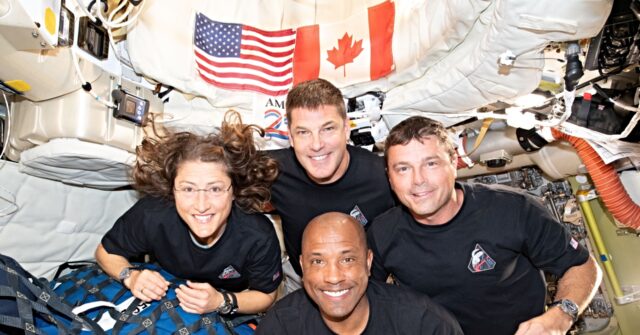
The four astronauts of NASA’s Artemis II were making final preparations for their return to earth Friday after launching from Kennedy Space Center nearly 10 days ago.
NPR reports the crew’s Orion space capsule is scheduled to enter the atmosphere at 7:53 p.m. ET, just southeast of Hawaii. Some 13 minutes later, it should splash down in the Pacific Ocean off the coast of San Diego.
To make it there, the spacecraft will first have to punch through the Earth’s atmosphere at about 25,000 miles per hour and experience temperatures upwards of 5,000 degrees Fahrenheit.
The splashdown sequence, beginning with the separation of the European Service Module, takes roughly 42 minutes to complete.
The Weather Channel sets out the exact timing and sequences that will prove critical to a safe return to earth:
Exposing the heat shield, Orion is ready to face temperatures soaring to nearly 3,000 degrees as it slices through Earth’s atmosphere. Don’t worry, this shield is designed to take the heat, though NASA is watching extra closely after significant erosion seen on the Artemis I.
Once reentry heat peaks, Orion will shed its cover, clearing the way for a precise parachute sequence. Two initial parachutes will deploy to slow the capsule from over 300 mph, followed by three pilot chutes that will pull out the final three main parachutes.
By the time Orion hits the Pacific Ocean, it’s expected to be gliding at a calm 17 mph. That’s when pre-positioned recovery teams from the U.S. Navy and NASA will move in.
Ahead of reentry, the crew will have returned to their cabin to its original configuration, stow all equipment and suit up.
After landing, helicopters will retrieve the astronauts and take them to the USS John P. Murtha, where they’ll undergo medical evaluations before taking a plane back to NASA’s Johnson Space Center in Houston.
The BBC reports the re-entry and subsequent splashdown are considered the most dangerous part of the Artemis II mission as the Orion capsule endures temperatures about half as hot as the Sun.
RELATED: Artemis II Astronaut Cites Love of Christ Just Before Losing Signal While Circling the Moon
Once safely landed, the crew of NASA’s Reid Wiseman, Victor Glover and Christina Koch, and Canadian Space Agency astronaut Jeremy Hansen, will have time to reflect on their achievements.
The Artemis II mission’s spacecraft, Orion, broke the record for human travel at about 13:56 EDT on Monday, beating a record of 248,655 miles (400,000km) held since 1970 by the Apollo 13 mission.
Straight after the Moon flyby, President Donald Trump spoke with the Orion team and congratulated them: “Today, you’ve made history and made all America really proud, incredibly proud.”
Artemis II marks the first crewed moon mission in more than 50 years.
The trip is a prelude to what NASA says will be a moon landing by 2028 and then a constantly inhabited lunar base.
