


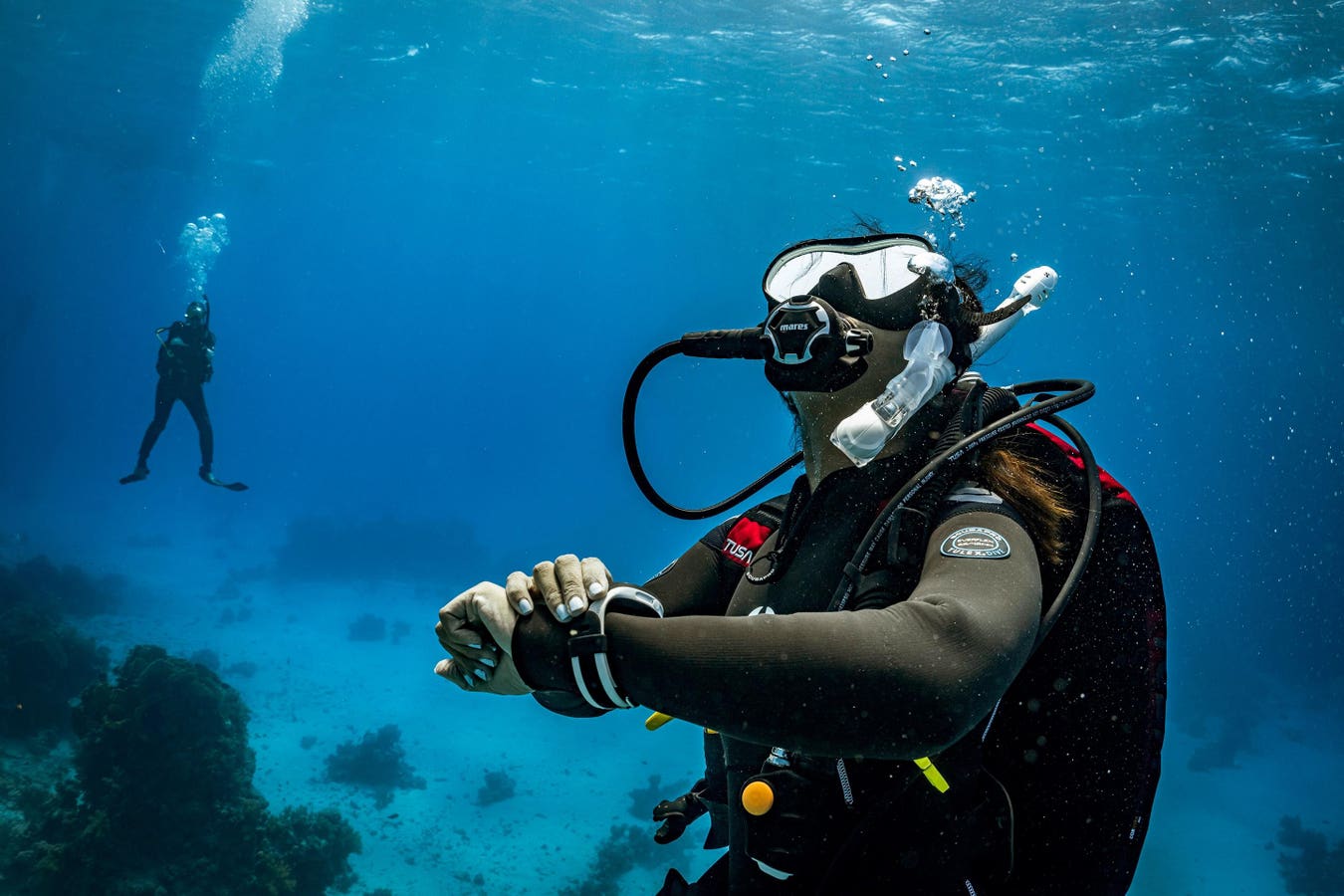
Divers in Egypt.
Scuba diving isn’t just an adventure, but it drives a multi-billion-dollar industry with over 50.7 million dives happening globally each year.
The latest peer-reviewed research, published on February 15, shows that upgrading all existing recreational dive sites to fully protected Marine Protected Areas (MPAs) could surge diving demand by 32% and generate an estimated $2.7 billion in additional annual revenue.
The study is the result of three years of work by scientists from National Geographic Pristine Seas and contributors from the Professional Association of Diving Instructors (PADI) network of 6,600 dive centers and resorts across more than 180 countries.
Divers Are Willing To Pay Nearly Double For Protected Sites
Scuba diver is exploring the coral reef and its marine life.
The study estimates a global median price of $58.75 per dive. However, findings show that divers would pay an additional $53 per dive inside a fully protected MPA, raising the median to $111.75.
The $953 million revenue increase from a 32% rise in demand only considers the current median price. The total potential revenue could nearly double to approx. $1.81 billion, taking into account the higher median price per dive.
To take it a step further, 67.35% of dive sites are in an MPA, but only 15.48% of total dives take place in highly or fully protected areas. That amounts to over 7.7 million dives annually.
Upgrading just 15% more dive sites to full protection could push revenue from this premium pricing model beyond $865 million annually. And that is in addition to factoring in the estimated 32% surge in overall demand.
Fully Protected MPAs Will Boost Marine Life By 113%
Reefscape with hard corals and tropical fish at the Great Barrier Reef, Australia.
The study also estimates that fully protecting all unprotected dive sites could increase marine life (biomass) by 113% on average.
If governments place only 1% of ocean areas used for recreational scuba diving into highly protected MPAs, the global biodiversity score could rise by 5% (from 0.54 to 0.57, where 1.0 means all marine species face no threats).
For comparison, protecting the entire ocean would boost the biodiversity score by 39% (from 0.54 to 0.76) since there are several additional factors, such as pollution or global warming.
Which Locations Could Be The Next Marine Protected Areas?
The study also concluded that more than half of all recreational dives (51.69%) happen in just eight countries: Egypt, Thailand, the United States, Indonesia, Australia, the Philippines, Mexico, and Malaysia.
If new Marine Protected Areas (MPAs) were to be created, 61% of the increased activity would be due to foreign tourists. The study estimated that the destinations where this spending will most likely concentrated are East Asia, the Pacific (including Oceania), Europe, Latin America, and the Caribbean.
Adopt the Blue is PADI’s global marine conservation program, sponsored by Blancpain. Since its launch in 2022, the program has successfully adopted 2,562 sites, covering over 29 million square miles of ocean worldwide.
Kristin Valette Wirth, global brand and membership officer at PADI highlighted in an email interview that PADI is working closely with several governments across the globe to provide real-time data on marine debris, coral bleaching and habitat loss.
In 2025 PADI’s priority is assist in establishing MRA in Rainbow Reef in Taveuni, Fiji and extending the coverage of MRAs in Barbados.
Great White Wall, Rainbow Reef, Taveuni Island, Somosomo Strait, Pacific Ocean, Fiji Islands.
The Hidden Problem Is Who Gets The Profits
While dive tourism may fuel economies in developing and least-developed countries, the financial benefits often slip away from local communities.
The study pointed out that foreign-owned dive operations dominate many diving destinations. As a result, a significant share of tourism revenue never reaches local businesses or workers since these operators frequently employ non-local staff.
One solution could be for local governments or park authorities to impose a fee to maintain and protect the MPAs through a dive site access fee, marine park entrance fees, or permits. For example, Raja Ampat in Indonesia levies IDR 700,000 as an entrance fee. Bonaire National Marie Park asks for a $40 nature fee, valid for a year.
Wajag Island, Raja Ampat Regency, West Papua, Indonesia
How To Protect The Oceans Without Hurting Local Communities?
Designating a fully protected MRA means an outright ban on fishing, which is usually an economic lifeline for many coastal communities. Without proper safeguards, these protections could do more harm than good, cutting off their earnings overnight.
For destinations looking to balance conservation with economic sustainability, the challenge is not only about protecting marine life or increasing income from tourism but also about defending local livelihood.
Working in tourism, including scuba diving, could replace fishing. However, the newly established Changuu-Bawe Marine Conservation Area shows another alternative.
In partnership with the Zanzibar government, Bawe Island by The Cocoon Collection established the Changuu-Bawe Marine Conservation Area in February 2025.
Changuee Bawe Marine Conservation Area and the Bawe Island by The Cocoon Collection
“Fishermen from Bumbwini in the northwest of Unguja used to camp on the Island for seasonal periods rather than full-time,” explains Atillio Azolla, founder of Bawe Island by The Cocoon Collection, on how the new MPA has affected local communities.
To support the transition, the resort has already built four functional homes for local fishermen and a private boat dock, ensuring they maintain easy access to fishing zones outside the protected area.
The resort also pays for the catch the fishermen willing to sell them. “Although 4 fishermen can only supply a small portion of Bawe’s seafood demand, it is considered a good starting point,” continues Azolla.
Bawe Island, off the coast of Zanzibar, Tanzania, located about 6 miles west of Stone Town in the … [+]
How To Strike the Right Balance?
Fully protecting more dive sites presents a huge economic and environmental opportunity, but they can also disrupt local livelihoods if safeguards aren’t in place.
Can sustainable tourism fully replace fishing in coastal communities? How can governments ensure that income will reach local businesses, not just foreign operators? What policies should be in place the balance marine life protection and economic boom?
The future of the dive tourism industry, the health of our oceans and the economic stability of coastal communities all depend on getting these answers right.
