


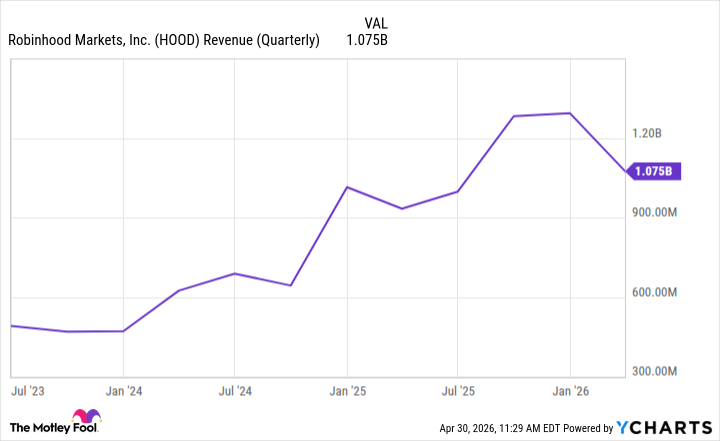
The first-quarter earnings report for Robinhood Markets (NASDAQ: HOOD) illustrates how widespread the downturn in cryptocurrency has been this year. The falloff is not only hurting digital currencies and the investors who hold them, but also stifling the returns of some companies, such as Robinhood.
Robinhood, an online broker that offers commission-free stock trading, as well as access to options, cryptocurrency, and prediction markets, posted revenue of $1.07 billion in the first quarter, up 15% from a year ago. But the market punished Robinhood stock, sending shares down 14% immediately after the report, because revenue growth slowed significantly from the fourth quarter of 2025.
Will AI create the world’s first trillionaire? Our team just released a report on a little-known company, called an “Indispensable Monopoly,” providing the critical technology Nvidia and Intel both need.
Continue »

The biggest culprit here isn’t Robinhood’s business model — it’s the rapid decline of cryptocurrency prices, which has cast a shadow on the entire sector. The global crypto market peaked in October at $4.38 trillion but has dropped 40% to $2.63 trillion at this writing. And while there’s been a lot of theories about why the crypto market stagnated, ranging from Middle East conflict to interest rates and inflation, the bottom line is that none of those are Robinhood’s fault.
But the company is feeling the pinch, nonetheless.
A look at Robinhood’s earnings
While Robinhood got hammered by the market for a drop in revenue growth, I think a look behind the curtain shows there’s still a lot to like here.
Robinhood earns revenue in many different ways. Roughly half of its sales come from transaction-based revenues. Equities (stocks and exchange-traded funds) revenue was up 46% to $82 million, while options revenue was up 8% to $260 million. Robinhood also saw a huge increase in its prediction markets business, as event contract revenue was up 320% to $147 million. The only downturn in the segment was in cryptocurrencies, which fell 47% to $134 million.

But every other notable segment of Robinhood’s business is on the rise. Net interest revenue was up 24% to $359 million as the company profited from growth in interest-earning assets. And its Robinhood Gold subscription revenue jumped 32% to $50 million as the number of premium members increased to 4.3 million.
Management shook off concerns about crypto trading and expressed confidence in the space. “We are crypto bullish … but it’s less than 20% of our revenue last year, about 18%. So it’s an important part of the business, but we’ve vastly diversified,” Chief Financial Officer Shiv Verma told analysts on the company’s earnings call.
