


Gold has quietly outrun Bitcoin by a wide margin — and one Wall Street analyst says that gap tells the real story of where markets are headed.
Related Reading
Bitcoin’s ETF Gains Pale Against Gold’s Run
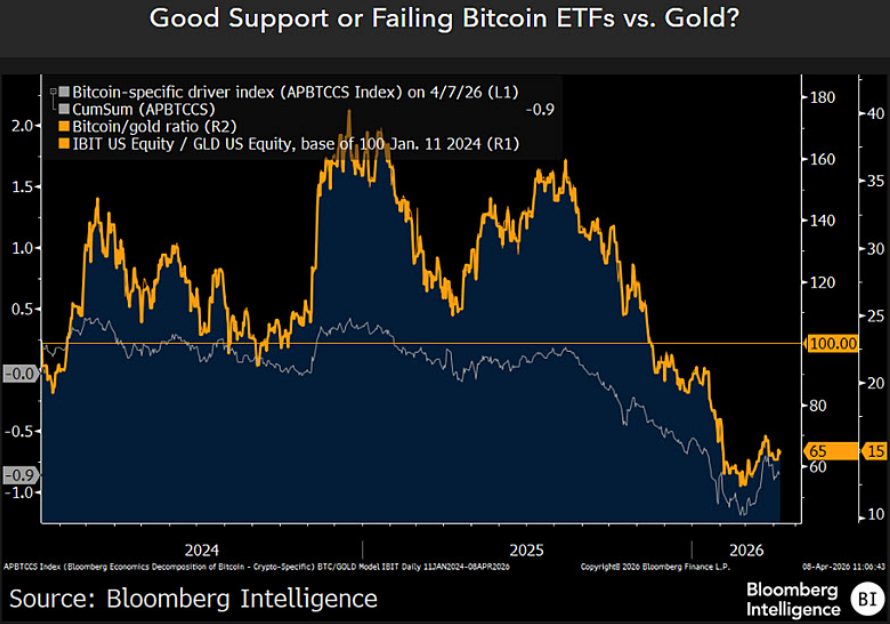
Since the launch of US spot Bitcoin exchange-traded funds in early 2024, BlackRock’s iShares Bitcoin Trust helped push Bitcoin’s price up roughly 50%.
Gold, over the same stretch, climbed about 135%. That performance gap is central to the argument being made by Mike McGlone, senior commodity strategist at Bloomberg Intelligence, who says capital may already be moving away from high-risk assets toward safer ground.
McGlone has been laying out his case through a series of posts on X, warning that the explosive run Bitcoin made past $100,000 following the arrival of spot ETFs may now be over.
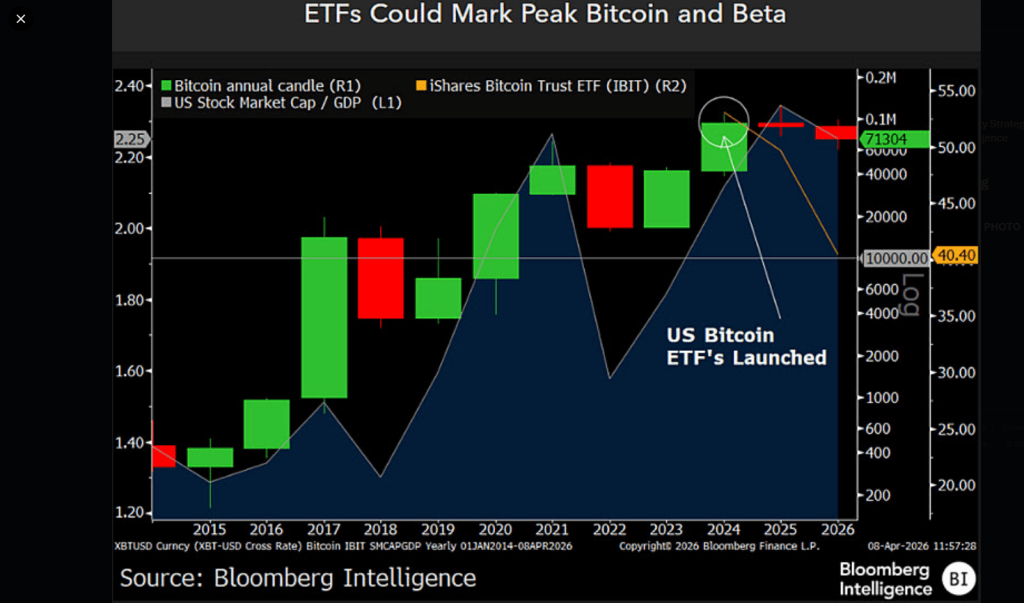
Bitcoin is currently trading around $72,000. McGlone’s downside target is $10,000. Getting there would require a drop of more than 86%.
Bitcoin May be Guiding Risk Asset Reversion
The launch of US Bitcoin ETFs in 2024 helped push the price above $100,000 and may guide reversion back toward $10,000. What’s notable from my graphic is the first-born crypto reaching an apex in 2025 alongside US stock market… pic.twitter.com/LCKF213Ss4
— Mike McGlone (@mikemcglone11) April 9, 2026
Peak Cycle, Not A New Era
McGlone traces Bitcoin’s 2025 high of $126,200 to a specific moment in broader market history. At roughly the same time Bitcoin hit that peak, the US stock market’s total value relative to the country’s gross domestic product reached its highest point since 1928 — a ratio widely used to judge whether equities are overpriced. According to McGlone, that overlap is not a coincidence.
He describes the conditions that drove Bitcoin’s rise as a mix of ETF-driven inflows, political tailwinds from US President Donald Trump’s embrace of crypto, and what he calls “peak beta” — a phase where speculative assets briefly surge before falling hard.
Reports from his analysis suggest this combination created the conditions for a sharp reversal rather than a sustained bull run.
Bitcoin is also about four times more volatile than the S&P 500, according to McGlone’s data, which he says makes it a difficult sell for institutional investors who weigh returns against risk.
Capital Rotation Raises Questions About Bitcoin’s Role
The S&P 500, on a risk-adjusted basis, has outperformed Bitcoin ETFs since their debut. McGlone points to that as a sign the ETF launch may have served more as a late-cycle catalyst than a structural turning point for the asset class.
Based on his analysis, the phase he calls “pump then dump” — where prices spike and then reverse — may already be underway. If that reading is correct, Bitcoin could fall alongside other speculative assets while gold continues to attract investors looking for stability.
Related Reading
McGlone stops short of saying exactly when a drop to $10,000 would occur. His argument is framed around broader market conditions tightening and investors pulling back from risk, not a specific timeline.
What he does say clearly is that the ETF boom, once seen as a long-term driver for Bitcoin, may have already done most of its work.
Featured image from Unsplash, chart from TradingView
