


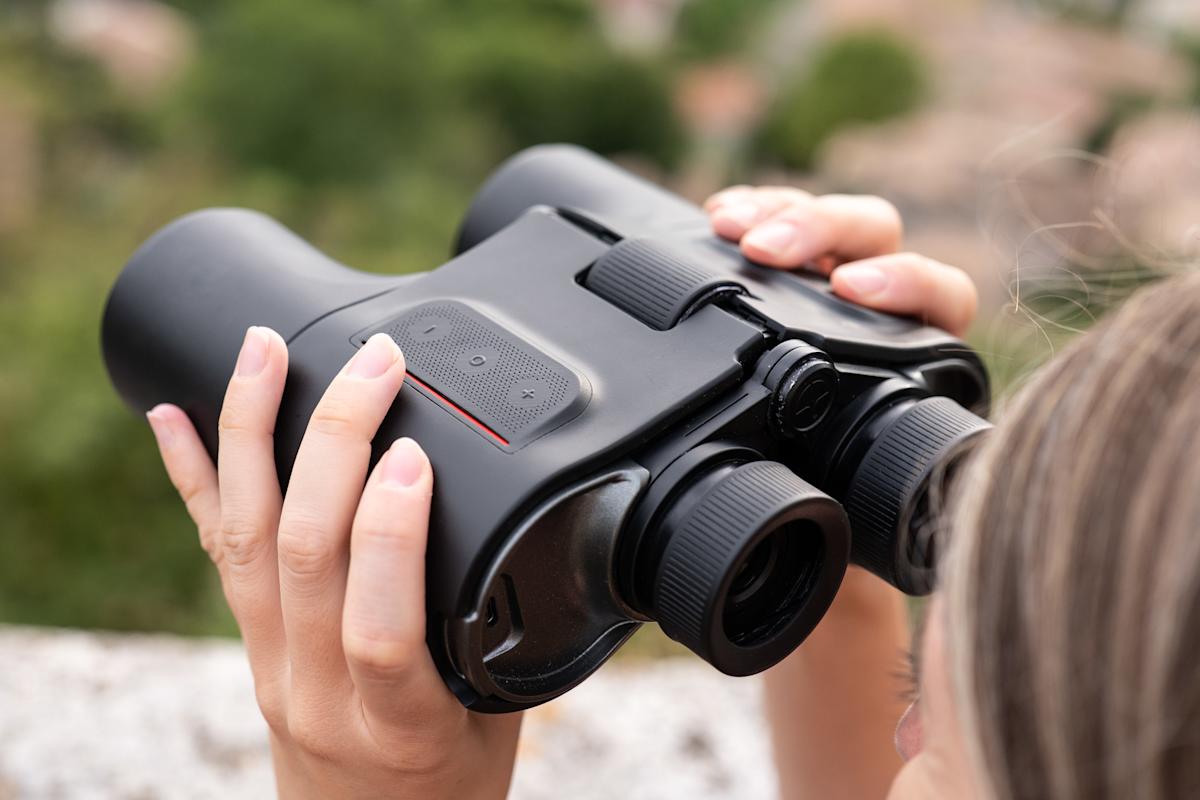
It’s not every day I get to try out an entirely new type of tech product. Telescope company Unistellar recently gave me the chance to do just that with Envision, the first smart binoculars that can identify mountains and stars. The only things like it on the market are Swarovski’s smart binoculars, but those are triple the price and strictly for birds and wildlife.
At an event near Marseilles, I tried an Envision prototype with the design and most of the functionality of the final product (like several other Unistellar products, the company marketed it on Kickstarter and raised $2.7 million). Some features were a bit rough and it took practice to use the binoculars smoothly. But it’s an interesting amalgam of analog and digital tech that’s bound to be a hit with astronomers and travelers.
The Envision initially came out of a conversation between Unistellar engineers wondering why there were no binoculars with an AR-like digital overlay. They soon found out: It was a huge engineering challenge. Combining all the data into an overlay and getting it to line up with the optical view was particularly vexing. Reducing latency was another problem, so that the digital display wouldn’t lag behind the optical view.
The company eventually came up with a solution it borrowed from AR tech. Envision combines premium lenses with an augmented reality projection system that beams contextual info into the optical path via a bright, high-contrast microdisplay. That overlay only appears in one eye, but your brain transforms it into a complete image.
The Envision binoculars take data from inertial sensors and a compass using custom software to “guarantee precise positioning and low-drift orientation” of the digital display. It then pulls in topographic and cartographic info from a large database and merges it onto an AR overlay based on your location and viewing direction. This information comes from your phone’s internet connection, but the binoculars can be used offline as well if you load specific regions in advance.
I tested a hand-built prototype that lacked the quality control that will happen in full manufacturing. However, the materials, optics and electronics were nearly complete. For daytime testing, I went to the Citadelle de Forcalcquier that offers a panoramic view of mountain ranges in the region. While it was a bit overcast and rainy, distant peaks up to 30 miles away were still visible.
Though a bit heavier than regular binoculars, the Envision was comfortable to hold and use over a period of an hour thanks to the rubberized coating and high-quality plastics. To use the Envision, you set them up as you would any pair of binoculars. They have a diopter adjustment for your specific vision and you can retract the eyecups for use with glasses. There’s a width adjustment to match your eyes and a focusing wheel to sharpen the view.
With all of that set, there’s a rocker control on the left side that enables the AR overlay, which consists of monochrome red graphics like an old-school arcade game. The previous/next buttons let you switch between targets, which you can then select by hitting the “validate” button.
The last button, “target lock,” does two things. Clicking it once does exactly that, locking onto the target. Then, if you pass the binoculars to someone else, they’ll be guided by arrows to the same object. And to correct any drift that inevitably occurs, you press and hold the target lock button and move the binoculars until both the overlay and optical view align. Lastly, release the button and everything is re-synced.
As regular binoculars, they gave me a clear view of distant objects. I switched on the AR and waited a few seconds for my eyes to adjust. When looking at a mountainous horizon, the Envisions overlaid a red outline matching the topography, with the names of peaks and ranges displayed at the bottom center of the screen, along with their elevations and distance from the viewer. It was a half-inch or so off the real-world view, so I used the target lock control to align them perfectly.
The latency wasn’t bad, but if I moved the binoculars too quickly it took a second or so for the overlay to catch up. After scanning across the horizon a few times, the overlay would drift out of sync again, so I needed to use the target lock to realign the views once more. Both the latency and misalignment should improve with the final production version, Unistellar told me.
For now, the Envision can only identify mountain peaks, valleys and ranges. In the production version and via future updates, however, it will identify things like water springs, shelters, hiking paths, rivers and lakes. A companion app will provide the updates, and the software also lets the user select points of interest, access the geographical database and receive guided tours. Sadly, none of those features were available in the prototype I used.
The next test was star spotting using Envision’s Night mode. Fortunately, I didn’t need to go far (the hotel pool) as the clouds covering the sky for most of the day serendipitously broke apart to give us a crystal-clear starscape.
For a stargazing experience, the Envisions were transformational. With the binocular optics set up as before, switching on the AR view instantly displays the names of individual stars, linked together in their constellations by lines. For example, it pointed out Lynx, a constellation that’s faint with the naked eye, along with its fourth brightest star Alsciaukat (31 Lyncis). The final version of the binoculars will also display nebulae, galaxies, planets, moons, comets, asteroids and even human-made points of interest like the International Space Station (ISS) and Apollo landing sites.
This could make the Envision an outstanding educational tool. You can lock onto a star, then give the binoculars to someone else and they can quickly locate the same body by following the arrows. They’ll also see whatever constellation it’s part of. It would only take a few nights of stargazing for someone to learn a lot about the night sky.
At the same time, it’s a great way for aspiring astronomers to survey interesting targets to study with a more powerful telescope. I did just that, using the Envision to home in on a star cluster. With the name clearly displayed, I punched it into Unistellar’s Odyssey Pro smart telescope and quickly saw it with a larger, clearer view. Conversely, you’ll be able to enter a star name into Unistellar’s app and be guided to it by Envision, in the final production version.
The Envision does have some issues. If you’re someone who already has trouble seeing through binoculars, these may not be for you. The AR display can be hard to read at times, and adjusting the brightness (especially for night viewing) can be a challenge. One missing feature is a built-in camera like the one on Swarovski’s binoculars. That was a bit disappointing, as you can’t easily share your experience on social media. The only way to do so is to snap images with your smartphone through the eyepiece. That effectively requires you to lock the binoculars onto a tripod which, well, defeats the purpose of binoculars.
With that being said, I think Unistellar’s first crack at smart binoculars was a success, even in their unfinished form. They add an informational element to a true optical view and finally bring binoculars, which have been around for hundreds of years, into the informational age.
Like any early product (I’m thinking of Pebble’s smartwatch), it’s bound to improve significantly in future versions. Yes, there are smartphone apps that can identify stars and geographical features. But there’s something about looking through a lens and seeing a true image that can’t be beat. And with Envision, you’ll finally know exactly what you’re seeing.
Unistellar is opening pre-orders for its Envision smart binoculars starting today at $999, a fairly steep discount from the final $1,499 retail price, with deliveries set for October 2026. That’s a long way off, but if you’re willing to wait, Unistellar has a perfect track record with its smart telescope deliveries. Retail availability is even farther away, set for 2027.
