


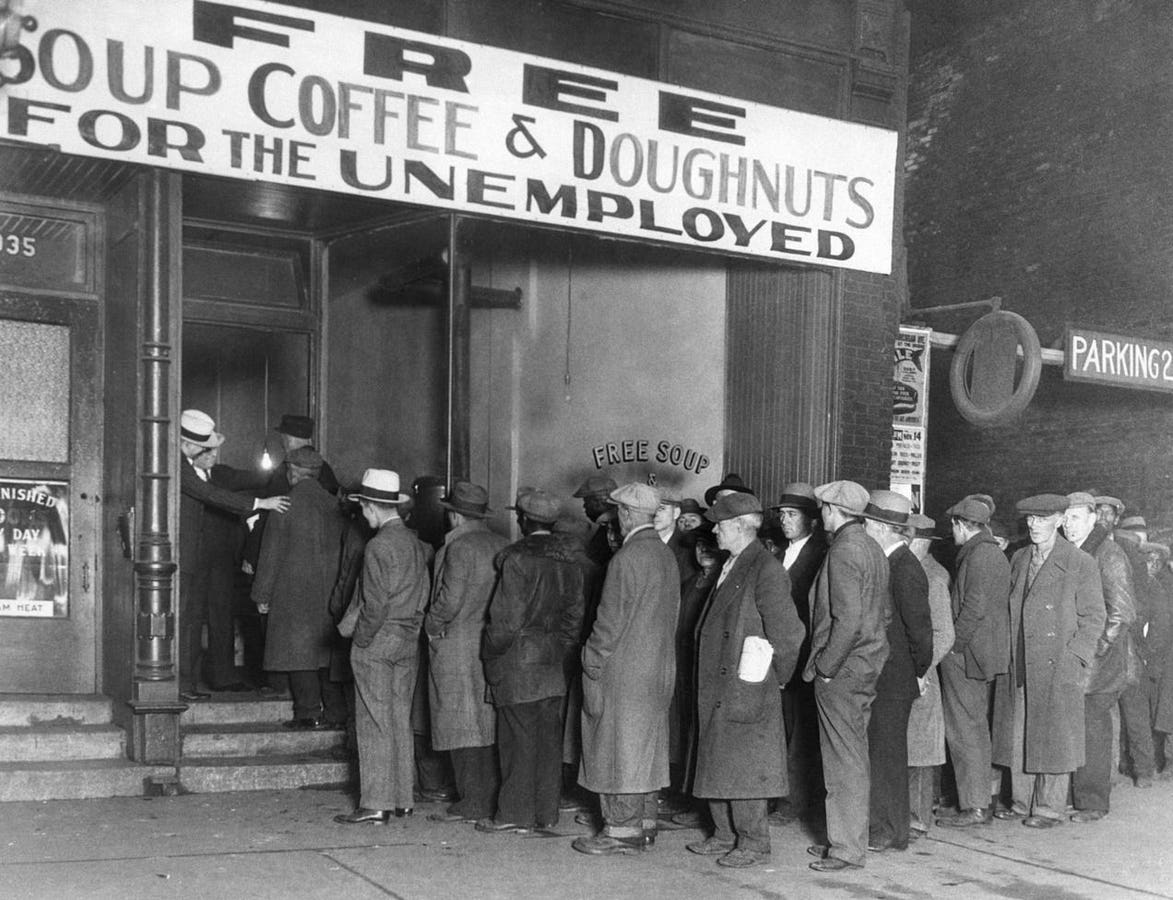
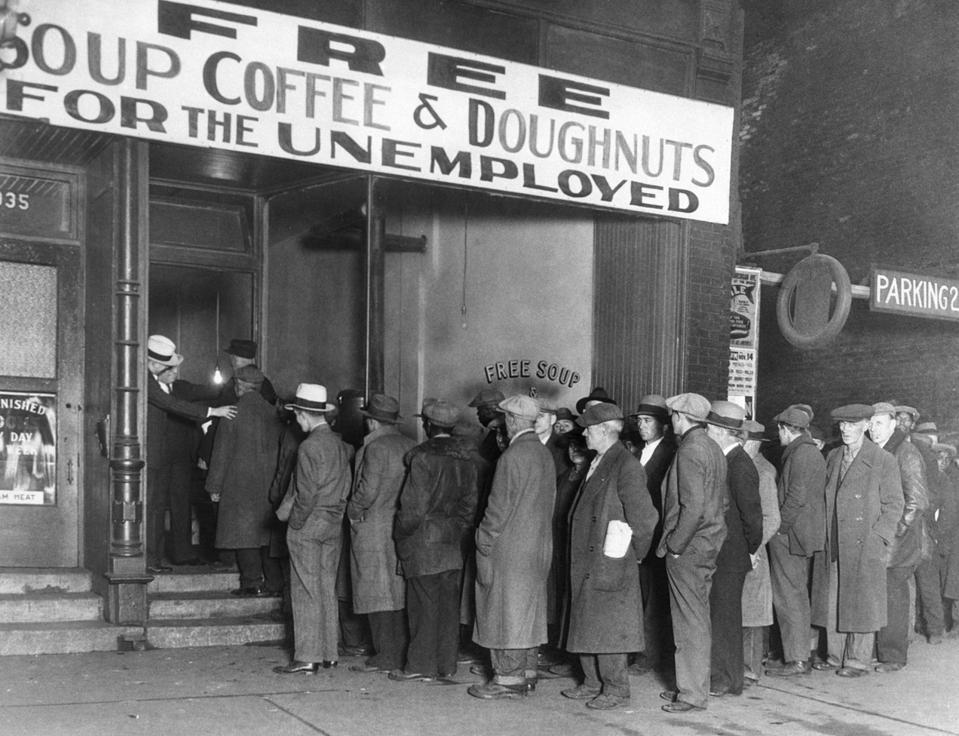
Notorious gangster Al Capone attempts to help unemployed men with his soup kitchen “Big Al’s Kitchen … More
The Federal Reserve did not cause the Great Depression. To pretend that it did is to believe that central planners dictate access to capital from the proverbial Commanding Heights, and that the central planners were “stingy” in the 1930s.
The fatuous Fed/1930s narrative raises a basic question: why are successful investors paid so well? The answer is simple: the returns from well-allocated capital are enormous.
That’s why there are so many well-paid investment bankers scouring the globe, and competing feverishly with each other to match the world’s greatest business and business ideas with capital. The rewards from well-allocated capital are once again enormous, which is why Judge Glock, director of research at the Manhattan Institute, could probably be persuaded to rethink his analysis of the 1930s from a recent book review published in the Wall Street Journal.
Glock’s review of George Selgin’s False Dawn accepts as true the conventional, Milton Friedman view of the 1930s that the Fed mistakenly caused the downturn through what Glock described as a “contraction in the economy’s” so-called “money supply.” Glock is focused on symptoms, not causes.
To understand why, readers need only ask why as they’re reading this opinion piece that there are copious amounts of dollars circulating in the New York City borough of Manhattan, but quite a bit fewer in the Bronx. Is this the Fed at work, or is there quite a bit more productive economic activity taking place in Manhattan? Crossing the country to Beverly Hills, why so many dollars in one of California’s best-known cities but so few in Banning, a California town 93 miles away?
Considering the above phenomenon globally, why do dollars liquefy exchange in Caracas, Teheran and Pyongyang? Did the Fed drop so-called “money supply” into all three?
More realistically, money in circulation mirrors production. It’s abundant where production is, less so where production is less evident. Where there’s production there’s always money precisely because the rewards from matching production with capital are so impressive. As Ludwig von Mises put it long ago, “No individual and no nation need fear at any time to have less money than it needs.” Precisely.
The monetarist, Friedman-ite narrative about the 1930s that just won’t die suggests that in response to alleged Fed tightness with so-called “money supply,” private, profit-motivated sources of credit didn’t respond to the opportunity of a lifetime whereby they brought capital, “money,” and money equivalents to the world’s biggest, most dynamic economy. The view isn’t serious. Where there’s dynamism, there’s always money in abundance.
To believe otherwise, as in to believe that the Fed and President Roosevelt restrained money circulating in the U.S., is for Glock and other free-market types to imply “market failure” whereby global investors who were and are rewarded for effectively allocating capital, chose not to, fell asleep, or both. No. Not a chance.
For much of the U.S.’s existence, productivity stateside has proven a powerful lure for global capital. This was true before the 1930s, and it’s been true since. That’s why the U.S. has always run “trade deficits,” which were and are nothing more than a signal of the U.S.’s attractiveness as a destination for global investment.
Considering the historical flow of capital to its highest use, we can then easily conclude that reduced money in circulation didn’t cause the 1930s, rather it was an effect of awful policy not just from FDR, but also President Hoover. Money in circulation reflected the atrocious policy that plainly restrained production. No, yet again, the Federal Reserve did not cause the Great Depression.
