


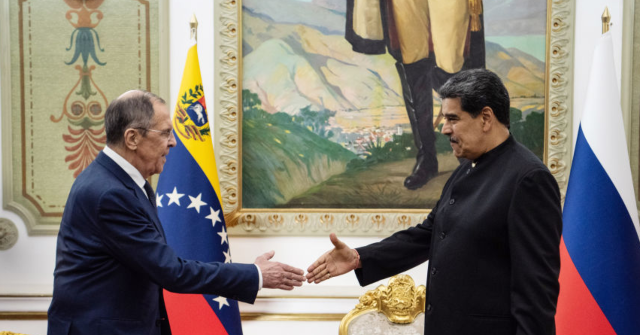
The Russian Foreign Ministry announced on Monday that it signed a joint “International Cooperation in the Field of Information Security” agreement with over ten different nations, including the authoritarian regimes of Venezuela, Cuba, Nicaragua, and North Korea.
In a joint statement, Russia — together with Belarus, Burkina Faso, Cuba, North Korea, Egypt, Iran, Iraq, Kyrgyzstan, Laos, Nicaragua, and Venezuela — claimed to stand for a “transparent and equitable system of international information security” based on the principles of the United Nations Charter, as well as “respect for the sovereignty of states and non-interference in their internal affairs.”
The signatory nations, which did not publicly disclose specifics on what their cooperation will entail, expressed support for the United Nations Convention Against Cybercrime, which was adopted in December and which will hold its first signing ceremony in Hanoi, Vietnam, on October 25 and thereafter at the U.N. headquarters in New York until December 31, 2026.
The cybersecurity convention, which both Russia and China had pressured the U.N. to sign for years, has reportedly been the subject of widespread criticism from the United States, European nations, and others on concerns that its language could be used to legitimize crackdowns on freedom of speech — especially in countries under authoritarian regimes such as China, Russia, and the signatories of the new joint agreement.
According to the United Nations, the Convention Against Cybercrime “acknowledges the significant risks posed by the misuse of information and communications technologies (ICT), which enable criminal activities on an unprecedented scale, speed, and scope.”
“It highlights the adverse impacts such crimes can have on States, enterprises, and the well-being of individuals and society, and focuses on protecting them from offenses such as terrorism, human trafficking, drug smuggling, and online financial crimes,” the U.N. said.
Russia, and the 11 other nations, called upon other states to sign the convention at the upcoming ceremony in Hanoi and to continue their engagement in the negotiations in accordance with the corresponding U.N. General Assembly resolutions to “negotiate an additional draft protocol that would address additional cyber-enabled crimes.”
“Our common goal is to forge cooperation between the competent authorities of States Parties at the earliest convenience in order to counter the use of ICTs for criminal purposes in a comprehensive manner,” the statement read.
“We assume that the next step should be to develop within the United Nations universal agreements on other aspects of the international information security, including stability in the ICT sphere,” the statement continued. “It is important to continue substantive discussions on this issue within the framework of the United Nations and other relevant organizations.”
The signatory countries, several of which notoriously stand accused of hacking or conducting mass-surveillance and censorship against their own people, claimed to be in support of the adoption at the 80th session of the U.N. General Assembly of a “final decision on the establishment of the Permanent Mechanism on ICT Security in the context of international security.” That mechanism would replace an existing working group.
“We condemn the use of ICTs for purposes inconsistent with maintaining international peace and security,” their statement declared. “We call for the peaceful use of ICTs and the non-use of such technologies to interfere in the internal affairs of sovereign States and destabilize the socio-political situation in other countries, as well as to violate national laws, including through low-orbit satellite communication systems and broadband Internet access.”
“We acknowledge the importance of strengthening international cooperation among States to ensure a solid and strong exchange of knowledge, expertise, and best practices with an emphasis on building capacities of the developing countries in the field of ICT-security,” the parties continued. “We reiterate the need for promotion, facilitation and provision of technical assistance, and transfer of technology for prevention, detection, investigation, and prosecution of crimes committed through the use of ICTs.”
The left-wing propaganda outlet Telesur claimed that all signatory countries of the joint statement have previously denounced “the use of digital technologies for geopolitical pressure or internal subversion.”
“The global governance of cyberspace cannot be in the hands of private actors or powers that impose their unilateral rules,” an unnamed Latin American diplomatic source told Telesur. “This convention makes it possible to regain control from a sovereign and multilateral approach.”
Christian K. Caruzo is a Venezuelan writer and documents life under socialism. You can follow him on Twitter here.
