


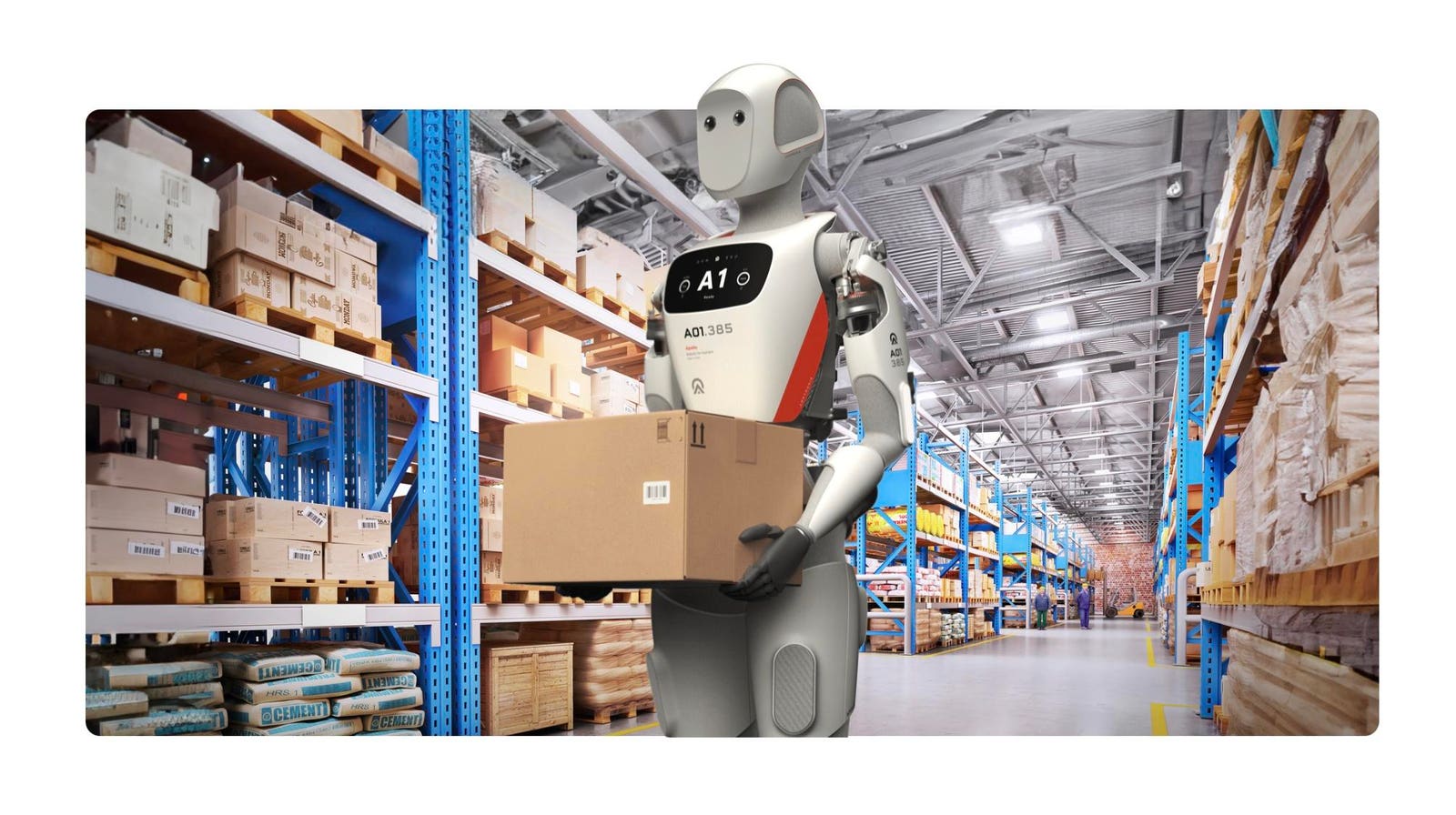
The Apollo robot by Apptronik, pictured in a warehouse environment.
The struggle to be first in humanoid robots is the space race of our time, says Apptronik CEO Jeff Cardenas, who also says that major upgrades are coming to Apptronik’s appropriately-named Apollo robot in 2025.
“It is just amazing to me to hear that there’s a hundred companies working on humanoid robots,” Cardenas told me recently on the TechFirst podcast. “Investors that I talked to two years ago that said humanoids don’t make sense. They didn’t want to pay attention to hardware. Now they have a humanoid thesis and hardware’s the name of the game.”
Apptronik closed a massive $403 million funding round early this year with blue-chip investors including tech titans like Google, massive automotive brand Mercedes-Benz, and venture heavyweights such as B Capital and Capital Factory. The company has also partnered with $30 billion global manufacturing giant Jabil to ramp up production capabilities and achieve mass scalability.
“One of the things that we realized was that if we really are going to ramp to tens of thousands, hundreds of thousands of units, we need to really learn about how to do manufacturing right and do it at scale,” Cardenas told me.
There are two main challenges now in humanoid robots. One is the breakneck race to bring the best, fastest, smartest, most capable and most adaptable humanoid robot to market, and that’s dominated by companies like Figure, Tesla, Agility Robotics, Apptronik itself, and about 20 other companies in humanoid robotics. A European manufacturer, Neura Robotics, says it will ship a “best in world” humanoid robot this summer.
The second is to manufacture at scale to get the price affordable.
Bank of America says that is likely to happen by 2028, when humanoid robots begin a mass adoption trend for commercial use. Humanoid robots, Bank of America says, can replace 20% of the world’s industrial sector jobs: roles that employ perhaps 800 million people today.
Service sectors and the home sector will come next, with a project penetration rate of .7 humanoid robots per household, and this phase is projected to kick off in 2034. Figure alone plans to ship 100,000 humanoid robots in the next four years: perhaps optimistic, but intriguing nevertheless.
China is a significant competitor here, as the country is investing $138 billion in a national robotics surge. China is already home to more traditional robots than the rest of the world combined, Cardenas says, and has humanoid robot developers like Unitree, Agibot, Beijing HRIC, EngineAI, Fourier Intelligence, Kepler, and others.
The first countries to develop effective and efficient humanoid robots will have huge manufacturing advantages over others: hence the “new space race.”
One thing we can say about Apptronik is that it has the capital and the manufacturing relationships to boost its odds of winning.
The Apollo 1 by Apptronik
Powered by recent AI breakthroughs, Apptronik is shifting beyond simple tasks like box-moving to advanced dexterous tasks. Cardenas emphasizes a human-centered design philosophy, aiming to create robots people want to be around, and expects meaningful industrial deployment in 2026, with additional use cases in healthcare, hospitality and elder care to follow 3–5 years later.
Apollo improvements we’ll see this year include upgraded dexterity, modular batteries for 24/7 uptime, and a design robust enough for factory floors or fulfillment centers.
While clearly there’s the fear of human replacement and job loss, Cardenas sees humanoid robots as helper, not usurpers.
“These are tools to augment human productivity and capability,” he told me. “I think that’s particularly important for humanoid robots is that they’re thought of and designed to be human helpers versus something that replaces humans.”
AI is massively accelerating the pace of innovation.
Powered by AI, Apptronik is shifting from simple tasks like box-moving to advanced dexterous tasks. And where previously robot behavior needed to be programmed, increasingly Apptronik is using AI to help robots learn needed behavior in some sense on their own.
Humanoid robots are especially needed in the home space, where elder care is getting more and more critical as our society ages.
“My dream is that for my parents, they’ll have a robot that helps take care of them so that they can age with dignity,” he told me. “My granddads both had different stories, but the gist was they lost their dignity as they aged. They never relied on anybody for anything, and then suddenly they had to rely on people for everything.”
“I dreamed of the idea that they would have a robot one day that would do all of these things for them. And I think that will happen.”
