


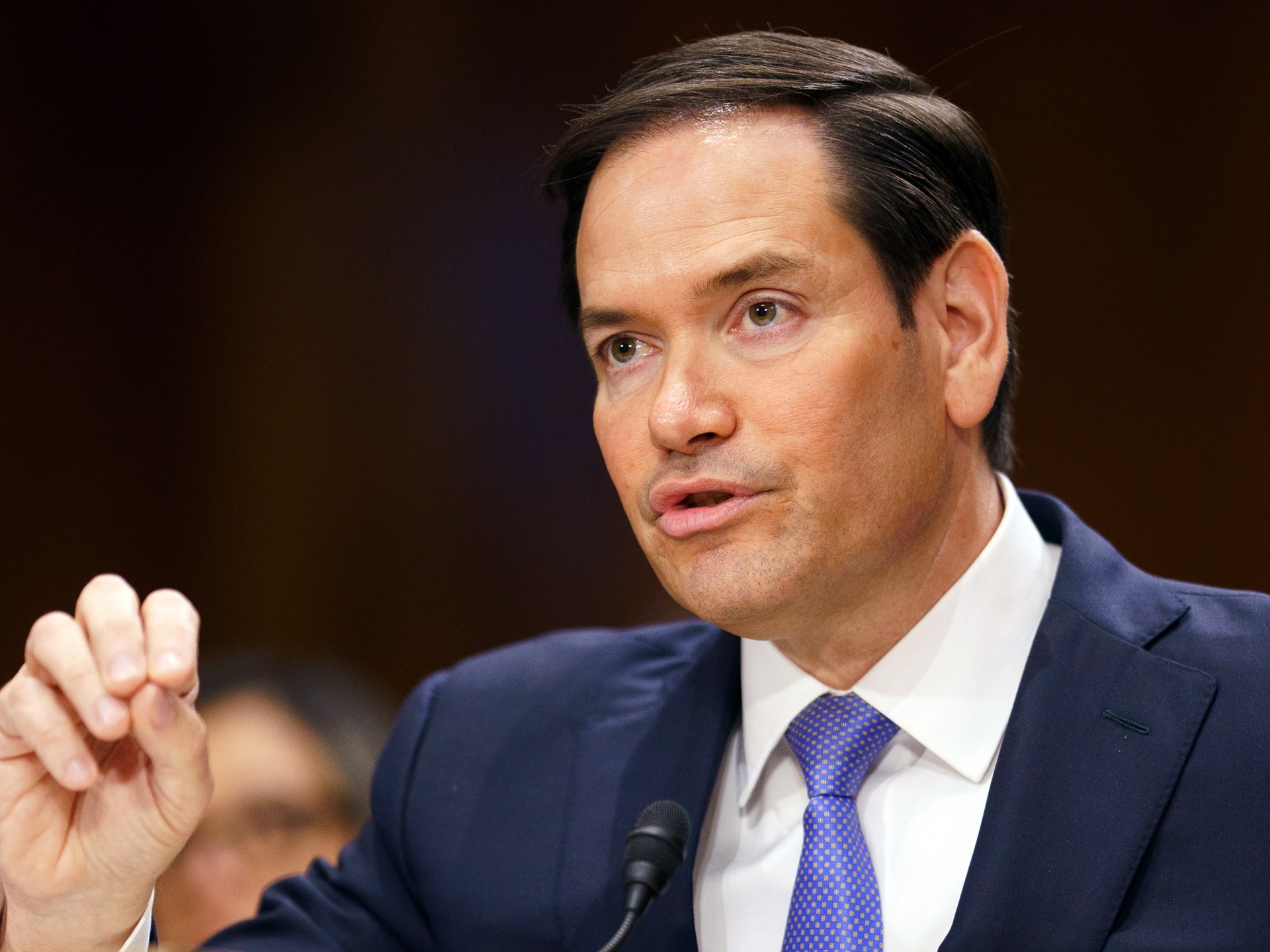
United States Secretary of State Marco Rubio announced on Wednesday that President Donald Trump’s administration will “aggressively” revoke the visas of Chinese students studying in the country.
The move comes amid the Trump administration’s ongoing efforts to crack down on international students attending universities in the US, and at a time when Washington and Beijing are trying to negotiate a trade deal to end a spiralling tariff war between the world’s two largest economies.
While China hawks in the US have long called for greater oversight of the country’s students at American universities, alleging that some among them might secretly be Beijing’s spies, Rubio’s announcement is the most dramatic step ever taken by a US administration against students from any specific nation.
Here is how it could impact students, American universities, US-China relations, and the US itself:
What has Rubio announced?
In an X post, Rubio wrote that “The US will begin revoking visas of Chinese students, including those with connections to the Chinese Communist Party or studying in critical fields.”
The U.S. will begin revoking visas of Chinese students, including those with connections to the Chinese Communist Party or studying in critical fields.
— Secretary Marco Rubio (@SecRubio) May 28, 2025
The US has not specified what counts as a “critical field”. But in March, a US congressional committee of the House of Representatives sent a letter to leadership at Carnegie Mellon University, Purdue University, Stanford University, the University of Illinois Urbana-Champaign, the University of Maryland and the University of Southern California requesting information about Chinese nationals in advanced science, technology, engineering and medicine programmes on their campuses.
John Moolenaar, the chair of the congressional committee, alleged that China was embedding its students in top research programmes to access sensitive technology.
“The Chinese Communist Party has established a well-documented, systematic pipeline to embed researchers in leading US institutions, providing them direct exposure to sensitive technologies with dual-use military applications,” Moolenaar said in the letter, adding that many Chinese students immigrate to the US or other Western countries after completing their degrees.
“This pattern raises significant concerns about the extent to which Chinese nationals, after gaining expertise in highly advanced fields, ultimately transfer knowledge back to China,” he said.
Rubio also did not specify what would constitute “connections” to the Chinese Communist Party (CCP), which is the only major political group in China, a one-party country. The party has about 100 million card-carrying members in a country of about 400 million families, so on average, one in every four Chinese citizens has an immediate relative in the CCP.
The US State Department website also released a press statement, titled “New Visa Policies Put America First, Not China”.
In this statement, Rubio added: “We will also revise visa criteria to enhance scrutiny of all future visa applications from the People’s Republic of China and Hong Kong.”
This move comes a day after Rubio circulated a memo saying that the US had ordered its foreign embassies to pause scheduling visa interviews for all foreign students while the State Department plans to expand the vetting of applicants’ social media.
How has China responded?
Beijing has condemned the Trump administration’s move, deeming it “political and discriminatory”.
“The US has unreasonably cancelled Chinese students’ visas under the pretext of ideology and national rights,” Foreign Ministry spokeswoman Mao Ning said on Thursday. “China firmly opposes this and has lodged representations with the US.”
Mao added that the move by the US government had “seriously damaged” the rights of Chinese students and hurt the normal cultural exchange between Washington and Beijing.
“This political and discriminatory practice of the US has exposed the lies of the so-called freedom and openness that the US has always advertised,” said Mao.
The spokesperson added that the move had “further damaged the US’s own international image, national image and national credibility”.
How many Chinese students does the US have?
During the 2023-2024 academic year, 277,398 Chinese students were enrolled in US universities, constituting 24.5 percent of the 1.13 million international students, according to the annual Open Doors report from the Institute of International Education (IIE) and the US State Department.
Only students from India outnumbered their Chinese counterparts. The 2024-2024 academic year was the first time that India replaced China in the top spot since 2009, according to Open Doors.
Which universities have a large Chinese student population?
In 2023, China was the top country of origin of international students at Carnegie Mellon University, constituting 46.8 percent of the international student population.
At New York University, Chinese students constitute more than half of the international student body — 51.6 percent.
China is the number-one country of origin of international students at New York University, making up 51.6 percent of the international student population. In the 2023-2024 academic year, the university had 14,072 Chinese students out of 27,247 foreign students.
A report by Duke University says that the institute had 5,000 international students in 2024, and the top two countries of origin were China and India.
Half of the international student population at Northwestern University is from China, the institute’s website states. On Thursday, after Rubio’s announcement, the group Northwestern University Graduate Workers signed an open letter to universities, urging them to reject the congressional committee’s March requests for information about Chinese students.
How much revenue do these students bring to the US?
US universities earn billions of dollars from the tuition fees that international students pay. But these students also bring benefits to local economies.
During the 2023-2024 academic year, international students studying at colleges and universities in the US contributed $43.8bn to the US economy and supported more than 378,000 jobs, according to data released by the non-profit organisation NAFSA: Association of International Educators.
A NAFSA release in November 2024 says that this economic activity is the highest amount ever calculated by the organisation.
The NAFSA data says there are 1.1 million international students in the US, so on average, an international student contributes around $39,800 to the American economy annually.
By that calculation, the 277,398 Chinese students in the US in 2023-24 would have contributed in excess of $11bn to the US economy that year.
How much have Chinese graduates contributed to the US?
Once they graduate, international students in the US contribute disproportionately to American innovation: A 2022 analysis by the National Foundation for American Policy (NFAP) found that 55 percent of all US-based startups valued at more than a billion dollars were founded by immigrants.
Since the year 2000, more than 50,000 Chinese PhD scholars in science and mathematics fields have remained in the US, pursuing scientific research and founding startups that in 2022 had a collective worth of $100bn.
They include 21 billion-dollar companies, also called unicorns, according to the NFAP.
One of these notable unicorns is Pony.ai, an autonomous driving technology company founded in 2016 and currently valued on the NASDAQ exchange at $6.4bn. The company was launched by James Peng and Lou Tiancheng, both of whom attended Beijing-based Tsinghua University for their undergraduate degrees. Co-founder Peng holds a PhD from Stanford University.
Another company is online Asian grocery retailer Weee!, valued at $4.1bn, according to NFAP, and founded by Larry Liu, who came to the US to earn a master’s degree in business administration from the University of California, Davis, after completing his undergraduate degree in China.
