


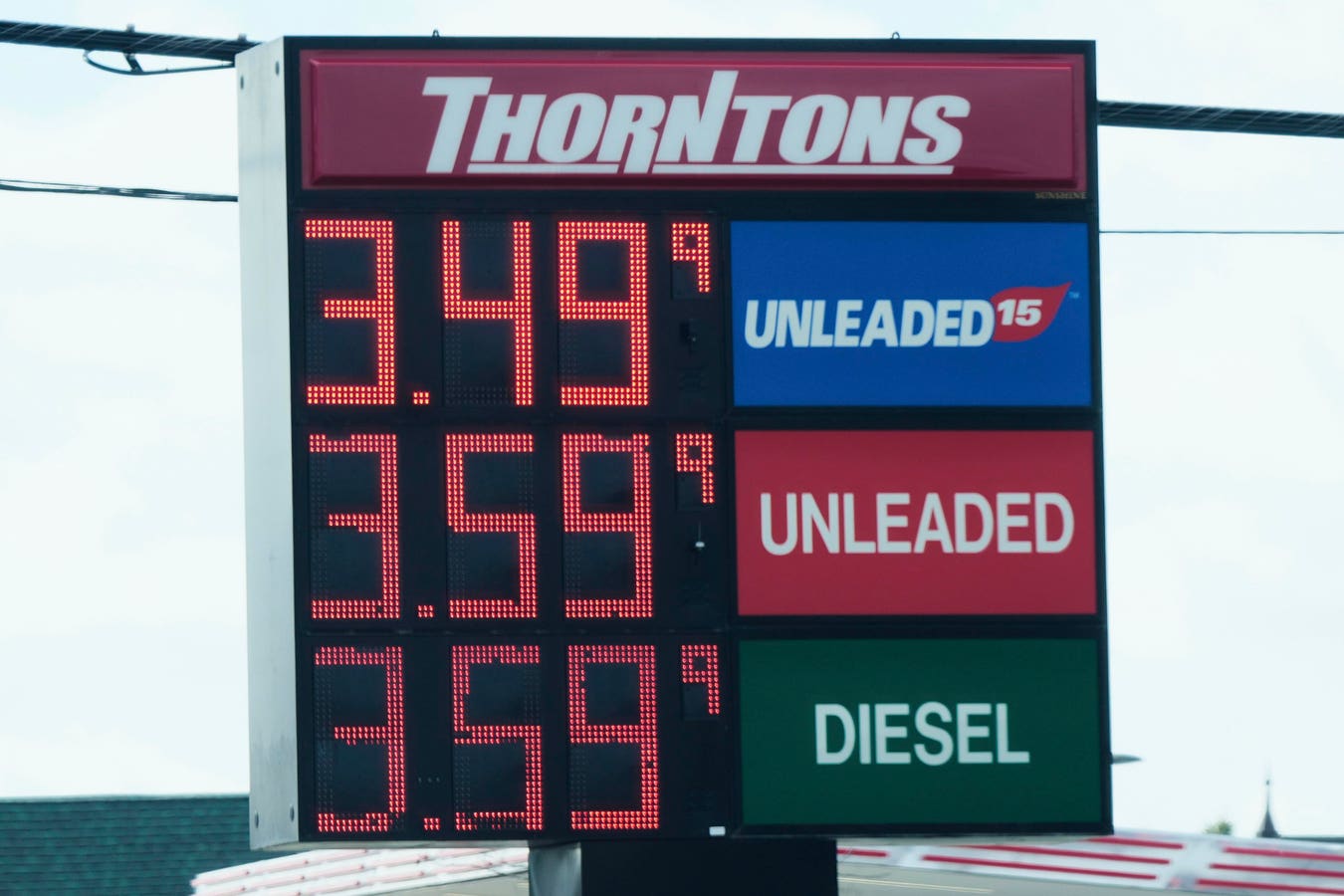
Gas prices are displayed at a gas station in Streamwood, Ill. (AP Photo/Nam Y. Huh)
For the first time in more than a decade, U.S. crude oil production is projected to decline in the coming year. That’s not just a headline—it’s a flashing warning light for policymakers, investors, and the broader economy. According to S&P Global, falling prices are already forcing drillers to scale back their operations, with the expectation that the U.S. is on course to see its first annual drop in domestic oil output since the fracking boom began.
What’s behind this reversal? A convergence of global economic uncertainty, rising OPEC+ production, and self-inflicted harm from the Trump administration’s tariff campaign. The very tools meant to protect American industry could threaten its energy independence.
S&P analysts recently issued a stark assessment that tariffs and weakening global growth are “significantly cutting into global oil demand,” driving prices lower and forcing U.S. shale producers to hit the brakes. That drop in investment and activity is already visible. Rig counts are falling. Frac crew numbers are down. And capital budgets are being slashed.
“A price-driven decline in U.S. production would be a pivot point for the oil market—and set conditions for a potential price recovery,” said Jim Burkhard, S&P’s head of crude oil research. But for the industry and the nation, that price recovery may come too late to stave off job losses, supply constraints, and a reduced geopolitical edge.
President Trump has pointed to falling gasoline prices—now averaging $3.18 per gallon nationwide—as evidence that his economic policies are working. “We’re drilling like crazy,” he told NBC News last week. But that claim doesn’t hold up to scrutiny. Rig counts are flat. Drilling activity is slowing, not surging. And the decline in oil prices has more to do with softening demand and surplus supply than any domestic production boom.
West Texas Intermediate crude has hovered around $60 per barrel in recent weeks, a price point that many operators see as unsustainable for continued growth. Diamondback Energy, a respected player in the Permian Basin, is already acting. CEO Travis Stice recently warned that the shale industry is reaching a tipping point, where the geologic headwinds now outweigh the technological tailwinds that once drove the boom.
Diamondback is slashing its capital budget by $400 million and pulling back rigs. “We are taking our foot off the accelerator as we approach a red light,” Stice wrote in a letter to shareholders. Other producers may soon be forced to do the same.
This underscores a growing tension in U.S. energy policy–Washington wants cheap fuel for voters but also robust production to support economic and national security goals. Those priorities are increasingly at odds. Oil producers can’t operate at a loss forever just to keep gas prices down, and they can’t plan the long-term investment needed to boost future production in an environment where trade policy is unpredictable and inflation remains sticky.
Not all producers share Diamondback’s cautious outlook. Chevron expects drilling in the Permian to rebound in the second quarter, and ExxonMobil is pushing to lower its breakeven price to $30 per barrel by 2030 through efficiency gains and scale. ConocoPhillips has so far held its activity steady, but its leadership signaled this week that they’re watching the $50-per-barrel mark closely. Below that threshold, further cutbacks are likely.
According to analysts at Wood Mackenzie, U.S. oil production will likely remain flat in 2025 and begin to decline in 2026 unless prices recover. Their latest forecast projects a slight dip of about 40,000 barrels per day in 2026, after previously expecting growth of more than 250,000 barrels per day. If prices fall below $50, the outlook darkens further.
We should be paying close attention. The U.S. oil and gas sector supports millions of jobs, drives investment in rural communities, and anchors our energy security. Tariff-driven price volatility and cost inflation risk undercutting those gains. Steel tariffs alone have already driven casing costs up more than 10%, reducing margins and weakening the case for new drilling.
This isn’t just an oil industry problem. When U.S. energy output declines, prices become more volatile. We cede influence to OPEC and petro-states like Russia and Iran. And we undercut one of America’s greatest strengths–and President Trump’s greatest successes–the rise of the U.S. as the world’s top oil and gas producer.
America’s energy dominance was built through innovation, investment, and smart policy. If we want to maintain that leadership, the industry needs stability.
