


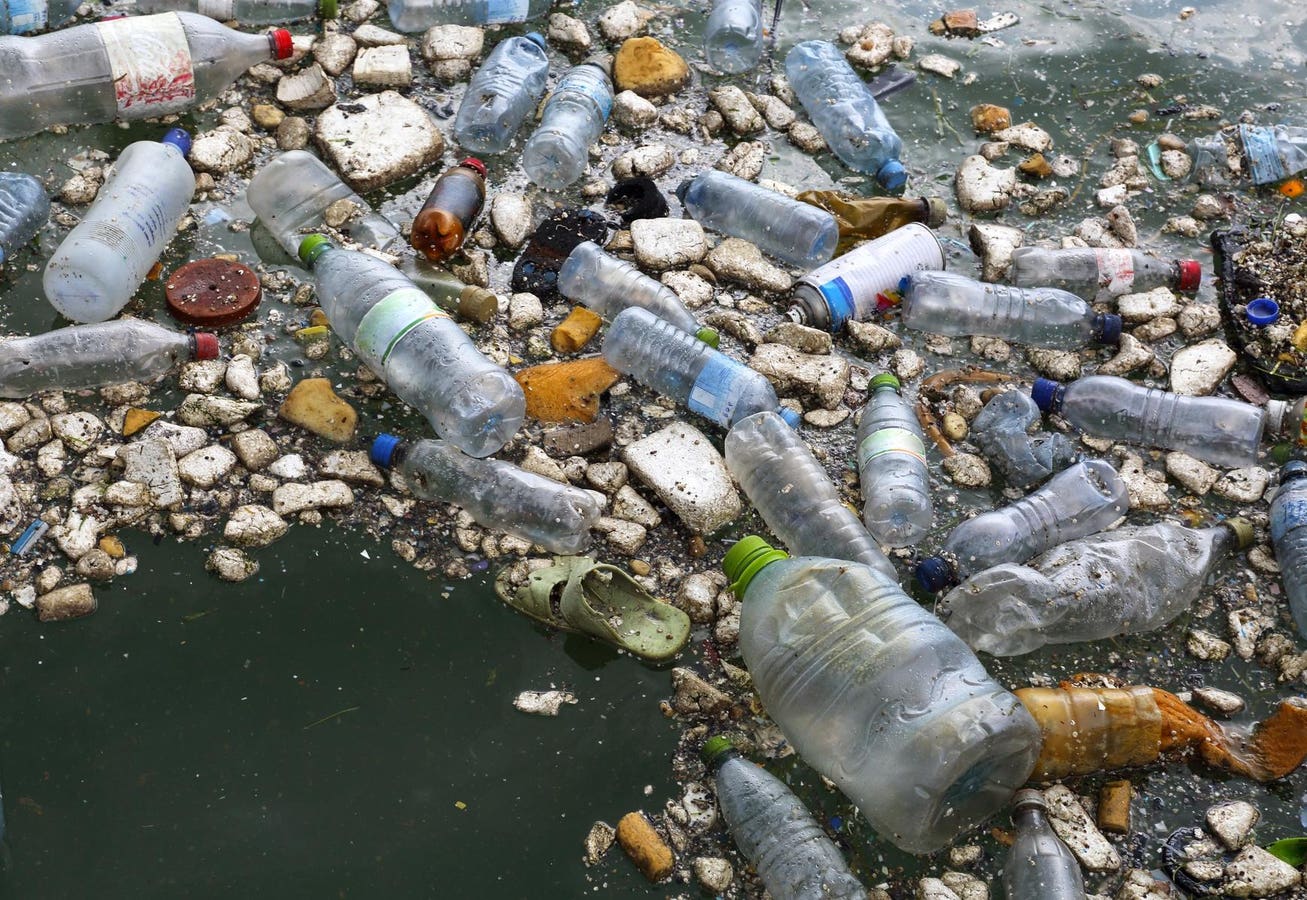
Rubbish floating in Naifaru Harbour, Maldives, Indian Ocean, January 25, 2015.
Our ability to survive on the only known habitable planet has always involved adaptation and innovation. Carbon emissions and plastics, while central to our current way of life, have detrimental effects on our climate, ecosystems and oceans. Emerging research suggests that converting plastics to fuel is possible, and innovative visionaries are actively seeking pathways for that potentially game-changing transformation.
The ‘So What?’
A 2022 study published in Nature described energy recovery of waste plastics in diesel fuel through a process called pyrolysis. The process produced fuel blends with less carbon monoxide and hydrocarbons. What is pyrolysis? According to the USDA website, it is, “The heating of an organic material, such as biomass, in the absence of oxygen.” It is done to break down things like biopolymers. The process may involve many phases, which are difficult to summarize in this type of format. For example, gasification is used to transform the carbon-based materials to gas. The USDA website went on to say, “Because no oxygen is present combustion does not occur, rather the biomass thermally decomposes into combustible gases and bio-char.” By now, you are probably saying, “Slow down, Dr. Shepherd, too much science jargon flying around.”
How plastic waste can be converted to fuel.
Polymers are chemical substances used to in the manufacturing of plastics. Biopolymers are known to be a bit better for the environment because they are more biodegradable or biobased than synthetic versions. According to the website Our World in Data, “Plastic production has sharply increased over the last 70 years. In 1950, the world produced just two million tonnes.” By 2020 that number had grown to over 450 million tonnes. Much of that plastic finds its way into our oceans, ecosystems and landfills. That’s where the concept of a circular economy is important.
“The circular economy is a system where materials never become waste and nature is regenerated,” The Ellen MacArthur Foundation website explained. “Products and materials are kept in circulation through processes like maintenance, reuse, refurbishment, remanufacture, recycling, and composting.”
A 2022 paper published in the Journal of Hazardous Materials provides a critical review of where we are on plastic to fuel conversion. Wanting to learn more about the world of converting plastics to fuel, I reached out to a young innovator based in Georgia after learning about his work on The Weather Channel recently.
Julian Brown is the founder of Naturejab and an innovator in the use of microwave pyrolysis of plastic waste. He is a also a 776 Climate Fellow, a program of the 776 Foundation that funds young people who want to “build a better future.”
Julian Brown wants to convert plastic to fuel using microwave pyrolysis.
What’s His Motivation?
Brown told me, “What motivated me was seeing the large plastic issue at hand throughout the world and not seeing any obvious solutions that were effective enough to make a difference.” He went on to share something that he experienced in high school that likely changed his life trajectory — a video of a turtle that had a straw in its nose. Brown said, “It made me so upset that even though we are told that we are recycling, plastic is clearly ending up in the oceans and landfills where it is affecting so many lives, including our own.”
Brown wants to apply microwave technology to destroy plastic while hoping to create fuel products. Using microwaves and solar power generation, he is exploring ways to sustainably produce diesel fuel. This next generation innovator, who was recently featured on the Weather Channel, is not working in a university lab or corporate innovation center. He credits high school welding classes and his welding profession for providing the skillsets to build his first reactor.
What’s Next?
Brown has received a $100,000 grant from Alexis Ohanian, cofounder of Reddit and husband of Serena Williams, but he hopes to attract larger funding from a government agency or other funding sources to scale up his work. Brown is just old enough to purchase alcohol legally, yet he is already engaged in the circular economy. Innovation does not appear — “poof” — out of thin air. Research and development, at any scale, requires funding, experimentation, verification, failures and persistent. It also takes passion, and I can tell Julian Brown has that too.
My University of Georgia colleague Jenna Jambeck is a global scholar tackling the plastic waste crisis. In a landmark 2018 finding, she and colleagues revealed 90% of plastic had never been recycled. It remains to be seen if Brown can scale his effort up. It’s certainly in our own best interests for him and other innovators to succeed given that daunting statistic. After all, there is no Planet B.
Julian Brown’s reactor system.
