


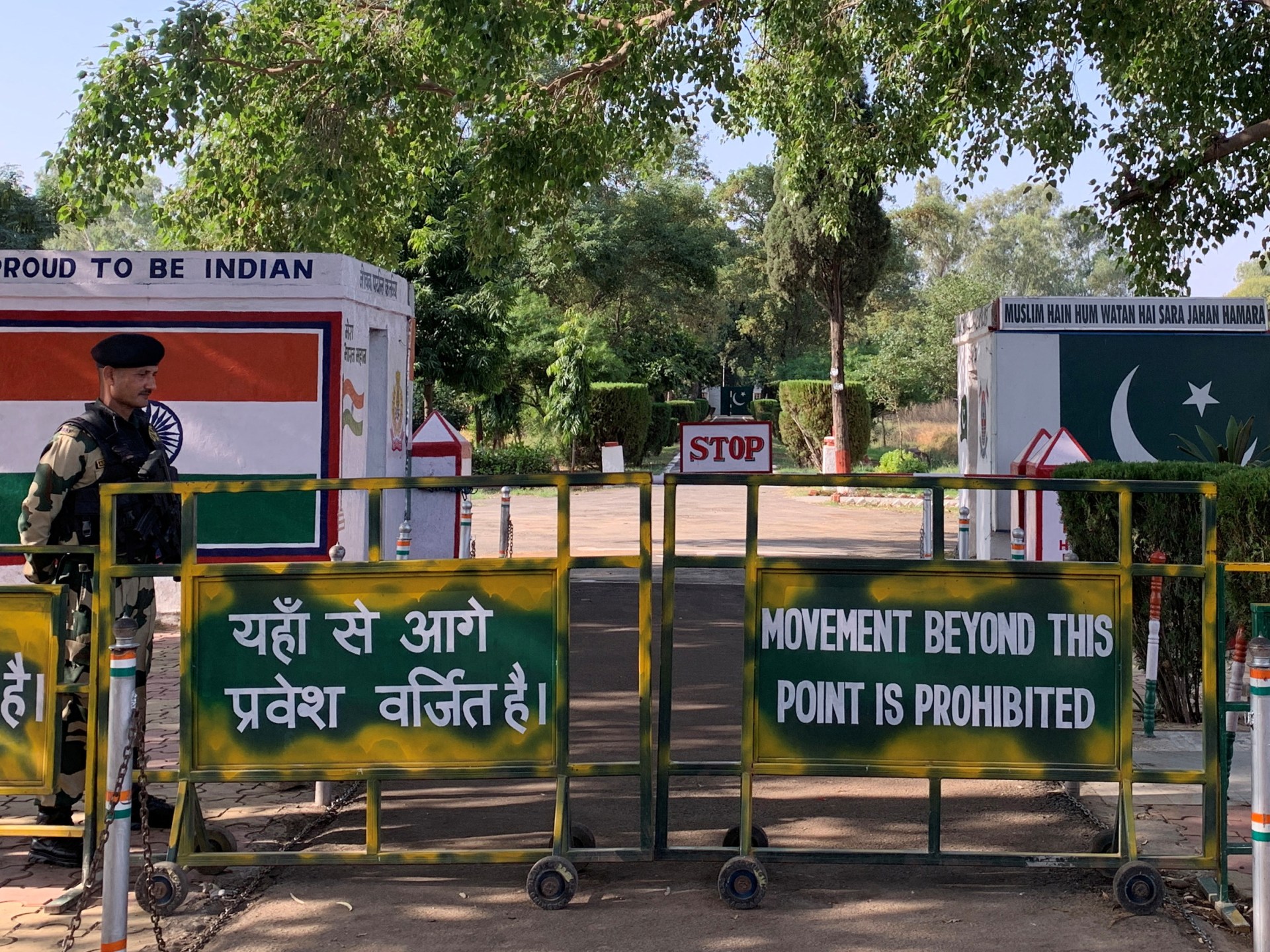
Islamabad, Pakistan – Tensions between India and Pakistan have soared since the April 22 attack on tourists in the scenic resort town of Pahalgam in Indian-administered Kashmir, in which at least 26 people were killed.
Both countries have announced a series of tit-for-tat measures, raising fears of a wider confrontation.
After a cabinet meeting led by Prime Minister Narendra Modi, India on Wednesday announced the suspension of the six-decade-old Indus Waters Treaty (IWT), a critical agreement that governs the use of the Indus River system, vital to both nations. It also announced the closure of its border with Pakistan, trade suspension, revocation of visas, and a reduction in Pakistani diplomats in India.
In response, Pakistan’s National Security Committee (NSC), its top civil-military decision-making body, announced similar measures, including border and airspace closures, suspension of trade, and, significantly, a threat to suspend its participation in all bilateral agreements with India, including the Simla Agreement.
Signed in 1972, the Simla Agreement forms the bedrock of India-Pakistan relations, governing the Line of Control (LoC) and outlining commitments to resolve disputes peacefully.
Pakistan’s threat to suspend the agreement marks a potentially serious escalation. But what exactly is the Simla Agreement, and what are the implications if Pakistan pulls out of it?
What is the Simla Agreement?
Seven months after the 1971 war, which India won and which led to the creation of Bangladesh, Pakistani President Zulfikar Ali Bhutto and Indian Prime Minister Indira Gandhi met in Shimla (sometimes also spelt as Simla), the hilly capital of the Indian state of Himachal Pradesh, to normalise relations.
Key points of the agreement [PDF], signed on July 2, 1972, included the peaceful settlement of disputes and resolving issues, including Kashmir, bilaterally.
It also urged respect for territorial sovereignty, integrity, political independence and noninterference in internal affairs.
One of the most important outcomes was the renaming of the Ceasefire Line, the working border between the two countries, to the Line of Control (LoC), with both sides agreeing not to change it unilaterally.
Following the 1971 war, the agreement also led to the release of more than 90,000 Pakistani prisoners of war India was holding.
“Pending the final settlement of any of the problems between the two countries, neither side shall unilaterally alter the situation, and both shall prevent the organisation, assistance or encouragement of any acts detrimental to the maintenance of peaceful and harmonious relations,” the agreement stated.

Why is Pakistan’s threat significant?
Ahmer Bilal Soofi, a leading international law expert and former legal adviser to the Pakistan government, described the Simla Agreement as an interim but crucial framework between the two countries.
“Suspending the agreement would require a meticulous internal assessment” by Pakistan to ensure that it serves the country’s interests in retaliating against India, Soofi told Al Jazeera. “Any decision must involve extreme due diligence.”
Another international law expert, Muhammad Mushtaq Ahmad of Shifa Tameer-e-Millat University, explained that India has long interpreted the Simla Agreement as superseding United Nations Security Council (UNSC) resolutions.
“India’s position is that the agreement made the Kashmir issue a purely bilateral matter, removing any need for international mediation,” Ahmad said.
The Himalayan territory has been a flashpoint between the two countries since they gained independence from British rule in 1947, with each controlling parts of Kashmir but claiming it in full. Since independence, the nuclear-armed neighbours have fought four wars, three of them over Kashmir.
Pakistan, on the other hand, maintains that the Simla Agreement reaffirmed UNSC resolutions advocating a diplomatic and political solution.
After the Modi government revoked Indian-administered Kashmir’s semi-autonomous status in 2019, Pakistan accused New Delhi of violating the Simla Agreement.
Islamabad could cite that to justify the suspension of its participation in the agreement, Ahmad said. Under the Vienna Convention on the Law of Treaties – a pact Pakistan is signatory to, but India is not – a material breach allows a country to denounce a treaty, he added.
But Indian defence analyst Ajai Shukla says if either or both countries walk out of the Simla Agreement, it would effectively represent an “open season” on the LoC.
“It could lead to both sides changing the ground position of the LoC, and they will be incentivised to use arms as there won’t be any treaty that will impose peace, which is currently in place,” the New Delhi-based analyst told Al Jazeera.
Does suspending the Simla Agreement mean war?
Despite the Simla Agreement, India and Pakistan have engaged in conflicts, including their four-decade-long joust for control of the Siachen Glacier — the world’s highest battleground — and the 1999 Kargil War.

Ahmad, the academic, said the LoC was never able to establish lasting peace.
Pakistani constitutional expert Rida Hosain argued that India had historically “misused” the Simla Agreement to its advantage.
“At the heart of Simla [Agreement] is peaceful coexistence. But India’s recent war-mongering rhetoric and blame for attacks without evidence suggest otherwise,” Hosain said, referring to India’s allegation that Pakistan was responsible for the Pahalgam attack. Pakistan has rejected the accusation and demanded that India present evidence to support its claim. Islamabad has also called for a “neutral investigation” in to the Kashmir attack.
Shukla, a former Indian Army officer, however, said a pullout by Pakistan from the Simla Agreement would not automatically amount to a declaration of war. Still, it would bring the neighbours closer to a potential military conflict.
“One does not automatically lead to another, but it does mean that both sides will no longer have guardrails of an international treaty that withholds them from engaging in armed hostilities,” he said.
What is Pakistan’s rationale?
Unlike its immediate implementation of other retaliatory measures, Pakistan has only threatened to walk out of the Simla Agreement.
According to Soofi, Pakistan’s rationale stems from a desire to return to multilateralism.
“India has used Simla to argue that Kashmir is a purely bilateral issue. Suspending it allows Pakistan to revert to UN Security Council mechanisms to internationalise the Kashmir dispute,” Soofi said.
Shukla said suspending the agreement could provide international cover for both sides to pursue their interests on the LoC in a manner not possible while adhering to the pact.
“Pakistan always sort of held to the notion that treaties like the Simla Agreement have tied its hands from pursuing its interests in places like Siachen, which Pakistan says is an example of India violating the agreement,” he said. India successfully captured the strategically located Siachen Glacier in 1984 in a military operation that Pakistan insists violated the Simla Agreement.
Meanwhile, India also feels hobbled by the agreement, Shukla said. New Delhi has long insisted that Pakistan-administered Kashmir belongs to India, and under Modi, the domestic rhetoric to militarily take back that territory has grown.
“In essence, both sides feel the agreement is not safeguarding their interests,” said Shukla.
Ahmad suggests that India’s suspension of the IWT could already constitute an act of aggression under international law, justifying self-defence measures by Pakistan. Under the IWT, India gets the waters of the Ravi, Beas and Sutlej rivers, all part of the Indus Basin. On the other hand, Pakistan is entitled to most of the water from the Indus, Jhelum and Chenab rivers.
“The water treaty underpins the lives of nearly 250 million Pakistanis. Its suspension can be seen as a hostile act,” Ahmad said.
The threat to pull out of the Simla Agreement, Ahmad said, was a “smart decision by the government to remind India, to issue them a warning of sorts”.
