


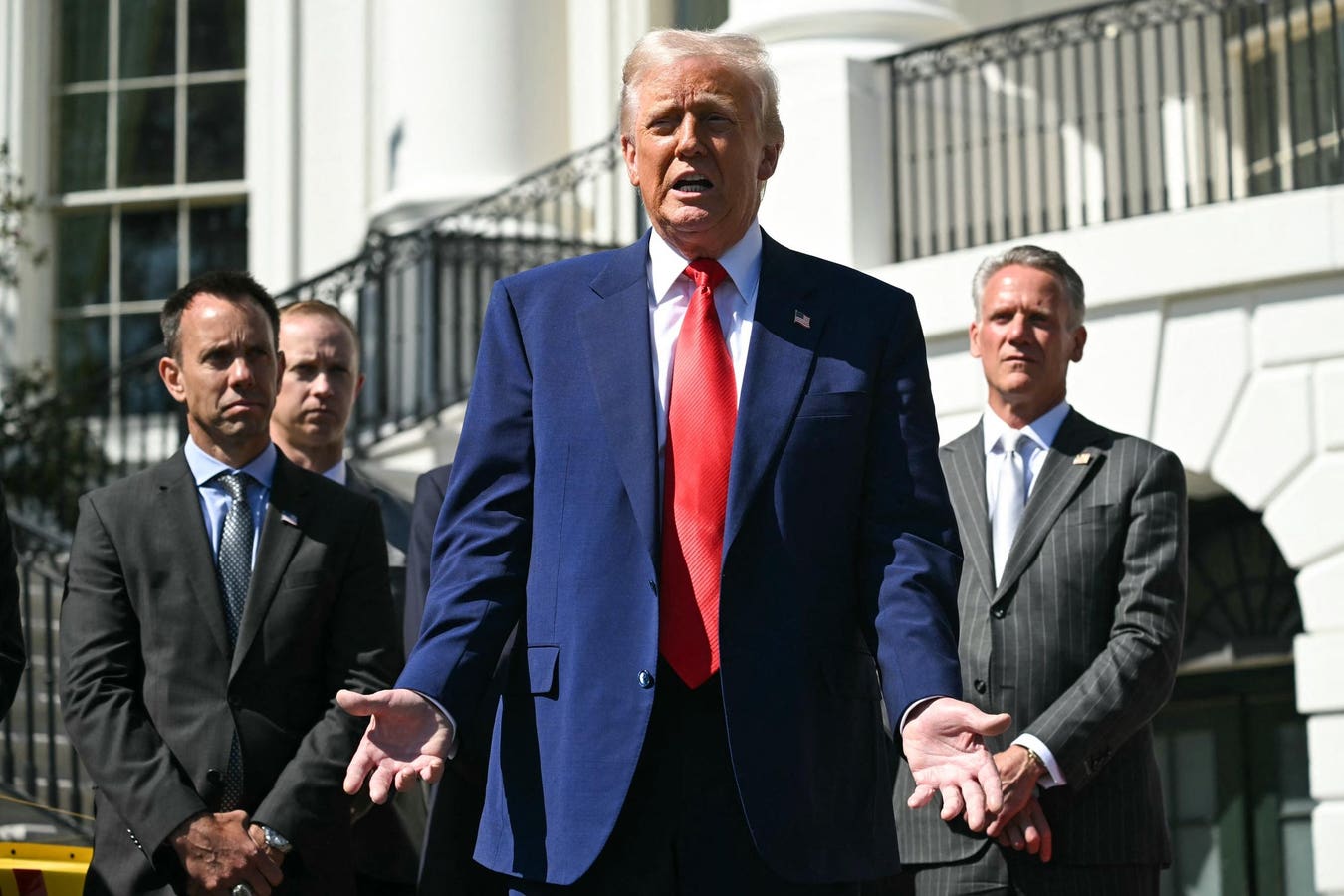
US President Donald Trump speaks during a photo opportunity with autoracing officials and champions … More
The White House is exploring a significant reduction in tariffs on Chinese imports, potentially lowering the current 145% rate to a range of 50% to 65%, as reported by The Wall Street Journal. The administration is also considering a tiered approach, applying 35% levies on non-strategic goods and up to 100% on items deemed critical to national security.
Treasury Secretary Scott Bessent, speaking at a closed-door JPMorgan investor summit, emphasized that the current tariff levels are unsustainable and anticipated a de-escalation in the U.S.-China trade war, though formal negotiations with Beijing have yet to begin, per Yahoo Finance.
This development marks a pivotal shift in the Trump administration’s trade strategy, which has sparked global economic concerns and market volatility. As the U.S. navigates this complex situation, the broader implications for global trade, economic growth, and financial markets remain hazy.
A Gradual Retreat From Tariff Hardball
The U.S.-China trade war, reignited by the Trump administration’s imposition of tariffs as high as 145% on Chinese goods, has prompted a fierce response from Beijing. China retaliated with 125% tariffs on U.S. imports and is actively forging trade agreements with U.S. partners affected by American policies. According to a Reuters report, the Chinese Ministry of Commerce has warned that it will take “resolute and reciprocal” countermeasures against any nation curbing trade with China to gain U.S. tariff relief.
However, President Trump himself has hinted at progress, stating on an April 22 press conference that tariffs on Chinese goods will “come down substantially, but it won’t be zero.” Yet, the question looms: what is the long-term cost of this aggressive-yet-evolving tariff policy?
The Ripple Effects Of Inconsistent Trade Policy
The Trump administration’s tariff approach has sent shockwaves through global markets, signaling to trading partners that U.S. policy may remain unpredictable. This perception is driving nations to seek alternative trade agreements, reducing reliance on the U.S. as a stable partner.
The economic fallout is rippling out. Tariffs are expected to increase consumer prices as businesses pass on higher costs after depleting inventories. Corporate profitability is under pressure, and global economic growth is projected to slow, with the International Monetary Fund slashing its 2025 forecast to 2.8% from 3.3% in 2024, largely due to U.S. tariff policies, as reported by NPR.
Beyond domestic impacts, retaliatory measures are creating financial market turbulence. Countries, including China, are selling U.S. Treasuries, pushing up the 10-year Treasury yield and increasing U.S. borrowing costs. This dynamic, combined with tariff-induced uncertainty, raises the specter of 1970s-style stagflation—rising prices coupled with economic stagnation.
Investor Strategies In A Volatile Environment
For investors, the current environment demands caution and diversification. The ongoing trade uncertainty, rising interest rates, and slowing growth suggest that traditional portfolios face significant risks. Some investors are increasing allocations to international stocks and gold as hedges against U.S.-centric risks. And on the bond side, many are limiting exposure to duration as yields rise.
While a U.S. recession does not appear imminent, high volatility and uncertainty are likely to persist. Stock market valuations, already strained by declining profit margins and growth prospects, may face further downward pressure if investor and consumer confidence continue to wane. Prolonged uncertainty could exacerbate these challenges.
The Trump administration’s potential tariff reductions may offer short-term relief for businesses and consumers, but the broader implications of its trade policy are emerging. By signaling unpredictability, the U.S. risks ceding influence in global trade networks. China’s strategic moves, including strengthening ties with Southeast Asian nations like Vietnam and Cambodia, highlight its intent to counter U.S. pressure.
For now, the path to resolution remains unclear. Trade negotiations, particularly with China, are notoriously complex and slow. The administration’s strategy of using tariff deals with other nations to isolate China may backfire, as Beijing’s defiance and global outreach suggest limited leverage for the U.S. Investors and businesses would be wise to prepare for a prolonged period of uncertainty, with economic growth, corporate earnings, and market stability hanging in the balance.
