


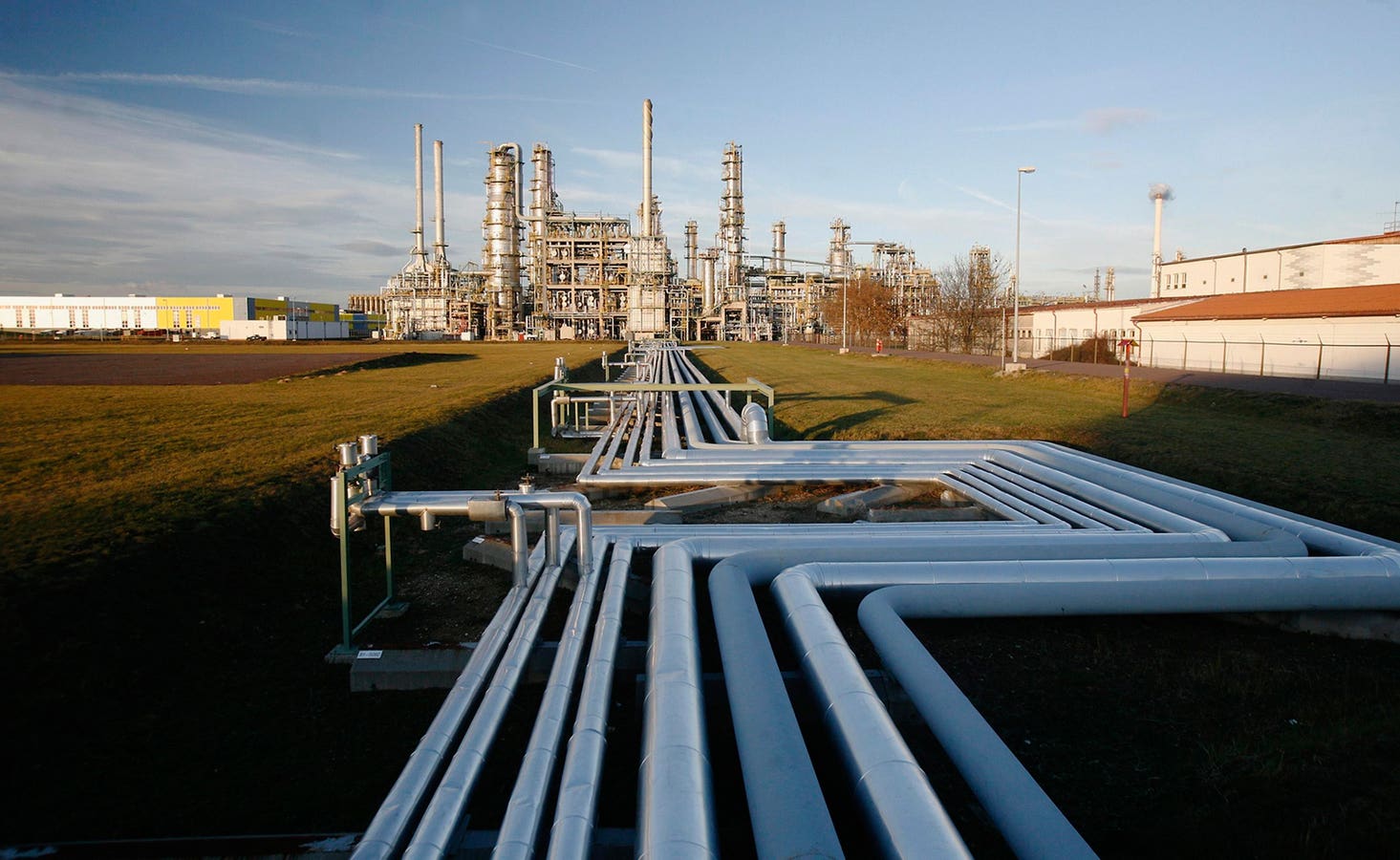
(Photo by Katja Buchholz/Getty Images)
As trade tensions escalate between China and the United States, investors are grappling with potential impacts on their portfolios. Concerns about stagflation—a situation characterized by rising consumer prices combined with declining economic growth—are increasing.
Historically, equities have performed well during periods of inflation because companies typically pass on higher input costs to consumers to preserve their operating margins. However, during stagflationary periods, consumer spending declines as economic weakness leads to job losses and a reduction in overall demand.
Investors must adapt their strategies to navigate stagflation, targeting market sectors resilient enough to withstand both rising input costs and weakened consumer demand. Infrastructure assets, such as roads, bridges, water systems, and energy facilities, can offer effective protection.
The Probability Of Stagflation Is Increasing
Recent economic indicators suggest that the U.S. economy may be entering a stagflationary period. According to the University of Michigan’s latest consumer survey, one-year inflation expectations jumped to 6.7% in April 2025, the highest level since 1981 and the fourth consecutive month of substantial increases.
Simultaneously, economic growth projections have been revised downward. S&P Global cut its forecast for real gross domestic product growth on April 16 by 0.6 percentage points to 1.3%, attributing the slowdown largely to tariff policies that are expected to boost inflation while suppressing economic activity. Bank of America’s latest Fund Manager Survey offers a more alarming perspective: 82% of institutional investors expect global economic weakness over the next 12 months—the highest proportion on record.
Why Infrastructure Assets Can Protect Portfolios During Stagflation
Infrastructure assets tend to perform well during stagflationary periods for several reasons.
First, many infrastructure assets have inflation-adjusted revenue models. For instance, the Indiana Toll Road, a 157-mile highway across northern Indiana, features automatic toll rate increases that adjust with inflation. Such contractual adjustments ensure stable inflation-adjusted returns.
Second, infrastructure assets provide essential services with inherently inelastic demand. Electricity, water, transportation, and communications remain necessary regardless of economic conditions, ensuring stable cash flows even during a recession.
Third, infrastructure investments typically feature predictable long-term cash flows backed by extended contracts or regulatory agreements. Such reliability is especially valuable during stagflation when earnings visibility is challenging for many companies.
Lastly, infrastructure assets have a low correlation with traditional stocks and bonds, adding diversification and stability to investment portfolios. A December 2024 KKR study that examined twenty-year quarterly returns for various asset classes showed private infrastructure had a 0.58% correlation with global equities. Other studies show an even lower correlation.
How To Invest In Infrastructure
Investors have various options for investing in infrastructure, including public and private assets, single stocks, industry-specific investments, or diversified infrastructure funds. Two examples are the iShares Global Infrastructure ETF (ticker: IGF) and the StepStone Private Infrastructure Fund (ticker: STRUX).
iShares Global Infrastructure ETF
The iShares Global Infrastructure ETF provides diversified exposure to 75 large-cap infrastructure companies across 23 countries, tracking the S&P Global Infrastructure Index. Sector allocation is roughly 39% utilities, 38% industrials, and 23% energy. IGF is geographically diversified, with 43% of holdings in U.S. companies, 17% in European firms, and 11% in Australasian stocks.
This global exposure reduces reliance on the U.S. dollar, benefiting investors if the dollar weakens. IGF’s top holdings include Spanish airport operator Aena SME, North American energy transportation giant Enbridge Inc., and Australian toll road operator Transurban Group.
IGF has performed strongly in 2025, returning 4.92% through April 16 compared to a -10% return for the S&P 500. With $6.16 billion in assets and a 0.42% expense ratio, IGF offers efficient access to global infrastructure assets.
StepStone Private Infrastructure Fund
StepStone’s STRUX is an evergreen fund that targets global private infrastructure investments in the transportation, power, and data sectors. Unlike traditional private equity vehicles, STRUX accepts daily subscriptions and provides quarterly liquidity.
An advantage of STRUX’s structure is simplicity: no capital calls, predictable distributions, and tax reporting via a 1099 rather than a K-1. StepStone acquires assets primarily in secondary markets, often at discounts of 3% to 7% below net asset value, directly enhancing investor returns. The fund also makes investments in the primary market and through co-investments with other private equity managers.
Similar to IGF, STRUX is geographically diversified, holding 68% of its assets outside the U.S. as of March 31. The fund has over 200 positions across 48 investments and 22 managers, effectively functioning as a fund of funds for private infrastructure. The fund has $391 million in assets and charges a 1.60% management fee.
Bob Long, CEO of StepStone Private Wealth, emphasizes the defensive appeal of the asset class: “Investors concerned about potential inflation triggered by tariffs should consider private infrastructure. These assets provide essential services and often feature built-in inflation escalators, such as CPI-linked highway toll adjustments.”
Highlighting diversification benefits, Long notes, “Private infrastructure has historically shown low correlation to public markets, making it an effective diversifier for traditional stock and bond portfolios.” STRUX has delivered a 6.75% return in 2025, reflecting the defensive nature of the portfolio and the less volatile price swings of private assets relative to publicly traded stocks.
Infrastructure investments have outperformed the S&P 500 in 2025
Who Should Consider Infrastructure Investments?
In the current climate, infrastructure assets may appeal to two types of investors. Defensive investors concerned about rising inflation and slowing growth can diversify their technology-heavy broad index equity exposure by incorporating infrastructure investments, either public or private, into their portfolios.
Additionally, investors with substantial cash reserves may find infrastructure-focused funds like IGF or STRUX appealing as a lower-volatility way to re-enter the equity market, offering potentially higher returns than traditional money market investments.
Infrastructure’s historical resilience during economic stress could yield higher returns compared to cash, without the volatility associated with broader equity markets. With the added benefit of essential services and inflation-adjusted cash flows, infrastructure investments could be a conservative way to protect portfolios from stagflation risk.
