


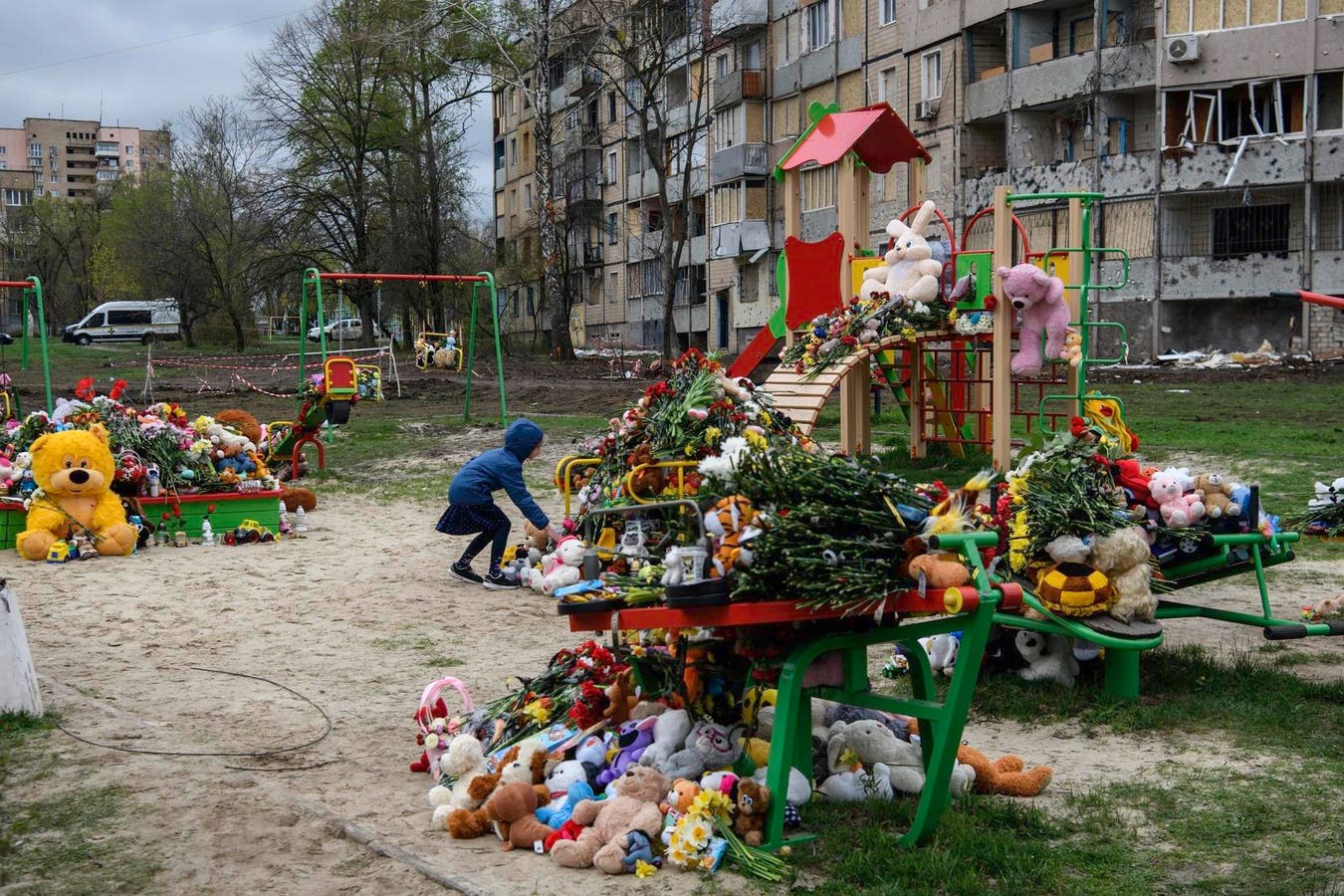
People bring flowers and toys en masse to a playground in Kryvyi Rih, Ukraine, on April 6, 2025, … More
Dispatches from Ukraine. Day 1,139.
Russia’s Attacks on Ukraine
Dnipropetrovsk region. A Russian missile attack struck a residential neighborhood and playground in the central city of Kryvyi Rih on April 4, claiming 18 lives, half of them children, with the death toll rising to 20 people over the weekend. Ukrainian investigators say they found evidence cluster munitions were used in the strike on Ukrainian President Volodymyr Zelenskyy’s hometown, dispersing shrapnel over a large area and leaving more than 75 people wounded. April 6 was declared a national day of mourning for the victims of the devastating attack.
Donetsk region. Systematic artillery attacks by Russian forces across Ukraine’s eastern Donetsk oblast, or province, killed three civilians on April 4.
Kharkiv region. A Russian glide bomb attack on a border village in northeastern Kharkiv oblast on April 7 resulted in the death of one resident.
A new Wall Street Journal poll reveals a growing rift among U.S. voters over military support for Ukraine, as Republicans, galvanized by President Donald Trump’s “America First” doctrine, grow resistant to continued aid. The survey, conducted in late March among 1,500 voters, found that, while 83% of Democrats support financial assistance to Kyiv, 79% of Republicans oppose it. Overall, only 49% of those surveyed back ongoing aid, with 44% against it.
In parallel, Republican skepticism about U.S. global involvement has grown, with 81% believing the country’s allies should defend themselves without American financial support. By contrast, 83% of Democrats see international alliances as a valuable strength.
In Washington, D.C., the sixth Ukraine Action Summit 2025 organized by American Coalition for Ukraine, takes place on April 6–9, 2025. This is the largest Summit of its kind, bringing together over 600 delegates from all 50 U.S. states. Besides providing an open platform for expert discussions on the current situation in Ukraine, and networking opportunities with Ukraine-focused non-profit organizations from across the country, the main goal of the Summit is to conduct congressional meetings with elected officials and to provide factually accurate information about Russia’s genocidal war in Ukraine to get the U.S. to help Ukraine.
Ukraine is dispatching a high-level delegation to Washington to negotiate the terms of a contentious new U.S.-drafted mineral agreement that could reshape bilateral economic ties and Ukraine’s postwar reconstruction strategy. The proposed deal, broader in scope than the prior iteration, extends beyond critical minerals, to include hydrocarbons, and would establish a jointly financed investment fund backed by future revenues from the sale of Ukrainian resources. However, Ukrainian officials, wary of diminished sovereignty and limited governance rights outlined in the leaked draft, are pushing to renegotiate the terms. Economy minister Yuliia Svyrydenko emphasized that the document, drafted by U.S. Treasury lawyers, remains a unilateral proposal, not a shared accord.
To avoid the worst-case scenario, Kyiv is now racing to assemble legal, financial, and investment advisors to safeguard its interests as negotiations move from informal overtures towards a high stakes, binding international agreement, one that would require parliamentary ratification and would likely define the next phase of Kyiv’s relationship with Washington.
The European Union has not engaged in discussions with the Trump administration regarding easing sanctions on Russia. The idea, floated as part of a potential ceasefire deal, was dismissed by EU sanctions envoy David O’Sullivan in comments to Bloomberg TV on April 7. Despite Moscow’s lobbying and Trump’s pressure campaign, reportedly including a demand to reintegrate Rosselkhozbank into the SWIFT system, the EU has made clear it will not relax restrictions unless Russian forces withdraw from occupied Ukrainian territories. Brussels views sanctions as a vital instrument in negotiations, to be lifted only after reaching a sustainable peace agreement.
An estimated 1.6 million children remain in Russian-occupied territories of Ukraine, where their education and cultural identity are being systematically eroded. Over the years of occupation, Ukrainian language instruction has nearly disappeared, with less than half of one percent of students in Crimea receiving lessons in Ukrainian. Concurrently, the Kremlin has escalated the militarization of education, creating “cadet classes” designed to prepare children for service in Russia’s military and security forces.
Norway has committed nearly $450 million in military aid to Ukraine for 2025, including over $400 million in grants to a Czech-led initiative for artillery procurement. The initiative builds on previous support, including the purchase of artillery from Norway’s defense industry in partnership with other Nordic nations, as well as the transfer of artillery from the country’s stockpiles and the sharing of defense technologies to enable local production in Ukraine.
Ukraine has seized more than $50 million in assets linked to sanctioned Russian oligarch Oleg Deripaska, including raw materials warehoused in Ukraine that were to be funneled into his factories in Russia to produce ballistic missiles, drones, and radar systems. The seizure was approved by Ukraine’s High Anti-Corruption Court following a 2023 investigation that blocked the export of 550 thousand tons of bauxite and alumina stored in a warehouse previously owned by Deripaska, one of the Kremlin’s most entrenched industrial enablers. Deripaska, like other longtime Putin allies, now faces formal charges for financing Russia’s war efforts both in Ukraine and abroad.
The Kremlin is “closely monitoring” oil markets after the price of its key export benchmark, Urals crude, plunged to $52 a barrel, nearing a two-year low. The price has fallen nearly $20 below the level used in Russia’s 2025 budget planning. The drop, attributed by Kremlin spokesman Dmitry Peskov to sweeping new U.S. tariffs, threatens to deepen Moscow’s fiscal deficit as oil and gas revenues accounted for nearly 30% of federal income in the first two months of 2025. Despite a brief uptick in global prices in late March, Russian energy revenues fell 17% year-over-year in March to $12.8 billion, hit by forced discounts, stronger ruble performance, and sanctions.
By Danylo Nosov, Karina L. Tahiliani
