Close Menu
  • Home
  • AI & Technology
  • Politics
  • Business
  • Cryptocurrency
  • Sports
  • Finance
  • Fitness
  • Gadgets
  • World
  • Marketing

Subscribe to Updates

Subscribe to our newsletter and never miss our latest news

Subscribe my Newsletter for New Posts & tips Let's stay updated!

What's Hot

Bitcoin Weekly Close On Sight As It Falls To $65K

March 28, 2026

3 Reasons XRP Rallies Stall — What Must Change For A Sustained Recovery

March 28, 2026

XRP Open Interest Surges As Price Slides—More Volatility Ahead?

March 28, 2026
Facebook X (Twitter) Instagram
  • Home
  • About US
  • Advertise
  • Contact US
  • DMCA
  • Privacy Policy
  • Terms & Conditions
Facebook X (Twitter) Instagram
MNK NewsMNK News
  • Home
  • AI & Technology
  • Politics
  • Business
  • Cryptocurrency
  • Sports
  • Finance
  • Fitness
  • Gadgets
  • World
  • Marketing
MNK NewsMNK News
Home » How Trump came up with his ‘reciprocal’ tariff formula
Finance

How Trump came up with his ‘reciprocal’ tariff formula

MNK NewsBy MNK NewsApril 3, 2025No Comments4 Mins Read
Facebook Twitter Pinterest LinkedIn Tumblr Email
Share
Facebook Twitter LinkedIn Pinterest Email


President Trump and his team had said a wide array of practices would go into their calculations for reciprocal tariffs announced this week, ranging from existing duties and currency manipulation to value-added taxes and agricultural constraints.

But once the numbers were released Wednesday afternoon, it quickly became clear that how they came up with the differing rates for 185 different nations was actually much simpler.

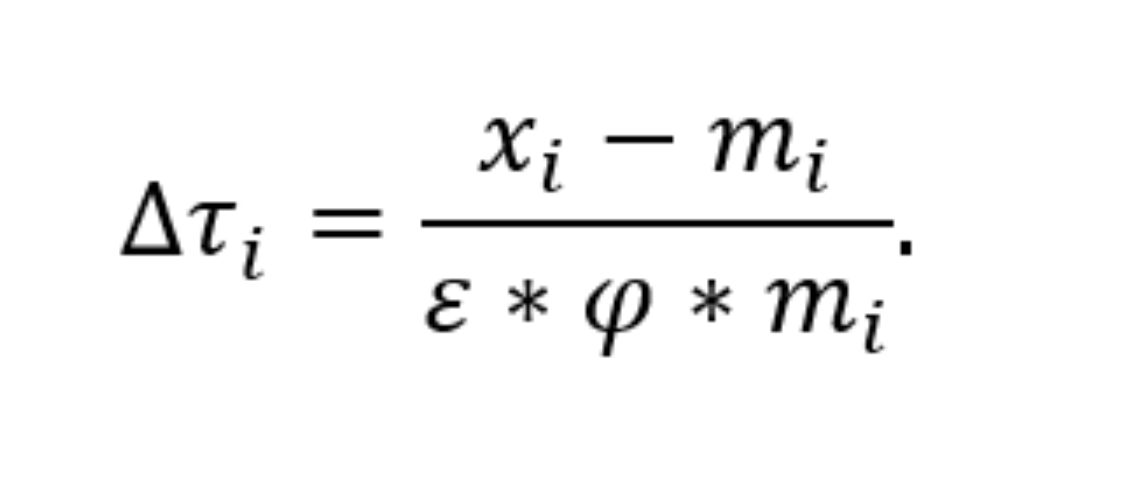
In a statement published Wednesday night, Trump’s trade representative explained that methodology for tariffs was a formula that — at its core — calculated a ratio based on any given country’s trade surplus with the US. The data came from import and export figures published by the US Census Bureau for 2024.

The formula shown below uses a country’s trade surplus as the numerator — with “x” representing total exports for a given nation and “m” representing total imports.

That was then divided by total exports. In the below formula “ε” represents price elasticity for import demand and was set at 4. Meanwhile, “φ” represents the elasticity of import prices and was set to 0.25 — effectively canceling each other out.

This is the formula that Trump's team says was used to calculate reciprocal tariffs. (Source: Office of the United States Trade Representative)
This is the formula that Trump’s team says was used to calculate reciprocal tariffs. (Source: Office of the United States Trade Representative) · SOURCE: USTR

Trump touted that result on Wednesday at the White House and then divided it by two to produce the reciprocal tariff rate that will be levied on countries on April 9.

Trump termed the 50% discount as a “kind reciprocal” policy.

Some countries have trade surpluses with the US and — using the formula above — would come out with a negative rate.

But Trump didn’t announce any tariff lowering on Wednesday; instead he also announced a 10% baseline tariff on other nations that aren’t subject to additional duties from the formula.

All told, the tariffs Trump announced Wednesday represent historic duties that Evercore ISI calculates will push the new weighted-average tariff rate imposed by the US to 29% once they are in force next week — the highest in more than 100 years.

It all amounted to a dramatic move that, if it holds, would reorient the global trading system and represents the climax of Trump’s decades-long focus on trade deficits, which he has long said are a measure of America being “ripped off.”

The USTR statement Wednesday night also noted that finding exact reciprocity “is complex, if not impossible,” but added that the combined effects “can be proxied by computing the tariff level consistent with driving bilateral trade deficits to zero.”

In a call with reporters Wednesday, a senior administration official offered more insight into the approach, saying the calculation was made by Trump’s Council of Economic Advisors and was “based on the concept that the trade deficit that we have with any given country is the sum of all the unfair trade practices, the sum of all cheating.”

The methodology was a clear departure from how Trump often described his approach to reciprocity — as countering specific measures.

It was even at odds with Wednesday’s announcement, where Trump held up a placard that listed the rates — derived from trade deficits — under a header listing them instead as “tariffs charged to the U.S.A. — including currency manipulation and trade barriers.”

WASHINGTON, DC - APRIL 02: U.S. President Donald Trump speaks during a “Make America Wealthy Again” trade announcement event in the Rose Garden at the White House on April 2, 2025 in Washington, DC. Touting the event as “Liberation Day”, Trump announced additional tariffs targeting goods imported to the U.S. (Photo by Chip Somodevilla/Getty Images)
President Donald Trump speaks during his trade announcement event in the Rose Garden at the White House on April 2. (Chip Somodevilla/Getty Images) · Chip Somodevilla via Getty Images

The calculation also flies in the face of decades of economic research long suggesting that a variety of factors can explain trade deficits between two nations beyond simply cheating.

The methodology immediately raised a variety of questions online. When Commerce Secretary Howard Lutnick was on Bloomberg Television Thursday morning, he was confronted with some of them.

He then confirmed that the underlying calculation was done by Trump’s Council of Economic Advisors but didn’t address the approach itself, saying the trade experts on Trump’s team have been “analyzing for decades all these different tools other economies use to hurt America.”

Ben Werschkul is a Washington correspondent for Yahoo Finance.

Click here for political news related to business and money policies that will shape tomorrow’s stock prices

Read the latest financial and business news from Yahoo Finance


Source link

Share. Facebook Twitter Pinterest LinkedIn Tumblr Email
MNK News
  • Website

Related Posts

Rite Aid files for bankruptcy — again

May 6, 2025

How to Track Driver Performance Without Micromanaging

May 6, 2025

Ford says its Q1 profit fell by two-thirds and it expects a $1.5 billion hit from tariffs this year

May 6, 2025
Add A Comment
Leave A Reply Cancel Reply

Editors Picks

Tiger Woods arrested, charged with DUI after Florida crash

March 28, 2026

Sabalenka, Sinner keep ‘Sunshine Double’ in sight with Miami Open wins

March 27, 2026

Hasan’s pace, all-round Ali give Kings victory over Gladiators

March 27, 2026

Iranian football players hold schoolbags in solidarity with girls killed in strike on Minab school

March 27, 2026
Our Picks

Bitcoin Weekly Close On Sight As It Falls To $65K

March 28, 2026

3 Reasons XRP Rallies Stall — What Must Change For A Sustained Recovery

March 28, 2026

XRP Open Interest Surges As Price Slides—More Volatility Ahead?

March 28, 2026

Recent Posts

  • Bitcoin Weekly Close On Sight As It Falls To $65K
  • 3 Reasons XRP Rallies Stall — What Must Change For A Sustained Recovery
  • XRP Open Interest Surges As Price Slides—More Volatility Ahead?
  • Tiger Woods arrested, charged with DUI after Florida crash
  • Sabalenka, Sinner keep ‘Sunshine Double’ in sight with Miami Open wins

Recent Comments

No comments to show.
MNK News
Facebook X (Twitter) Instagram Pinterest Vimeo YouTube
  • Home
  • About US
  • Advertise
  • Contact US
  • DMCA
  • Privacy Policy
  • Terms & Conditions
© 2026 mnknews. Designed by mnknews.

Type above and press Enter to search. Press Esc to cancel.