


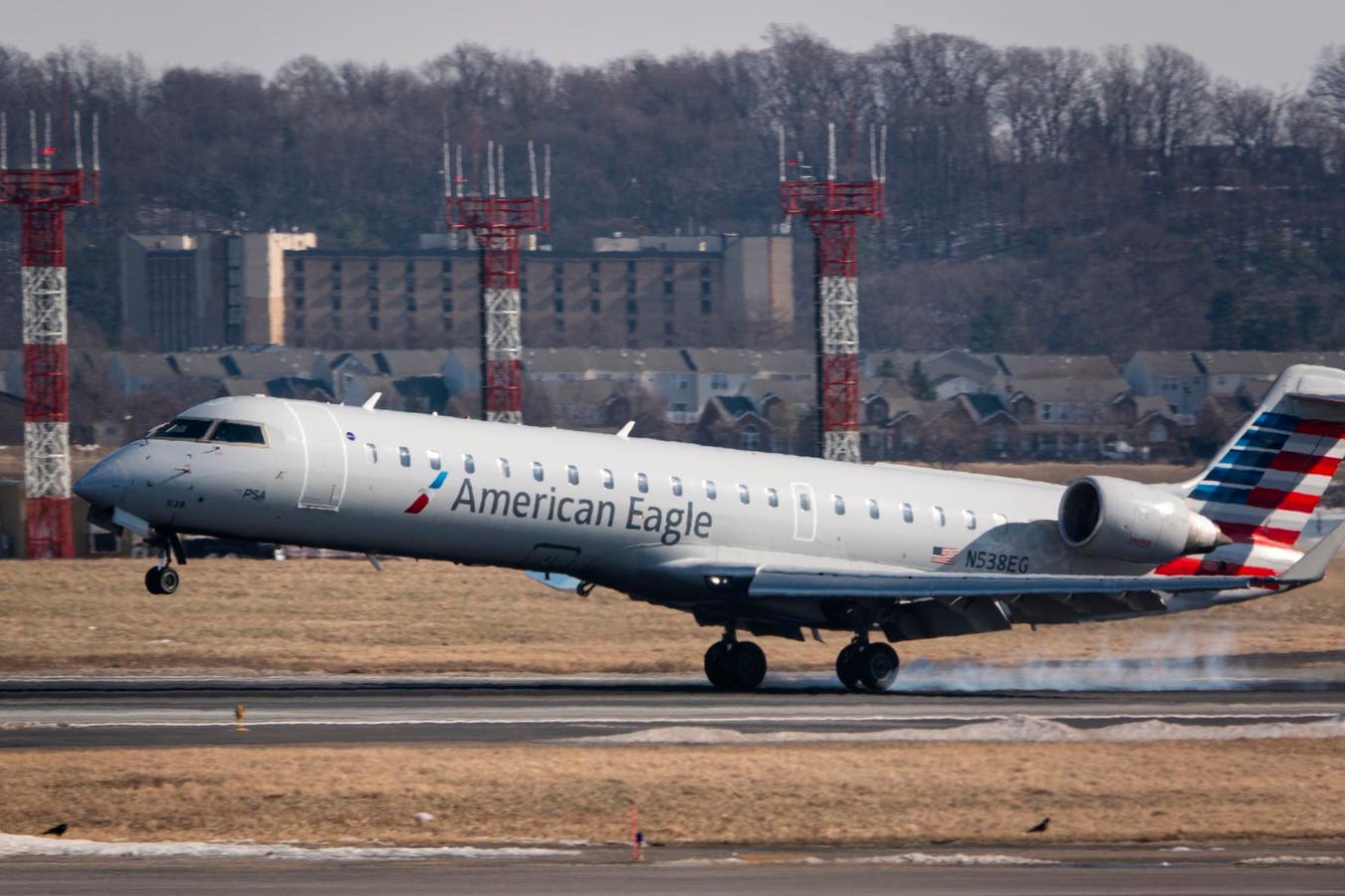
A PSA Airlines CRJ-700 arrives at DCA in January. (Photo by Kevin Carter)
January 29th was set to be a dramatic day for Dayton, Ohio-based PSA Airlines, a regional carrier owned by American Airlines. Executives had planned for months to announce that after 35 years, PSA was moving to Charlotte.
“We announced it that morning,” CEO Dion Flannery recalled this week. “It was a very busy day, a well-thought-out day, after a lot of preparation,” he said. “It was an emotional day, a heartbreaking day for the people in Dayton,” where PSA has about 350 headquarters employees. “We held three or four internal meets and had calls with constituents,” he said.
That Wednesday, one of the constituents, Jeff Hoagland, president and CEO of the Dayton Development Coalition, told The Dayton Daily News, “We are disappointed PSA chose to relocate their headquarters to Charlotte,” noting, “We didn’t have the opportunity to tell PSA why they should keep their corporate headquarters in Dayton.”
PSA publicly announced the move late in the afternoon. Joe Horvath, PSA’s communications was scheduling reporters for interviews with Flannery for the next morning when American Airlines Flight 5342, operated by PSA, crashed at Washington National Airport around 8 p.m., killing 64 people on the airplane and three in the helicopter that flew into its path.
That led to a period of mourning at PSA, a relatively small airline where the death of two pilots and two flight attendants, all Charlotte-based, had a deep impact on their co-workers.
PSA’s new headquarters will be in an office park three miles from Charlotte Douglas International Airport. The carrier will have nearly 80,000 square feet of space, which is being renovated and which will include an operations control center, where the movements of the carrier’s fleet of 140 CRJ 700s and 900s will be constantly monitored. (An additional 14 aircraft are scheduled to be added.)
PSA operates about 750 daily departures for American, including 180 in Charlotte, its largest base of operations. It also serves the hubs at Dallas, Washington National and Philadelphia.
The carrier employs about 5,000 people including 1,800 pilots; 1,300 flight attendants, 700 mechanics and its headquarters staff. Charlotte is already its training center for both pilots and flight attendants. Pilot training has six CRJ simulators and annually trains about 600 new pilots, 250 upgrading pilots and others who undergo recurrent training.
Coincidentally, Wednesday was a day of action for the PSA flight attendants, members of the Association of Flight Attendants, who staged demonstrations in Charlotte, Dayton, Philadelphia and Washington. About 50 flight attendants demonstrated in Charlotte, according to Sean Griffin, president of the Charlotte local of the Association of Flight Attendants. He is also vice-president of the union’s master executive council.
PSA’s current flight attendant contract was signed in 2019 and became amendable in July 2023. “The company has been slow with its proposals, which a lot of the time are insulting,” Griffin said. “Our members are getting upset with how long this process is taking.”
Talks have reached what is typically the final stage, where economic issues are negotiated. Pay scales at PSA and other regionals are generally about 45% below what American Airlines pays: new hires start at around $24,000 annually. Griffin said the union is seeking 30% raises: the company recently raised its offer to 5% from 3%.
Flannery said, “We’re in negotiations and we intend to move those along and to get the contract our flight attendants deserve.”
Flannery looks forward to the day when he can regularly walk in to training classes and the operations center and the airport. Employees like to meet the CEO, he notes: “They get to ask real questions,” he said.
Another benefit of the Charlotte headquarters is access to American’s second biggest hub, which has about 690 daily departures to 170 destinations in 25 countries. Dayton International Airport has non-stop flights to ten airports, which for other destinations means making connections. Hub residents often manage to avoid many of the complications of air travel. “I look forward to being able to enjoy the power of the hub in Charlotte,” Flannery said.
