


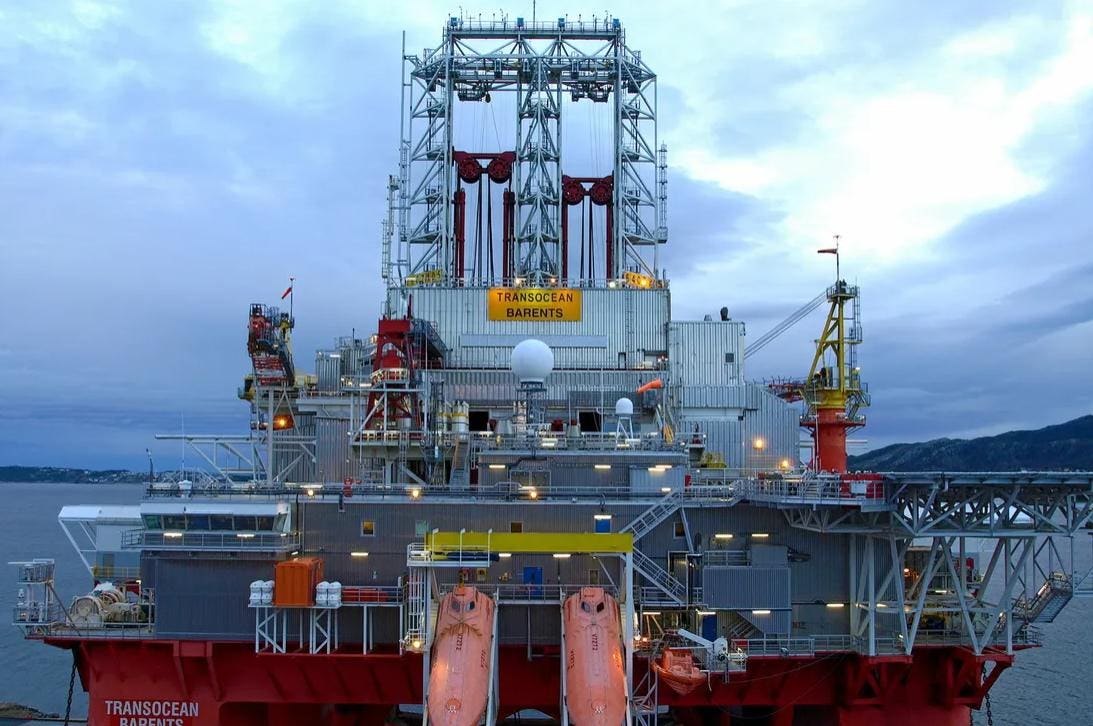
The Transocean Barents Rig is expected to begin drilling the Neptun gas field in May, helping to … More
Over three years after Russia invaded Ukraine, some European countries were still reliant on Russian gas. While the war in Ukraine compelled most of the European Union to diversify its energy imports and avoid buying gas from Moscow, certain countries, whether motivated by domestic politics or geography, such as Slovakia, Austria, and Hungary, continued buying. In January 2025, Ukraine stopped allowing the transit of Russian gas to the EU via the Urengoy–Pomary–Uzhgorod pipeline (also known as the Brotherhood pipeline) after its contract expired. This has pushed Europe to continue decoupling from Gazprom.
According to the Council of the European Union, imports of Russian gas dropped from 40% of European consumption in 2021 to 8% in 2023. To offset the loss of Russian gas, the EU increased LNG imports and funded a range of energy projects, especially in wind and solar generation. The United States also helped to fill the energy gap, with 55% of its LNG exports going to Europe in 2024. Other proposed projects included the Bulgaria-Romania-Hungary-Austria (BRUA) pipeline to transmit non-Russian gas via the Caspian and Black Seas, and an agreement between Azerbaijan, Georgia, Hungary, and Romania to transmit electricity across the Black Sea. Currently, a new Romanian gas project with the potential to further Europe energy self-sufficiency is set to begin drilling this year.
A New Opportunity: The Neptun Deep Gas Field
The ten-well Neptun Deep Gas Field is located on Romania’s Black Sea continental shelf, 160 kilometers off the coast. It covers an area of 7500 square kilometers, with depths between 100-1000 meters, and is estimated to hold 100 billion cubic meters of gas. Delivery is projected to begin in 2027. The Transocean Barents rig will start drilling the field this spring.
The Neptun Deep gas field will allow Romania to become an energy exporter and reduce European energy … More
Neptun Deep field is considered one of the most significant gas deposits in the EU, and it will make Romania an energy exporter. However, there is resistance to the project from both sides of the country’s political divide, with the far right regarding the project as counter to Romania’s national interests and left-wing activists attempting to halt the project on environmentalist grounds. Proponents of Neptun argue that it will create significant opportunities for Romania, enhance the country’s energy security, support its energy transition, contribute to economic growth, and serve as an asset for regional energy resilience.
Neptun is not devoid of political risk either, as foreign influence may advance voices against European and Romanian energy independence. Romania is holding national elections in May, following the annulment of last year’s voting round, in which a previously rather obscure, far-right Russia-friendly candidate, Calin Georgescu, was barred from running when his victory was shown to have benefited from Russian manipulation.
Russia has been involved in numerous influence operations in Romania, promoting narratives about keeping Romanian resources in Romania to undermine foreign investment, and especially targeting America’s involvement in oil and gas projects. Romania is the country in the EU with the least dependence on imported natural gas. Its growing role as an energy exporter could help reduce the bloc’s reliance on Russian gas.
A New Era of European Energy Security
Other European countries are also seeking to benefit from Romania’s gas field. As Romanian production increases, it should be able to export to other EU countries that are still reliant on Russian gas. Romania and Hungary are seeking to further cooperate on energy, with a gas interconnector already in place between the two countries. Roughly two-thirds of Hungary’s gas imports still come from Russia.
The EU and its member countries must continue to develop new initiatives and work with regional partners. While the United States has been able to help bridge the gap after the reinvasion of Ukraine, tension between the EU and the U.S. are growing as President Trump threatens to levy tariffs if the EU does not agree to buy more American oil and gas. At the same time, reportedly, secret talks to revive Nordstream 2 have begun.
Brussels must navigate a geopolitical tightrope with the Neptun Deep gas field. On the one hand, it provides a means of advancing European energy security, reducing exports from Russia. On the other hand, embarking on projects that consciously aim to reduce Europe’s consumption of American energy risks will exacerbate rifts across the Atlantic. Even if Washington is pushing for a Russo-American “reset” while Moscow bombs Ukrainian cities hours after the Trump-Putin phone call, experts believe that Russia will remain a high risk/low reward place to invest in the foreseeable future.
Kirsten Terrill contributed to the production of this article.
