


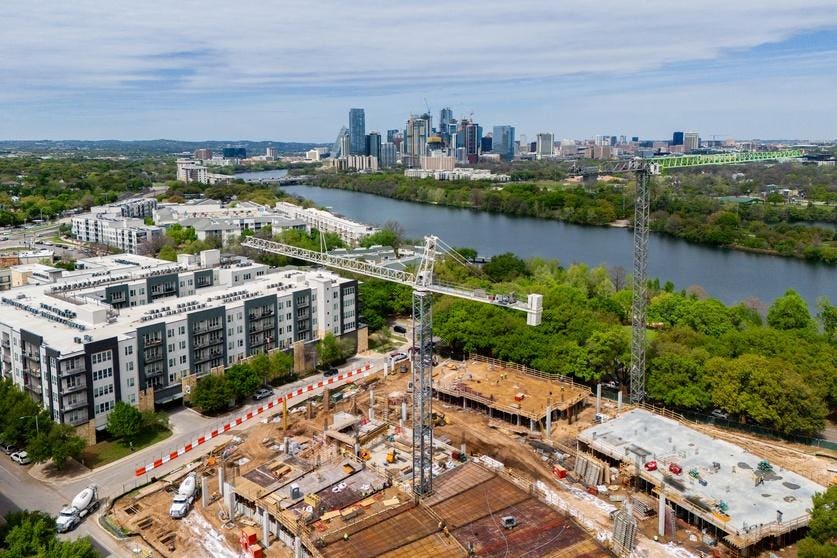
Austin is one of Texas’s many booming cities. But the state can do even more to encourage home … More
Texas Governor Greg Abbott is eager to make Texas bigger. Last year, he flew across Asia touting his state as a good place to do business. He has consistently urged American companies to move their headquarters to the Lone Star state, citing the low cost of business and lack of state income tax.
But even though Texas still has lots of wide-open spaces, the state is struggling with a lack of housing and the affordability of housing. About 1,000 people move into the state each day. According to housing advocacy group Up For Growth, Texas trails only California in the number of missing housing units. Dallas-Fort Worth ranked high among metro areas for housing underproduction.
Like much of the United States, the barriers to building housing in Texas are laid thick. Fortunately, there are lots of good ideas in the Texas Legislature to reform zoning codes and pave the way to new homes.
Smaller, more affordable homes can be especially hard to build in much of America. Many cities have minimum lot sizes for new developments. This makes it impossible to build starter homes in some communities.
Senate Bill 15 reduces minimum lot sizes for new developments in certain sized cities. It’s just simple economics that reducing the minimums will encourage home builders to go smaller. While most new development may be in outlying areas, major Texas cities have a lot of land that can be developed. According to Dallas officials, the city has 21,000 acres of vacant land.
Urban growth in Texas has been shaped by restrictive zoning, with residential and commercial areas often strictly separated. But getting in the car every time you want go to the grocery store or grab a latte isn’t for everyone. Mixed use development, with housing above or around stores, has been on the rise for years. But building such projects often means getting special permission from cities.
Senate Bill 840 would allow mixed-use and multifamily housing to be constructed by right in commercial zones. This would pave the way for a type of housing that is both in demand and would help add density in places that may have easy access to transit. The bill would make it much easier to convert existing commercial buildings into housing.
Since the pandemic greatly increased the number of Americans working from home, the demand for office space has decreased. Converting vacant office space to housing is difficult, with a New York Times article comparing it to a “Rubik’s cube.” But even when the architectural problems are surmountable, the zoning barriers remain. This bill would let the market, rather than zoning boards, decide whether conversion is feasible.
The Legislature is also considering Senate Bill 673, a bill that would allow construction of accessory dwelling units by right. ADUs are a great way to provide affordable housing to fill in urban areas without replacing existing homes or changing the scale of existing neighborhoods. Although often called “grandmother suites,” ADUs are affordable for younger workers and retirees.
While California has struggled to build homes in many ways, legislation enabling ADUs has led to a building boom. ADUs accounted for 20% of California’s new home construction in 2023. And since these units cost about one-third of constructing a single-family home, rent is much more affordable.
Another way to bring down construction costs is to clear the backlog of plan approvals at city halls. Senate Bill 1450 would allow applicants to use a third party to review building plans. Those plans have to meet the city’s standards and failing to build to code would have all the typical repercussions.
While there are some worries that third parties may not be as capable as government bureaucrats, the government isn’t immune from making mistakes either. Dallas improperly approved construction of a duplex in a neighborhood with special zoning restrictions. The city stopped construction for a time but ultimately granted the builder a variance to move forward. The builder lost an estimated $60,000 to the delays and cost to rework his plans.
One barrier to housing that many people may not even be aware of is restrictions preventing people who aren’t in the same family from sharing a home. These laws prevent people from renting a room out to a friend, or roommates locating shared housing. SB 1567 would overrule these antiquated restrictions that have nothing to do with ensuring health or safety.
By the time Texas celebrates its bicentennial in 2036, it may be home to three to five million more people. But there won’t be more Texas jobs and more proud Texans unless there are places for people to live. The Legislature and Governor should push forward with zoning reforms to keep Texas growing.
